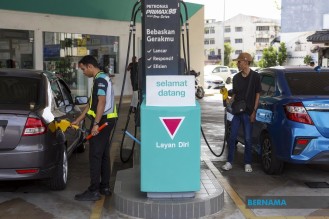
The Malaysian government has received reassurance that fuel supplies flowing through the Petronas petrol station network will remain adequate through August, according to Datuk Seri Azalina Othman Said, Minister in the Prime Minister's Department (Law and Institutional Reform). The confirmation emerged following discussions at a weekly National Economic Action Council meeting, where Petronas provided official projections on its fuel inventory and distribution capabilities across the country's largest retail fuel network.
Petronas Dagangan Bhd, the publicly listed downstream subsidiary of national oil corporation Petronas, operates the petrol station network that fulfils approximately half of Malaysia's domestic fuel consumption. This commanding market share underscores the critical importance of maintaining uninterrupted supply flows through the company's retail outlets, as any significant disruption could cascade across the broader economy and affect industrial operations, transport, and household energy costs across the nation.
The reassurance comes against a backdrop of growing uncertainty in global energy markets, driven primarily by geopolitical tensions emanating from West Asia. These regional conflicts have introduced volatility into crude oil pricing and supply routes, prompting governments throughout Asia-Pacific to reassess their energy security postures and establish contingency arrangements. Malaysia, as a significant energy producer and consumer in the region, faces particular exposure to these global supply chain disruptions, making proactive monitoring and diversified sourcing strategies essential components of national economic resilience.
In response to these emerging risks, the Malaysian government has established a dedicated Crisis Management Task Force (PPPK) operating under the auspices of the National Economic Action Council. This inter-agency body has been charged with continuous oversight of the nation's fuel, petroleum, and broader energy supply landscape. The task force's mandate extends beyond simple monitoring, encompassing responsibility for supply security planning, price stability measures, and enforcement activities targeting fuel smuggling and other irregular market activities that could destabilise legitimate distribution channels.
The creation of this oversight structure reflects a recognition that stable energy supplies require coordinated government intervention across multiple policy domains. Rather than relying solely on commercial market mechanisms, Malaysian policymakers have determined that an active government presence is necessary to identify emerging bottlenecks, coordinate with industry stakeholders, and implement protective measures when global conditions deteriorate. This approach aligns with energy security practices adopted by neighbouring nations similarly exposed to supply disruptions.
Beyond immediate supply management, the government is pursuing a strategic diversification of crude oil sourcing that deliberately reduces Malaysia's exposure to West Asian supply dependencies. According to Minister Azalina, procurement efforts are actively targeting crude oil from alternative exporters located in West Africa and the Americas, regions that offer geographic insulation from Middle Eastern conflicts while presenting stable, commercially viable supply relationships. However, such sourcing shifts cannot proceed without careful attention to crude oil grade specifications and commercial terms, as different crude varieties possess distinct characteristics affecting refinery operations and product yields.
This supply diversification strategy carries particular significance for Southeast Asian energy security more broadly. Malaysia's experience navigating global energy market volatility provides lessons for other regional economies similarly dependent on Middle Eastern oil. The emphasis on African and American sourcing options demonstrates that strategic alternatives exist for Asian energy importers willing to negotiate diverse supply partnerships and adapt refining infrastructure accordingly. Such geographical rebalancing of energy flows could reshape trade patterns across the region over coming years.
The government's message regarding August supply stability appears calibrated to address immediate business and consumer concerns without suggesting that longer-term energy challenges have been resolved. The specific timeframe suggests that officials have visibility into inventory levels and contracted supply volumes extending through the summer months, but the focus on this particular horizon implicitly acknowledges that conditions beyond August remain uncertain. This measured communication reflects a balance between providing reassurance about near-term fuel availability and maintaining realistic expectations about sustained global energy volatility.
The fuel supply guarantee question arose from parliamentary scrutiny, with opposition parliamentarian Khairil Nizam Khirudin from Jerantut pressing the government on earlier Petronas statements indicating supply security only through June 2026. This parliamentary engagement illustrates how energy security considerations have become matters of routine legislative oversight rather than remaining confined to executive decision-making. Such public accountability mechanisms encourage transparency about supply conditions and force policymakers to articulate contingency planning, strengthening institutional resilience across the energy sector.
For Malaysian consumers and businesses, the immediate implications involve relative stability in fuel availability and expectations of no major supply-related price shocks through August. However, the underlying message suggests preparation for potential turbulence beyond that timeframe, with government establishing mechanisms to respond to various scenarios ranging from temporary supply interruptions to extended global energy market disruptions. Companies dependent on predictable fuel supplies for operations may prudently use the August window to review procurement strategies and inventory management practices.
The Petronas network's role supplying half of national fuel demand means that government support for this network's operations carries systemic importance extending throughout the economy. Independent fuel retailers and alternative suppliers serve the remaining market demand, and their ability to maintain competitive supply depends partly on global market conditions and partly on their own commercial arrangements. The government's focus on the Petronas network's stability thus represents attention to the largest single component of Malaysia's retail fuel distribution system, though total energy security depends on coordinated performance across multiple suppliers and distribution channels.

