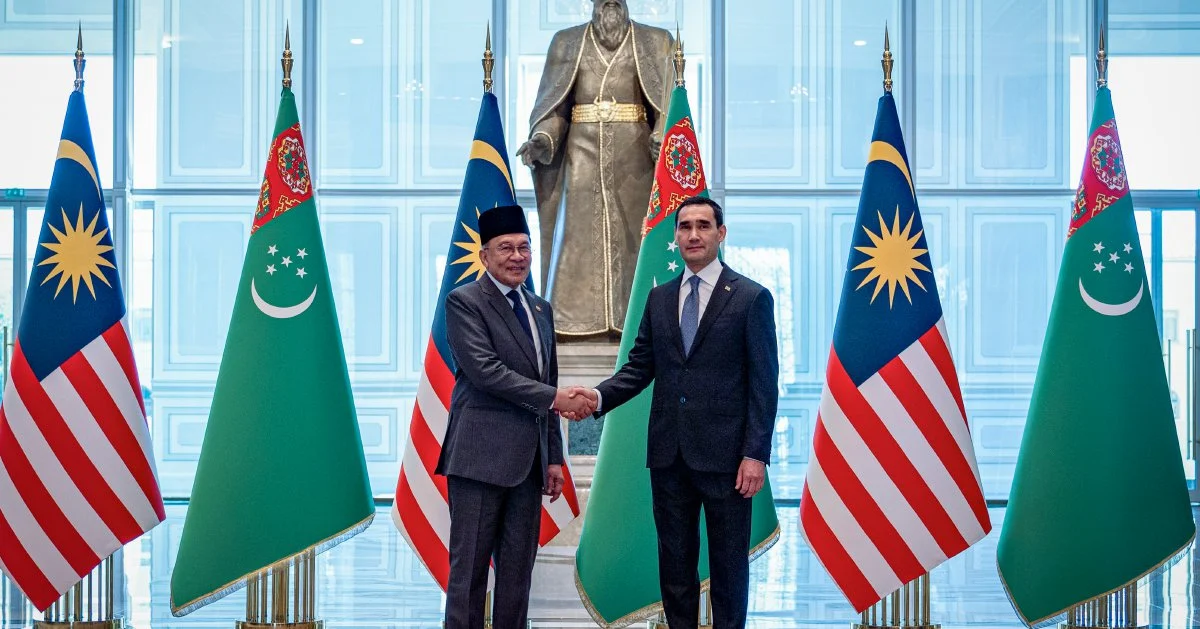
Malaysia's state-owned energy giant Petronas has positioned itself as a strategic fulcrum in Malaysia's broadening engagement with Turkmenistan, particularly following Prime Minister Datuk Seri Anwar Ibrahim's official visit to the resource-rich Central Asian republic. The company's longstanding operational footprint in the country, coupled with fresh diplomatic momentum from Kuala Lumpur, signals a deliberate recalibration of bilateral relations beyond traditional trade channels toward deeper energy sector collaboration.
Turkmenistan's vast natural gas reserves, among the world's largest, represent a compelling opportunity for Malaysian entities seeking to diversify energy sources and secure long-term supply agreements outside traditional Middle Eastern suppliers. Petronas's existing infrastructure and technical expertise position it advantageously to facilitate knowledge transfer, develop new fields, and establish integrated value chains that benefit both nations. The timing of this intensified cooperation reflects Malaysia's strategic pivot toward securing energy security whilst simultaneously strengthening political and economic ties across Asia.
The expansion of Petronas operations in Turkmenistan extends beyond hydrocarbon extraction into downstream processing, liquefied natural gas (LNG) development, and associated infrastructure investment. Such integrated approaches create employment opportunities in both countries, facilitate technology diffusion, and establish interconnected supply chains that encourage sustained economic interdependence. For Turkmenistan, partnerships with internationally experienced operators like Petronas enhance operational efficiency and global market access, whilst Malaysia gains preferential positioning in a nation increasingly important to Central Asian geopolitics.
Prime Minister Anwar's diplomatic engagement signifies recognition that energy cooperation serves as a foundation for comprehensive bilateral development. Official visits of this calibre typically precede formal agreements addressing investment frameworks, tax incentives, and regulatory harmonisation—essential prerequisites for major project financing. The Malaysian government's implicit endorsement of Petronas's regional expansion strategy suggests cabinet-level commitment to supporting the company's competitive positioning against established international competitors vying for Central Asian assets.
Turkmenistan occupies a distinctive position within Central Asia's geopolitical landscape, balancing relationships with Russia, China, and now increasingly with Southeast Asian powers like Malaysia. Economic partnerships with entities such as Petronas provide Ashgabat strategic flexibility, reducing dependency on any single power whilst diversifying revenue sources and technology partnerships. This alignment interests Malaysia, which itself navigates complex regional dynamics and benefits from strengthened ties across diverse geographical blocs.
The commercial implications for Malaysia's broader economy deserve consideration. Petronas's expanded Central Asian presence generates high-value contracts for Malaysian engineering firms, equipment suppliers, and logistics providers. Service sectors including consulting, finance, and legal services follow major resource projects, creating multiplier effects throughout Malaysia's economy. Success in Turkmenistan potentially opens doors to other Central Asian republics where Malaysian companies possess competitive advantages.
Energy security remains strategically critical for Malaysian policymakers managing a nation dependent on hydrocarbon imports for industrial operations and electricity generation. Establishing reliable supply relationships with diversified geographical sources insulates Malaysia from supply shocks emanating from geopolitically volatile regions. Turkmenistan's stability compared to Middle Eastern producers, combined with substantial reserves and limited existing commitments to Southeast Asian consumers, makes this partnership particularly attractive from a medium-term energy planning perspective.
Beyond energy, Malaysia-Turkmenistan cooperation creates pathways for people-to-people exchanges, educational partnerships, and cultural initiatives that humanise bilateral relations. Petronas presence in Turkmenistan typically generates expatriate communities requiring local services, educational facilities, and recreational infrastructure—spillover benefits that extend throughout Turkmenistan's economy and create constituencies favouring sustained Malaysian engagement.
The strategic significance of this partnership reflects broader shifts in Malaysian foreign policy emphasising pragmatic economic engagement across diverse regions rather than concentrating influence within traditional Commonwealth or ASEAN frameworks. Turkmenistan represents untapped potential within Asia's emerging energy markets, where Malaysian expertise commands respect and where competition from Chinese and Russian firms remains manageable. Petronas's role as both commercial entity and unofficial envoy epitomises this balanced approach.
Looking forward, deepening Malaysia-Turkmenistan relations through Petronas operations likely generates policy alignment on international energy governance, climate transition strategies, and regional stability issues affecting Central Asian hydrocarbon development. As global energy markets undergo unprecedented transformation through renewable energy adoption and decarbonisation pressures, maintaining established relationships with significant gas producers becomes increasingly valuable. Malaysia's early positioning through Petronas activities establishes foundations for navigating this uncertain transition period collaboratively.
For Malaysian investors and businesses, this diplomatic thaw opens reconnaissance opportunities within Turkmenistan's broader economy. Sectors adjacent to energy development—telecommunications, construction, hospitality, professional services—stand positioned to capture opportunities accompanying Petronas's expansion. Chamber of commerce networks and trade missions can leverage heightened governmental focus on bilateral relations to identify specific investment prospects.
The trajectory of Malaysia-Turkmenistan cooperation ultimately reflects pragmatic statecraft where national energy interests align with broader geopolitical objectives. Petronas serves simultaneously as commercial enterprise and diplomatic instrument, advancing Malaysian strategic interests whilst pursuing legitimate commercial returns. This dual character, characteristic of state-owned energy companies, enables Malaysia to project influence and secure resources within competitive international markets where purely commercial considerations prove insufficient for achieving national objectives.

