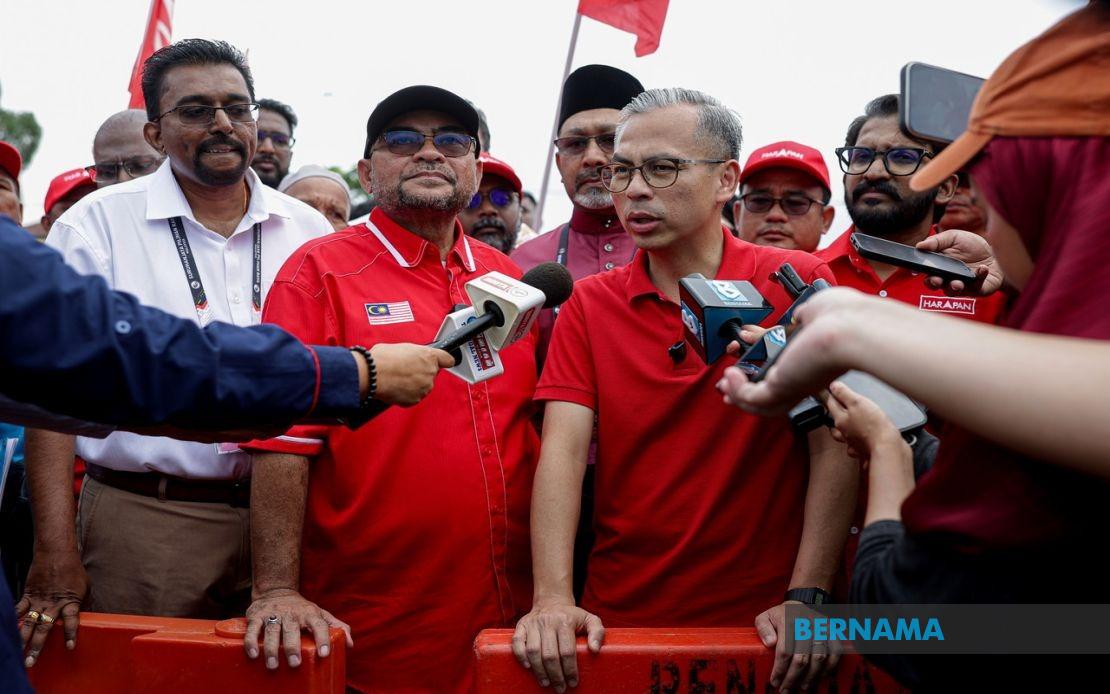
The Pakatan Harapan coalition has unveiled its central campaign plank for the forthcoming Negeri Sembilan State Election: a concentrated push on administrative continuity and the stewardship record of incumbent Menteri Besar Datuk Seri Aminuddin Harun. According to PH Communications director Datuk Seri Fahmi Fadzil, who is simultaneously serving as Communications Minister, this strategy seeks to demonstrate to voters why maintaining the current administration represents the surest path to sustained economic prosperity across the state.
The messaging framework rests upon a catalogue of accomplishments that PH attributes to Aminuddin's leadership since he assumed office in 2018. Party officials point to measurable increases in zakat collections, enhanced revenue generation for the state government, and a steady attraction of foreign direct investment as concrete proof of competent stewardship. Among the flagship projects cited is the development of a new port facility, which the coalition positions as evidence of strategic economic vision and infrastructure modernisation.
Fahmi articulated this argument when speaking to reporters following the candidate nomination proceedings for four state seats within the Jempol parliamentary constituency. He framed the election fundamentally as a referendum on whether voters wish to preserve the economic trajectory that PH claims has benefited Negeri Sembilan. The implicit contrast is with alternative governance models that, from PH's perspective, would introduce uncertainty and disrupt the state's development momentum.
The four-cornered contest for the Jeram Padang state seat illustrates how PH intends to translate this broad economic narrative into constituency-level engagement. The party's candidate, G. Manivannan—a lawyer serving as political secretary to Prime Minister Datuk Seri Anwar Ibrahim—will prioritise dialogue around employment generation, an issue consistently raised by younger residents. PH strategists evidently believe that linking Aminuddin's record of attracting investment to tangible job creation opportunities represents persuasive ground for voter mobilisation in this particular seat.
Manivannan faces a notably fragmented field. Incumbent Datuk Mohd Zaidy Abdul Kadir represents Barisan Nasional, while Perikatan Nasional's challenger is R. Sri Sanjeevan. Distinctly, Dayana Dal campaigns as the sole Orang Asli candidate, representing Asli, introducing an additional dimension of identity politics into what might otherwise appear as a straightforward three-way contest. The multiplicity of candidates reflects broader volatility within Malaysia's political landscape, where traditional two-coalition binaries have fractured into more complex configurations.
Elsewhere within the Jempol parliamentary constituency, the competitive landscape varies significantly. In Bahau, a straight fight between PH's incumbent Teo Kok Seong of DAP and MCA's Chong Fui Ming of BN suggests clearer polarisation. The Serting seat presents a three-way battle between PH's Yaacob Mahmood, Perikatan Nasional's incumbent Mohd Fairuz Mohd Isa, and Bersatu's Muhammad Noraffendy Mohd Salleh. Similarly, Palong witnesses a three-cornered contest featuring BN incumbent Datuk Mustapha Nagoor, PH's Muhammad Zahin Zinal Abidin, and Bersatu's Rebin Birham.
This electoral fragmentation carries implications for Malaysian federalism and state-level governance. The presence of Perikatan Nasional and Bersatu across multiple contests reflects the broader national political realignment that followed the 2022 general election. Unlike the relatively binary competition that characterised earlier state elections, contemporary Malaysian campaigns must navigate substantially messier competitive environments where coalition boundaries remain fluid and individual personalities sometimes overshadow party affiliations.
Fahmi used the nomination conclusion to emphasise standards of electoral conduct, appealing to all contestants, party organisations, and media practitioners to observe a two-week campaign period characterised by responsibility and civility. As Communications Minister, he specifically urged restraint regarding sensitive subjects encompassing religion, race, and the monarchy—the constitutional framework that Malaysian political discourse designates as the "3Rs." He also cautioned against disinformation and defamatory material, issues that have acquired heightened salience in Malaysia's digitally mediated political environment.
The formal election calendar provides tight parameters for this campaign effort. The Election Commission designated July 28 for early polling and August 1 as the main election day. This compressed timeframe means that parties must execute their messaging and ground operations with considerable efficiency. For PH, concentrating messaging around Aminuddin's tangible achievements potentially offers an economical approach: a unified narrative reduces the need for complex, differentiated messaging across constituencies.
Yet this strategy contains inherent vulnerabilities that opposition parties will likely exploit. Voters dissatisfied with specific aspects of state governance—particular infrastructure gaps, healthcare access, or development imbalances between urban and rural areas—may view the "continuity" argument as defensive rather than visionary. Moreover, the tight association between national leadership (via Anwar Ibrahim's political secretary) and state-level candidacy in Jeram Padang carries the risk that unpopularity at the federal level could impose collateral damage on state-level campaigns.
The Negeri Sembilan contest also merits attention as a test case for whether narratives centred on administrative performance and economic metrics retain sufficient persuasive force in contemporary Malaysian politics. Rising dissatisfaction with living costs, employment quality, and opportunities for younger cohorts might render PH's emphasis on macroeconomic indicators—investment flows, zakat collections, revenue increases—insufficiently responsive to bread-and-butter concerns that voters prioritise. The party's explicit strategy to address employment in Jeram Padang suggests internal recognition that this vulnerability requires targeted response.
For Malaysian political observers, the Negeri Sembilan election provides a microcosm of contemporary state-level competition. The presence of fragmented opposition, the emphasis on administrative record rather than transformative vision, and the attempt to straddle economic narratives with targeted local grievance management together illustrate the complexity of maintaining political dominance under conditions of heightened volatility. Whether PH's strategy successfully translates administrative achievements into electoral retention remains an open question, with implications extending beyond Negeri Sembilan to inform calculations about broader political trajectory in coming years.

