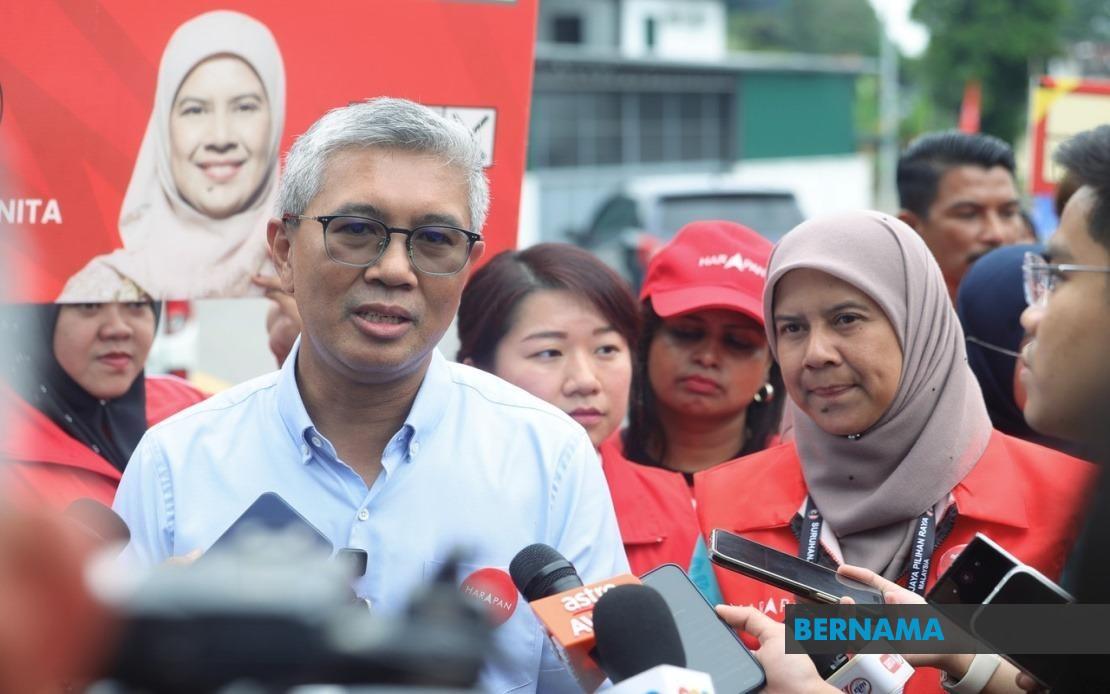
Senior Political Advisor to the Prime Minister Tengku Datuk Seri Zafrul Tengku Abdul Aziz has declared that voter sentiment in Kuala Pilah's Pilah state constituency has swung decisively in favour of the Pakatan Harapan coalition, underpinned by confidence in the government's track record and the ground-level activities of party workers mobilising support for the incumbent state assemblyman.
Speaking to reporters after accompanying Datuk Noorzunita Begum Mohd Ibrahim, the PKR candidate, on a campaign walkabout in the constituency on July 25, Tengku Zafrul disclosed that internal analyses and grassroots assessments conducted well before the campaign launch indicated a markedly receptive mood among Pilah residents. He attributed this positive reception to recognition of Noorzunita Begum's constituency work and the visible support she has provided during her tenure as the sitting assemblyman, though he cautioned against complacency and stressed the importance of sustained campaign activity and continued service provision to consolidate gains.
The campaign trail in Kuala Pilah, a town positioned strategically in central Negeri Sembilan between the state capital Seremban and the district of Bahau, took on a grassroots character as Tengku Zafrul and Noorzunita Begum engaged directly with voters, discussing hyperlocal concerns, recording citizen proposals, and acknowledging resident complaints about infrastructure and development priorities. These interactions provide the PH machinery with real-time feedback on community sentiment and offer voters an opportunity to articulate their aspirations directly to senior party figures.
Tengku Zafrul framed Negeri Sembilan's economic performance as a vindication of PH governance, citing RM19 billion in total investments flowing into the state and state reserves exceeding RM1 billion as evidence of both economic vitality and prudent financial stewardship. He linked this economic robustness explicitly to the leadership of Menteri Besar Datuk Seri Aminuddin Harun, suggesting that maintaining political continuity and the current administration's approach would be essential to preserving these gains. The messaging appears designed to tie the Pilah race to broader state-level governance narratives and to frame the contest as a choice between proven competence and uncertainty.
On the question of development strategy within the Pilah constituency itself, Tengku Zafrul identified employment generation for Generation Z as a paramount concern, acknowledging that many young people in the area lack quality professional career pathways that would allow them to establish themselves economically without relocating to major cities. This focus on youth unemployment and retention reflects broader demographic and economic pressures affecting rural and semi-urban constituencies across Malaysia, where outmigration of younger cohorts has become a chronic challenge for local economies and community cohesion.
Central to the MADANI Government's messaging, according to Tengku Zafrul, is the imperative to narrow economic disparities between thriving metropolitan hubs and rural or traditionally oriented communities scattered throughout the peninsula. He characterised Kuala Pilah as possessing considerable untapped economic potential, despite recognising that indirect economic spillovers in certain areas remain limited. He indicated that the government is actively designing investment attraction schemes and working to distribute economic opportunities more evenly across Negeri Sembilan's districts, a priority that resonates with rural constituencies feeling left behind by Malaysia's uneven development patterns.
The Pilah contest has crystallised into a direct two-way race between Noorzunita Begum of PKR and Barisan Nasional's S. Leza Md Yasin, with no other candidates in contention. This binary configuration concentrates voter choice sharply and likely increases the salience of direct comparisons between the incumbent's record and the opposition's alternative vision. According to the Election Commission's electoral roll updated on June 4, the constituency encompasses 18,034 registered voters, of which 17,775 are ordinary voters and 259 are police personnel and their spouses, reflecting the modest but not insignificant security force presence in the area.
The electorate in Pilah exhibits an almost perfect gender balance, with male voters constituting 49.49 per cent and female voters 50.51 per cent of the registered roll, a distribution that may carry implications for campaign messaging and policy emphasis. By the eighth day of campaigning, Noorzunita Begum's party machinery had achieved broad geographic coverage of residential zones and was preparing to intensify efforts in traditional villages during the remaining campaign period. She signalled that voter inquiries during the walkabout revealed acute demand among local young people for professional employment paths, suggesting that the generation Z employment agenda has substantial grassroots resonance beyond the rhetoric of senior party figures.
Noorzunita Begum has restated her commitment to advancing public welfare within the constituency, specifically highlighting education provision, support for elderly residents, and opportunities for young people as pillars of her governing approach. This tripartite focus—education, senior welfare, and youth opportunity—spans the demographic spectrum and suggests an attempt to broaden her coalition across multiple generational groups rather than concentrating narrowly on any single demographic segment.
The Negeri Sembilan State Election will proceed with early voting scheduled for July 28 and polling day set for August 1. The Pilah constituency represents one of five state constituencies within the larger Kuala Pilah parliamentary zone, making the outcome locally significant while also contributing to the broader state-level outcome. The contest occurs within the context of Negeri Sembilan's evolving political landscape and Malaysia's continuing pattern of electoral competition between the ruling PH coalition and its main opposition forces, particularly the Barisan Nasional alliance that governed the country for decades until 2018.
From a regional perspective, the Pilah race illustrates the competitive dynamics now characteristic of Malaysian state politics, where incumbency, grassroots organisation, economic performance claims, and demographic targeting converge around specific constituency contests. The emphasis on bridging rural-urban development disparities and retaining young talent reflects anxieties prevalent throughout Southeast Asia as rapid urbanisation and economic concentration reshape settlement patterns and opportunity distribution. For Malaysian observers, the Pilah campaign offers a microcosm of the concerns animating contemporary electoral politics: good governance delivery, inclusive development, employment generation, and intergenerational equity.

