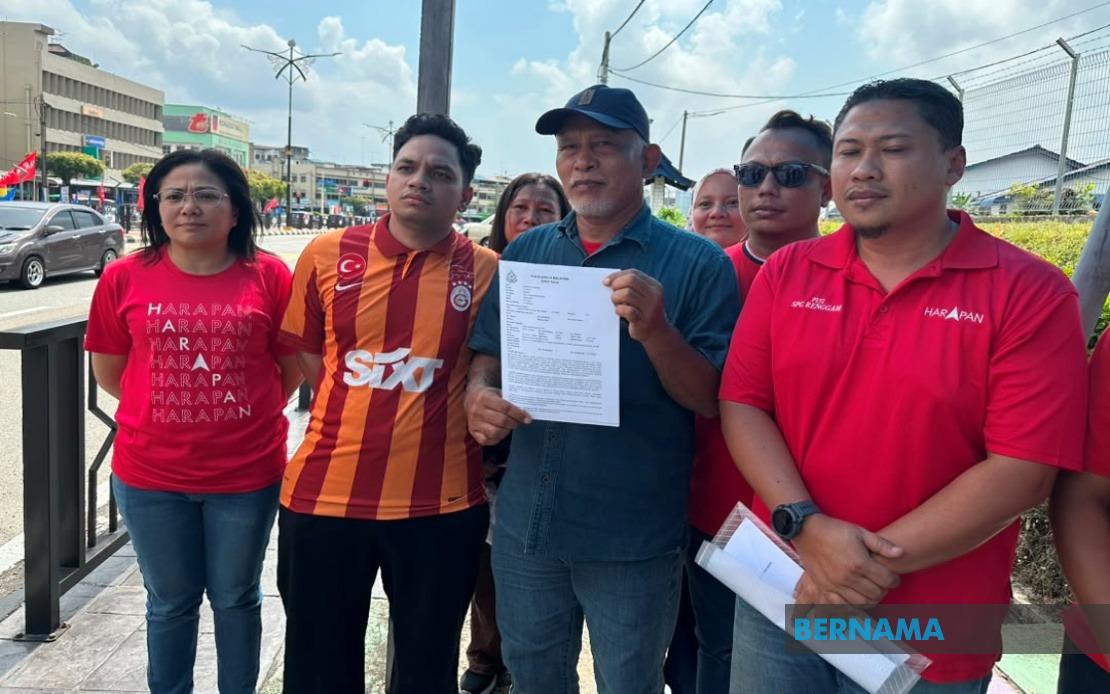
The representative backing the Pakatan Harapan candidate in the Machap constituency has formally reported Johor's Menteri Besar Datuk Onn Hafiz Ghazi to police, claiming misconduct in leveraging Technical and Vocational Education and Training (TVET) students for campaign purposes during the ongoing Johor state election race. The complaint, lodged at Simpang Renggam police headquarters, centres on allegations that government-linked vocational institutions were weaponised to marshal student attendance at partisan political events designed to benefit Barisan Nasional candidates.
Khiru Nasir Rohani, who holds the position of deputy division chief for Simpang Renggam Amanah, contends that a systematic approach was employed to mobilise TVET students across local educational facilities, directing them towards programmes with explicit campaign objectives. He characterises the practice as a calculated manoeuvre to funnel grassroots support toward the ruling coalition ahead of Saturday's polling day. The allegation specifically references a gathering held in Kluang on July 4, where a cohort of vocational students reportedly attended what organisers subsequently acknowledged functioned as a platform for open electioneering in favour of state election contenders.
The core complaint hinges on violations of the Election Offences Act 1954, with Khiru Nasir identifying two critical legal breaches: the application of undue influence over voters and the misappropriation of official position coupled with institutional resources for electoral advantage. By framing vocational education organisations as conduits for political mobilisation, the allegation suggests that institutions ostensibly dedicated to skills training were repurposed as campaign infrastructure. This crosses a constitutional boundary designed to maintain neutrality in state-managed educational settings and preserve the sanctity of electoral processes.
The complaint arrives at a pivotal moment in Johor's political calendar, with 172 candidates vying for representation across 56 state assembly seats. The timing underscores the intensity of competition as both major coalitions mobilise resources in the final stretch before voters head to polling stations. For Southeast Asian observers, such allegations reflect broader regional tensions between incumbent administrations seeking to leverage state machinery for electoral benefit and opposition movements attempting to constrain such advantages through institutional oversight mechanisms.
Khiru Nasir has explicitly called upon three principal investigative bodies—the police, the Malaysian Anti-Corruption Commission (MACC), and the Election Commission (EC)—to undertake rigorous scrutiny of the allegations. His appeal emphasises that comprehensive investigation serves as essential guardrail for democratic integrity, particularly in contexts where state resources substantially outmatch opposition capacity. This multi-agency approach reflects recognition that electoral misconduct frequently straddles jurisdictional boundaries, requiring coordinated action across enforcement hierarchies.
The TVET sector occupies strategic importance in Malaysian electoral mathematics. Vocational institutions operate under significant government supervision and funding, positioning students as a readily accessible demographic for organised mobilisation efforts. Unlike university campuses, where student activism remains traditionally autonomous and sometimes oppositional, TVET institutions maintain tighter administrative hierarchies and fewer traditions of independent political organising. This structural vulnerability creates fertile ground for what critics characterise as institutional capture for partisan objectives.
Onn Hafiz, as Menteri Besar, commands substantial administrative authority over state-level resources, including oversight of educational programming and institutional coordination. The accusation essentially contends that this executive power was deployed to subordinate vocational education to campaign imperatives. Such allegations, whether ultimately substantiated or refuted, carry reputational weight affecting public confidence in institutional impartiality—a concern transcending the immediate electoral contest to implicate longer-term governance legitimacy.
The Machap seat itself represents one node within a broader competitive landscape where Pakatan Harapan seeks to expand beachheads within traditionally Barisan Nasional territory. The filing of this complaint signals that PH intends to contest not merely through conventional campaigning but through institutional challenge mechanisms, attempting to level an electoral playing field perceived as tilted toward incumbent advantages. This legalistic counter-strategy reflects sophisticated understanding that electoral outcomes increasingly hinge on regulatory enforcement, not merely voter persuasion.
For Malaysian observers, the unfolding investigation carries implications extending beyond immediate electoral consequences. If investigations substantiate the allegations, enforcement action would signal that institutional safeguards against electoral misconduct retain functional capacity even against powerful incumbents. Conversely, if inquiries conclude insufficient evidence warrants prosecution, this would reinforce opposition narratives that state investigative agencies subordinate neutrality to partisan protection of entrenched power structures. The investigation's trajectory will therefore reverberate across Malaysian civil society discourse regarding institutional credibility.
The complaint also intersects with broader questions about appropriate boundaries between government promotional activities and partisan campaigning. State institutions routinely conduct awareness and skills-development programmes targeting youth populations. The allegation implies that such legitimate educational initiatives were commandeered and repackaged as electoral mobilisation exercises. Distinguishing between authentic institutional function and partisan exploitation of institutional platforms represents an ongoing challenge for electoral regulators across the region, requiring careful evidentiary analysis and forensic assessment of intent and consequence.
Saturday's polling will proceed regardless of investigative timelines, but the complaint establishes a documentary record and activates institutional oversight mechanisms before ballots are cast. This sequencing maximises political impact while respecting procedural constraints. Whether the complaint ultimately influences electoral outcomes depends partly on investigative pace and visibility, factors partly beyond the complainant's control but relevant to assessing PH's capacity to mobilise institutional resources as electoral leverage.

