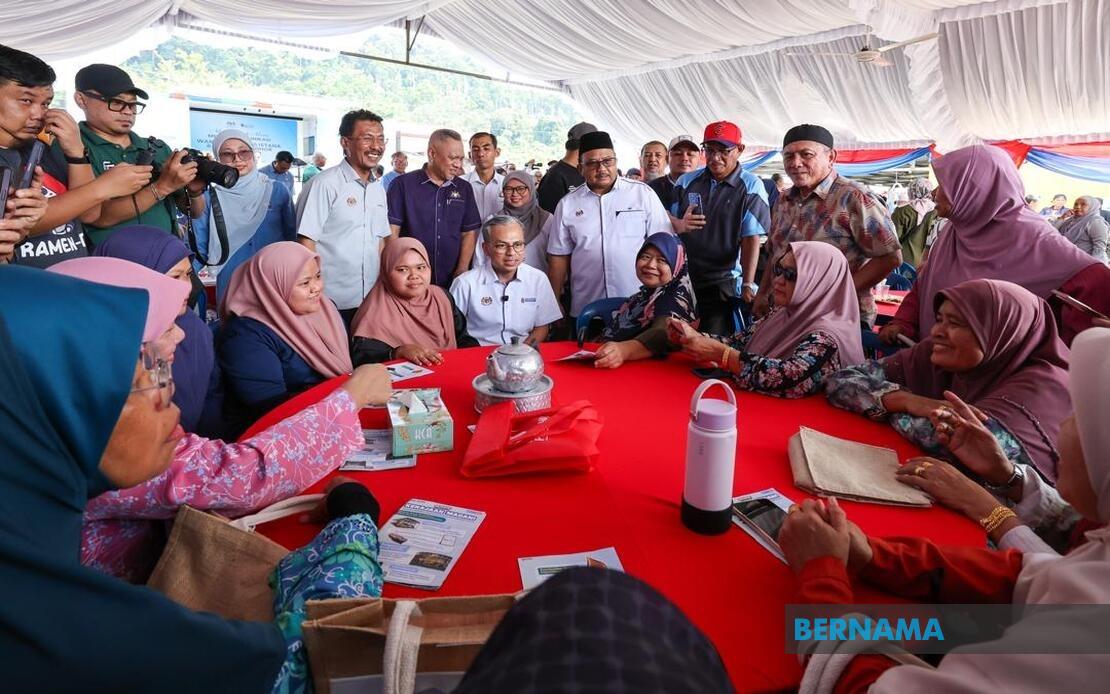
Pakatan Harapan's communications chief Datuk Fahmi Fadzil has firmly pushed back against suggestions that the coalition's delayed manifesto launch in the Johor state election campaign undermined their competitive standing, insisting the timing aligned precisely with strategic campaign objectives. Speaking during a constituency engagement in Batu Pahat on July 4, Fahmi maintained that the decision to unveil the 'Johor for All' manifesto followed thorough internal deliberation and sign-off from the coalition's highest echelons, ensuring the document met the movement's substantive standards before public presentation.
The timing question has become a focal point of debate among political observers tracking the 16-seat contest, which will send 172 candidates to the polls across 56 state constituencies on July 11. Fahmi's comments directly addressed earlier criticism from Ong Kian Ming, the former Bangi MP and PH strategist, who had warned that the manifesto's staggered unveiling created a narrative vacuum PH could ill afford when confronting a well-oiled Barisan Nasional machine. Ong had listed multiple structural disadvantages facing the coalition—the absence of a named chief minister candidate, scarcity of senior figures contesting seats, and muted campaign messaging—painting a picture of an opposition struggling to gain momentum during the critical early campaign phase.
Instead of conceding the point, Fahmi reframed the manifesto launch as strategically positioned within the broader campaign calendar. He characterized the Friday unveiling as arriving at precisely the moment when voters had already been introduced to candidate profiles and both coalitions were advancing their competing policy visions. This sequencing, he argued, proved neither premature nor dilatory but rather calibrated to maximise public absorption of PH's policy platform once the electorate was sufficiently attentive. The framing reflects a broader communications strategy attempting to neutralise the impression of organizational sluggishness that could prove costly in a contest where perception of momentum carries tangible electoral weight.
Fahmi's defensive posture intensified when addressing jabs from the opposing camp regarding manifesto substance. Former UMNO Youth chief Khairy Jamaluddin had alleged the PH document amounted to wholesale plagiarism of Barisan Nasional's platform, a charge often deployed in Malaysian campaigns to delegitimize opponents as lacking original vision. Rather than defend the manifesto's distinctiveness directly, Fahmi pivoted toward a more cutting observation about campaign dynamics: Khairy appeared to be canvassing with considerably greater vigour than Johor Menteri Besar Datuk Onn Hafiz Ghazi, suggesting perhaps that the senior UMNO figure possessed greater political credibility or organisational capacity than his nominal party superior. The comment hints at underlying tensions within Barisan's Johor coalition, where UMNO's dominance occasionally creates friction with other component parties.
The coalition has simultaneously confronted criticism centred on the Democratic Action Party (DAP), traditionally PH's largest component and a perennial target for Barisan attacks. Allegations circulated on social media platforms suggesting DAP leadership supported clemency for former prime minister Datuk Seri Najib Tun Razak, a deeply divisive proposition within Malaysia's fractured political landscape. Former Skudai assemblyman Marina Ibrahim, herself a DAP-affiliated politician, publicly announced her political retirement, citing disillusionment with what she characterized as DAP leaders' performative stance on the pardon question. Her withdrawal, announced via social media, represented a potential crack in the coalition's armour during a closely watched state contest where defection or demotivation among grassroots members can ripple across marginal constituencies.
Fahmi's response to these DAP-specific challenges emphasised empirical observation rather than rhetorical deflection. He pointed to robust attendance and visible enthusiasm at campaign events across his recent circuit, arguing that the grassroots response provided concrete evidence that DAP-related controversies had failed to translate into material erosion of PH support. This evidence-based framing attempts to shift conversation away from abstract speculation about party stability toward observable activist engagement and voter receptivity. He specifically referenced Ng Yak Howe, the DAP candidate contesting the Bentayan state seat, noting that the party continues fielding strong candidacies despite the turbulence. His allusion to Marina's criticisms having minimal impact suggests confidence that reputational damage, if any, remains containable within PH's broader coalition structure.
The Johor election represents significant stakes for both coalitions as Malaysia's electoral landscape continues recalibrating following the 2022 general election. PH's performance in this traditionally competitive state serves as a barometer of whether the coalition can maintain momentum and expand its presence in state legislatures beyond its core strongholds. Barisan Nasional, conversely, hopes to demonstrate it remains competitive in major contests despite losing federal power, validating its claims to a residual power base among certain voter demographics. The contest occurs against a backdrop of persistent questions about PH's internal cohesion—particularly DAP's role and the broader coalition's capacity to manage diverse partisan interests—making the campaign narrative genuinely contested rather than predetermined.
Fahmi's visit to Kampung Istana formed part of sustained PH engagement with constituency-level voters, a traditional campaign emphasis that parties maintain even as digital and broadcast media dominate overall coverage. The presence of Communications Ministry secretary-general Datuk Abdul Halim Hamzah alongside the communications director underscores how state elections increasingly involve federal government representation, blurring lines between administration and campaign machinery in ways that invite periodic scrutiny regarding propriety. The meet-the-people programme model reflects PH's strategy of mobilising grassroots support networks, compensating potentially for any organisational disadvantage relative to Barisan's established state apparatus.
The manifesto timing debate ultimately encapsulates broader questions about PH's campaign competence and strategic clarity heading into July 11. Fahmi's insistence on optimal timing reflects either genuine confidence in the coalition's positioning or, alternatively, post-hoc rationalisation of a decision made under other pressures or constraints. Malaysian voters, particularly those in marginal constituencies, will judge whether PH's delayed platform articulation proves immaterial to their electoral calculations or whether it indeed reflects the organisational sluggishness critics allege. The outcome will carry implications extending far beyond Johor, shaping perceptions of PH's viability as governing coalition and influencing momentum ahead of potential future national contests.
The election itself occurs within Malaysia's complex ethnic and religious political economy, where state-level contests frequently revolve around parochial concerns—development allocation, civil service representation, educational funding—alongside broader ideological positioning. PH's ability to synthesise its national narrative about political renewal with localised demands in Johor will partially determine whether manifestos and messaging ultimately influence voter behaviour or whether traditional demographic patterns and incumbent advantages prove decisive. Fahmi's confidence about grassroots momentum, even if rhetorical flourish, suggests PH believes it can compete effectively despite the perceived handicaps Ong and other critics have identified, setting up a genuine test of Malaysian electoral dynamics on July 11.

