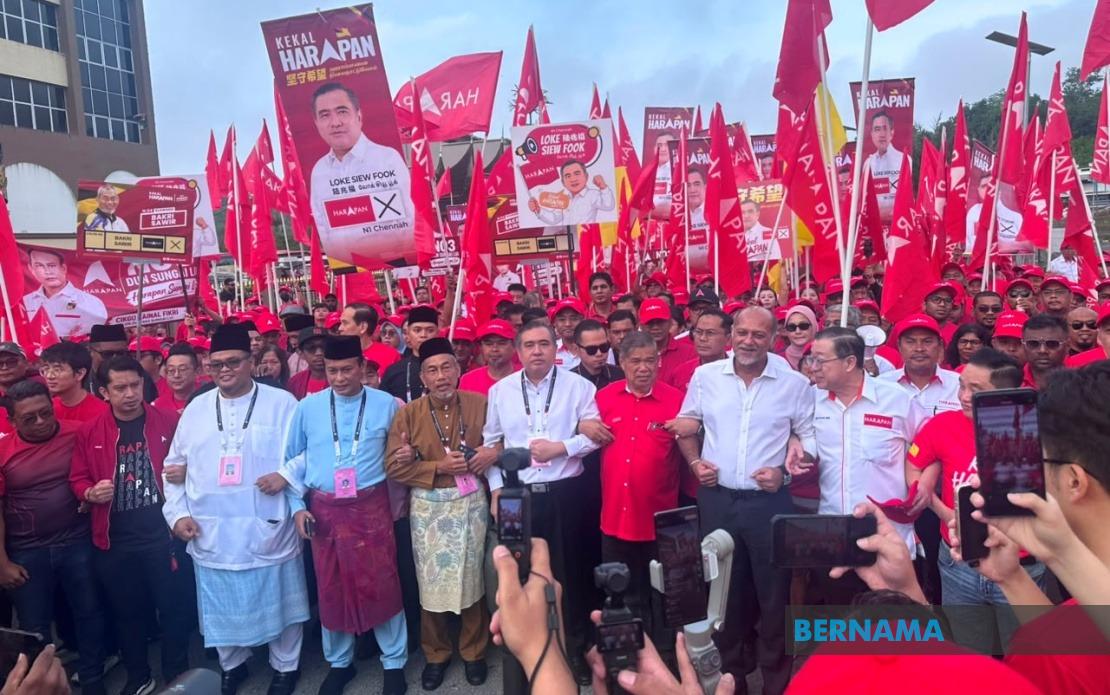
Negeri Sembilan's political landscape shifted into high gear this week as Pakatan Harapan orchestrated a coordinated show of strength across the state's nomination centres. The coalition fielded its senior cadre across multiple constituencies on nomination day, a tactical deployment that underscored PH's determination to consolidate its position ahead of the August 1 polling date. The carefully choreographed presence of ministers, party officials, and state leaders at filing locations throughout the day demonstrated the coalition's intent to project unity and momentum as candidates formally entered the contest.
Transport Minister Anthony Loke, who serves as DAP secretary-general, fronted the party's campaign effort in the Jelebu district, personally submitting nomination documents for the Chennah state seat. His appearance at Dewan Besar Kuala Klawang came alongside a delegation of heavyweight figures, including DAP chairman Gobind Singh Deo and party adviser Lim Guan Eng. The presence of Amanah president Datuk Seri Mohamad Sabu signalled the broader coalition's backing for the DAP candidate, reinforcing the multi-party architecture that has sustained PH's electoral competitiveness across Malaysia.
In the Jempol district, Deputy Communications Minister and Wanita DAP chief Teo Nie Ching shepherded PH's candidate through the nomination process for the Bahau seat. The incumbent legislator Teo Kok Seong's re-nomination carried strategic weight; his continuation as a candidate provided continuity in a constituency he has represented since the 14th General Election. Nearby, Communications Minister Datuk Seri Fahmi Fadzil oversaw filing procedures for a quartet of candidates contesting Serting, Palong, Jeram Padang, and Bahau. Among these, three candidates are newcomers to state-level electoral competition, suggesting PH's willingness to refresh its roster and tap fresh talent beyond the incumbent ranks.
The state's Menteri Besar Datuk Seri Aminuddin Harun centralised PH's efforts in the Port Dickson area, filing his own nomination for the Linggi seat whilst coordinating the submission of papers across multiple constituencies in that locale. His entourage included DAP deputy secretary-general Hannah Yeoh and PKR secretary-general Datuk Dr Fuziah Salleh, embedding state-level and national party structures into what might otherwise have appeared as routine administrative filings. The presence of the Prime Minister's political secretary Datuk Farhan Fauzi underscored the federal government's stakes in preserving PH's majority in a state assembly it has controlled since 2023.
Notably, the nomination day turnout included several incumbents preparing to defend their seats. Yew Boon Lye in Chuah and Choo Ken Hwa in Lukut both arrived to refile, signalling PH's confidence in retaining these constituencies. Dr G Rajassekaran's filing for Sri Tanjung similarly reflected the coalition's strategy of maintaining existing representation whilst introducing new faces elsewhere across the 36-seat parliament.
Entrepreneur and Cooperatives Development Minister Steven Sim deployed himself across the Seremban constituency complex, coordinating nomination submissions for six candidates at Wisma Majlis Bandaraya Seremban. The concentration of ministerial and party infrastructure around the state capital reflected Seremban's traditional political significance and the likely competitive intensity there. Selangor State Legislative Assembly Speaker Lau Weng San and Bukit Gelugor MP Ramkarpal Singh joined Sim's efforts, extending cross-state party machinery into Negeri Sembilan's nomination proceedings.
The electoral context animating this mobilisation remains significant. PH secured 17 of 36 assembly seats in the 2023 state election, whilst Barisan Nasional captured 14 and Perikatan Nasional five. That distribution granted PH a working majority, albeit one that requires careful management. The August 1 polling date offers an opportunity for the coalition to strengthen its position or at minimum defend existing gains against anticipated challenges from both BN and the increasingly assertive PN.
Early voting on July 28 provides a window through which to assess momentum before formal polling day. The coalition's decision to deploy ministerial firepower across multiple nominations simultaneously signals confidence, yet also suggests an appreciation for the competitive terrain ahead. Negeri Sembilan occupies a crucial position in Malaysia's political geography; it remains a barometer for inter-coalition dynamics and a testing ground for policy messaging as the country contemplates potential federal-level recalibrations.
The nomination day theatre, whilst appearing routine administratively, carried deeper implications. PH's systematic coverage of multiple filing locations demonstrated organisational capacity and factional cohesion across its constituent parties. The absence of visible discord or competing narratives during the day suggested party discipline, though internal dynamics inevitably persist beneath such public displays. For voters observing this spectacle, the messaging remained straightforward: the coalition presents itself as organised, unified, and committed to defending its state-level governance record.
The path to August 1 will inevitably intensify these dynamics. Campaign messaging will crystallise around state-specific issues—economic management, infrastructure delivery, allocation decisions—as well as broader national currents. PH's nomination day performance established a baseline of apparent organisational readiness; whether that translates into electoral success depends on the resonance of campaign themes and the effectiveness of BN and PN counter-positioning in a state where Malaysia's electoral equilibrium remains genuinely contested.

