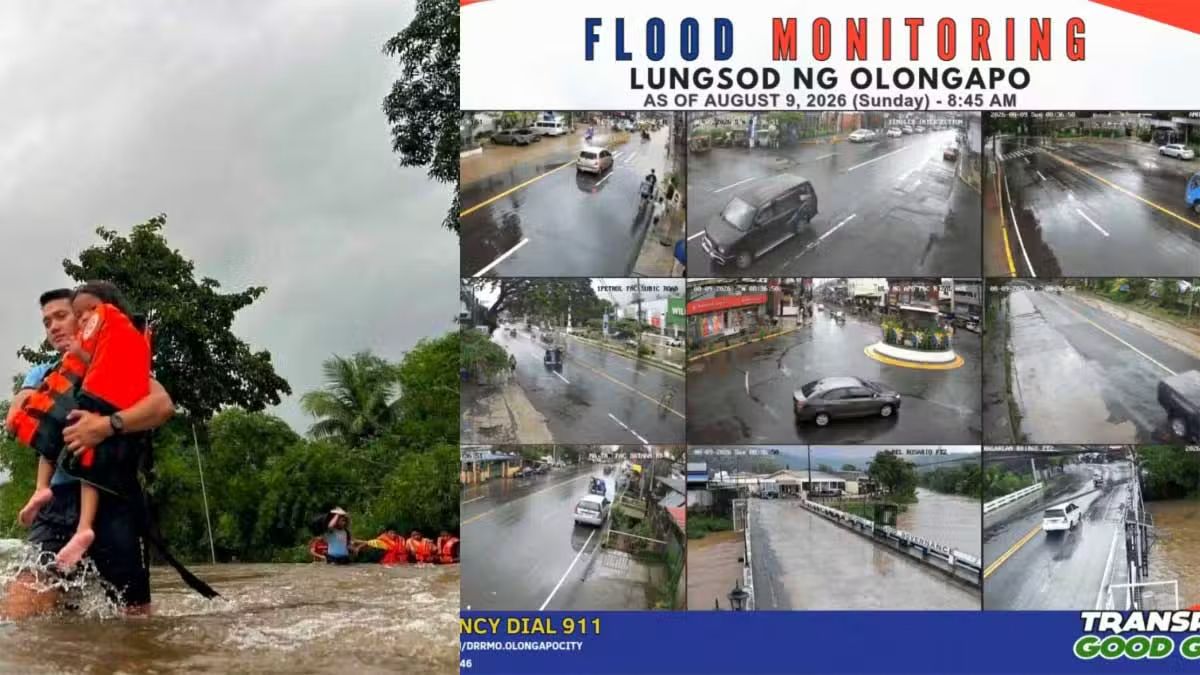
The Philippines faces a mounting humanitarian crisis as authorities intensify rescue and relief operations across flood-devastated communities spanning multiple regions. The southwest monsoon, locally known as habagat, has been amplified by the passage of Tropical Depression Luis and Tropical Storm Maymay, creating perfect conditions for catastrophic flooding that has swept across vulnerable settlements from Luzon to Mindanao. The National Disaster Risk Reduction and Management Council reported that the calamity has directly impacted approximately 382,000 people—representing around 110,000 families—with the majority concentrated in eight regions across the Philippine archipelago's most populated areas.
The human toll continues to mount as rescue teams work against the clock to locate missing persons and retrieve bodies from flooded zones. Nine fatalities have been confirmed, including a police officer who perished while attempting a daring rescue of two fellow officers trapped in a raging river in Negros Occidental. Among the victims was a 28-year-old resident of Cuenca, Batangas, who died from electrocution while navigating a submerged section of J.P. Laurel Highway in Lipa City. Additional deaths were recorded across Luzon through separate drowning and landslide incidents, with casualties reported from multiple provinces including Ilocos Sur, La Union, Pangasinan, Benguet, and Rizal. The diversity of locations underscores how the monsoon's reach extends far beyond metropolitan centres into remote highland communities and low-lying plains, each vulnerable in different ways.
Meteorologists warn that the deluge shows no signs of abating in the immediate term. The Philippine Atmospheric, Geophysical and Astronomical Services Administration issued advisories on Sunday forecasting persistent heavy rainfall through at least Wednesday, with particularly intense accumulations expected in mountainous and elevated terrain where water runoff converges rapidly into river systems. The agency cautioned that areas already saturated by days of continuous precipitation face escalating danger as soil reaches maximum absorption capacity and rivers approach critical overflow thresholds. This compounding effect means that communities at lower elevations downstream face heightened flood risks even if local rainfall momentarily decreases.
The nation's critical water infrastructure has reached concerning levels as reservoirs swell beyond normal capacity. Angat Dam in Norzagaray, Bulacan, experienced a dramatic rise of nearly 15 metres within a ten-day period, climbing from a record-low of 150.61 metres above sea level on July 30 to 164.80 metres on Sunday afternoon. The reservoir's rapid filling—gaining three metres in just eight hours between morning and midday—demonstrates the sheer volume of water entering the system. Downstream, the Ipo Dam approached its critical spilling level of 101 metres above sea level while releasing enormous volumes of water at 314.91 cubic metres per second, exacerbating flooding in communities along the discharge path. These engineering structures, designed with specific capacity margins, face stress levels that push their operational limits and raise questions about infrastructure resilience in an era of intensifying weather patterns.
Central Luzon has emerged as one of the hardest-hit regions, with 98 villages succumbing to floodwaters that affected nearly 170,000 individuals. The provincial governments of Nueva Ecija and Zambales initiated precautionary mass evacuations, relocating 781 families totalling 2,544 people before conditions deteriorated beyond safe thresholds. In Zambales, the situation proved particularly dire when a protective dike failed in San Marcelino, cutting off entire communities and forcing residents to seek refuge on higher ground. A bridge in Barangay Santa Fe was destroyed by the force of churning floodwaters, severing transportation links and complicating rescue operations. In the Calabarzon region surrounding Metro Manila, more than 7,000 families sought shelter in 117 evacuation centres scattered across 29 localities, straining resources and creating logistical challenges for local government units attempting to provide basic services, food, and sanitation facilities.
Traffic paralysis and structural damage compound the disaster's immediate aftermath. The Philippine National Police reported that severe flooding and gridlocked roads have rendered major highways across Luzon impassable, disrupting commerce and preventing the movement of emergency vehicles. Two bridges spanning the Chico River in Cagayan province became unusable as water levels surged, while scattered landslides and rockfalls in Nueva Vizcaya, Abra, and Mountain Province closed critical mountain passes that communities depend upon for supplies and medical access. In Benguet, floodwaters reached approximately two feet in parts of La Trinidad municipality, inundating homes and agricultural areas. The Bulusan Riverbank in Calumpit, Bulacan, became impassable to light vehicles, effectively isolating nearby settlements. Meanwhile, suspected tornado activity in Iloilo City damaged 52 houses, uprooted trees and utility poles, and displaced more than 150 residents, adding wind damage to the broader flood crisis.
Coastal communities face additional complications from sea conditions amplified by the monsoon system. The Philippine Coast Guard reported that 543 passengers, truck drivers, and cargo handlers remain stranded at 28 ports distributed across four coastal regions, unable to return home or complete commercial journeys. The suspension of sea travel impacts supply chains for island communities and restricts the movement of goods and people at a time when efficient logistics become essential for disaster response. High tidal conditions exacerbated flooding in low-lying areas, as evidenced by the evacuation of nearly 1,000 residents from several Bulacan towns where floodwaters reached approximately four feet in some neighbourhoods. The combination of river overflow, coastal surge, and direct rainfall creates a triple threat that overwhelms local drainage systems and natural water absorption capacity.
Government leadership has mobilised law enforcement and disaster response personnel across multiple regions to coordinate evacuations and manage emergency operations. Philippine National Police chief Gen Jose Melencio Nartatez Jr issued a statement urging the public to remain vigilant while following official guidance, emphasizing that widespread deployment of police personnel and resources supports local government disaster management teams. However, the PNP chief also warned communities to avoid sharing unverified information through social media channels, recognizing how misinformation and exaggerated reports during natural disasters can trigger panic and overwhelm emergency response systems with false emergency calls. This communication challenge reflects the modern reality of disaster management, where controlling information flow becomes as critical as controlling floodwaters.
Political commentary has already emerged regarding infrastructure adequacy and resource allocation. The Makabayan coalition used the disaster as an occasion to criticise flood control and other infrastructure projects under the current Marcos Jr. administration, suggesting that engineering failures are being exposed by the monsoon's severity. The coalition further raised concerns about the government's reliance on unprogrammed appropriations—discretionary budget funds that can be deployed rapidly but lack formal legislative oversight—warning that such mechanisms create opportunities for political patronage and corruption. These accusations reflect broader political tensions around how disaster preparedness funding is allocated and managed, questions that gain prominence when catastrophic weather events reveal infrastructure gaps. As the national budget for 2027 undergoes legislative deliberation, such criticisms will likely intensify pressure on government officials to demonstrate that public resources dedicated to disaster mitigation are being spent effectively rather than diverted toward political objectives.
For Malaysia and the broader Southeast Asian region, the Philippine flooding offers sobering lessons about monsoon vulnerability and infrastructure resilience. The habagat system that devastates the Philippines brings moisture northward from the Indian Ocean, and similar monsoon patterns affect Malaysia, particularly during the southwest monsoon season from May through September. The rapid elevation of water levels in major dams and the cascading failures of flood control infrastructure underscore how climate variability challenges traditional engineering assumptions. Communities across Malaysia's flood-prone areas in Selangor, Pahang, Kelantan, and elsewhere should monitor these developments as potential early warning indicators of more intense precipitation patterns. The coordination challenges faced by Philippine disaster managers—spanning multiple regions with varying conditions, limited transportation access, and communication breakdowns—mirror obstacles that Malaysian authorities might confront during similarly distributed flooding events affecting multiple states simultaneously.

