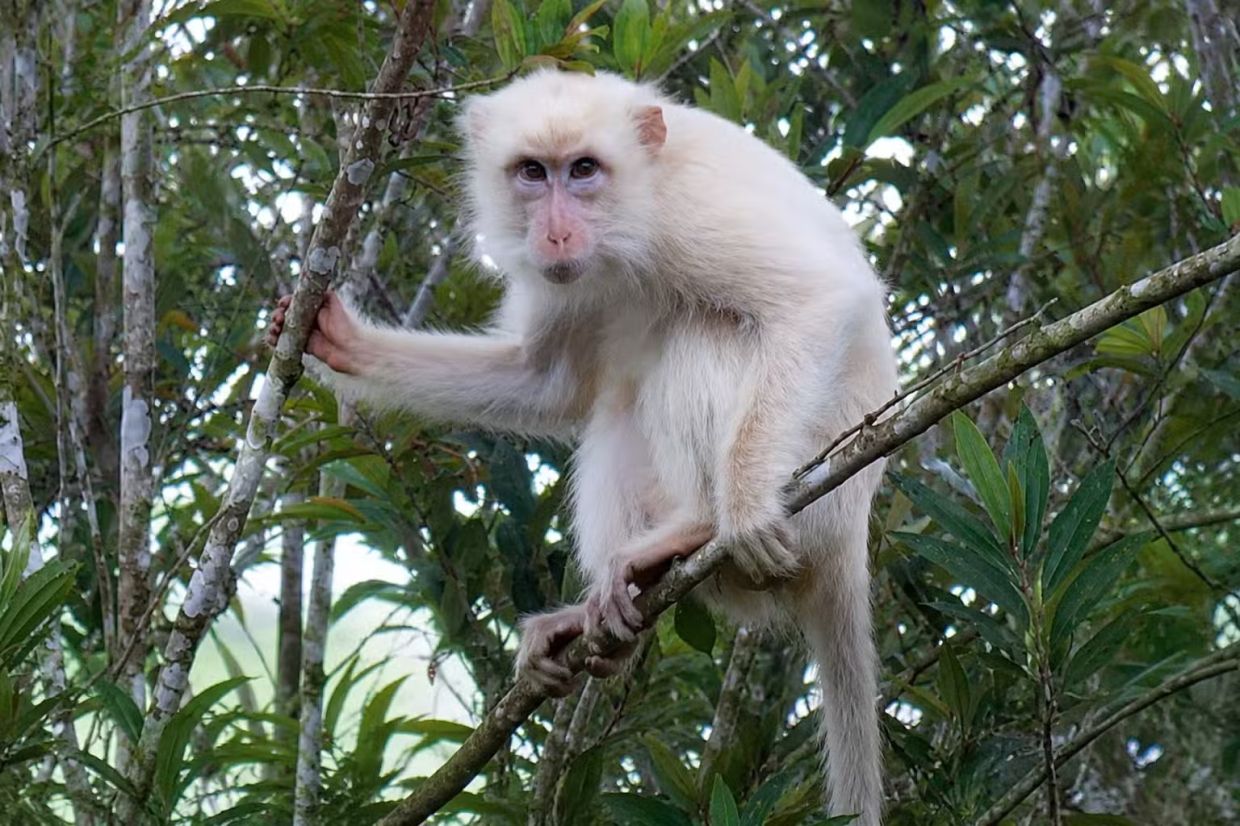
A distinctive white macaque that has inhabited a forested region of Sultan Kudarat province for nearly a decade has suddenly become the focus of an intensive conservation effort by Philippine authorities, following its viral exposure on social media platforms. The animal, which blends into human settlements and has become a familiar presence to local residents, initially drew limited notice until photographs and videos began circulating online, transforming a quiet biological phenomenon into a high-stakes wildlife protection challenge. The Department of Environment and Natural Resources (DENR) Region XII and the municipal government of Senator Ninoy Aquino have responded by cordoning off the area and implementing protective measures designed to shield the creature from potential harm.
Identified as a Philippine long-tailed macaque (Macaca fascicularis philippensis), the animal exhibits a striking pigmentation anomaly that distinguishes it markedly from other members of its species in the region. Initial assessments suggested the macaque suffered from albinism, but a field investigation conducted by DENR XII specialists revealed a more complex biological condition. The team observed that the animal possessed brown to dark brown eyes rather than the pink eyes typical of albino primates, suggesting instead that the macaque may have leucism or another related pigmentation disorder. This distinction carries scientific significance, as it points towards a different genetic mechanism affecting the animal's appearance. DENR officials have acknowledged that wildlife experts must undertake formal scientific verification before the precise condition can be conclusively determined, underscoring how little remains known about this particular animal's biology.
Local resident Armando reported observing the white macaque regularly since 2016, during which time it moved freely through the forest without drawing exceptional attention from outsiders. The situation changed dramatically once digital imagery achieved widespread circulation online, creating what conservationists describe as a textbook case of how modern social media dynamics can inadvertently threaten vulnerable species. The exponential increase in awareness and interest triggered alarm bells among both DENR officials and local government representatives, who recognised immediately that heightened visibility exponentially increases risks including habitat disruption, illegal capture attempts, poaching, and integration into the wildlife trafficking network. The speed with which online interest translates to ground-level threats to animals has become a significant conservation challenge across Southeast Asia, where rare or unusual creatures routinely become targets once their existence becomes common knowledge among potential buyers and collectors.
Field assessments by DENR XII specialists determined that the macaque's forest environment remains ecologically robust and continues supporting the resident population adequately. Secondary forest vegetation provides suitable cover, whilst native food sources remain sufficiently abundant to sustain the animals without artificial supplementation. This finding proved crucial to conservation strategy, as it meant that habitat degradation was not the primary threat requiring intervention. Rather, the primary concern centred on preventing human-induced disturbance and preventing the animal from becoming a target for illegal collection or poaching. This distinction shaped the response measures that authorities implemented, focusing on access restriction and public awareness rather than habitat rehabilitation initiatives.
The Senator Ninoy Aquino municipal government took immediate action by temporarily closing the area where the white macaque is frequently observed, effectively creating an exclusion zone around the animal's range. This administrative closure serves multiple purposes simultaneously: it prevents casual disturbance of the macaque and associated wildlife populations, deters would-be collectors and poachers by establishing a legal barrier to entry, and reduces the likelihood that visitors will obtain photographs with precise location data that could be weaponised by criminals operating in the wildlife trafficking sector. The closure represents a precautionary measure implemented whilst more permanent protections are formalised through legislative processes. Barangay Bugso, the local administrative division encompassing the macaque's habitat, has begun drafting a municipal ordinance that would embed legal protections for both the white macaque specifically and its broader ecosystem more generally.
Until the barangay ordinance receives formal enactment, unauthorised access to the immediate vicinity of recorded sighting locations remains prohibited under existing administrative directives. This interim prohibition establishes legal grounds for enforcement action against those attempting to enter the protected zone without authorisation, providing authorities with tools to deter and prosecute would-be poachers or collectors. The barangay government has additionally committed to implementing habitat restoration and tree-planting initiatives designed to strengthen overall ecosystem health and resilience. These activities serve conservation purposes beyond the single macaque in question, contributing to broader biodiversity preservation within the region. The authorities have framed these interventions as part of a wider commitment to promoting responsible ecotourism, suggesting that future economic development may depend on protecting rather than exploiting the area's distinctive wildlife assets.
The Philippine legal framework already establishes comprehensive wildlife protections applicable to all native species, including the macaque in question. Republic Act No. 9147, formally designated the Wildlife Resources Conservation and Protection Act, establishes comprehensive prohibitions against hunting, capturing, collecting, possessing, transporting, trading or disturbing wildlife without government-issued permits. The law creates legal mechanisms through which authorities can prosecute those engaged in illegal wildlife activities, though enforcement effectiveness varies across regions and depends significantly on coordination between national agencies and local government units. DENR officials have used this case as an opportunity to remind the general public and specific stakeholder groups of their obligations under existing legislation and to emphasise that legal jeopardy attaches to wildlife crimes.
Recognising that the greatest ongoing threat originates from digital platforms and digital sharing practices, DENR officials issued a direct appeal to content creators, photographers, journalists, social media users and residents requesting they refrain from disclosing precise location information regarding wildlife sightings. Specifically, authorities cautioned against sharing geotagged content that could provide would-be collectors and poachers with actionable intelligence regarding protected animal locations. This message represents an attempt to reshape social media behaviour by appealing to conservation consciousness and encouraging users to recognise that sharing innocuous wildlife photographs may inadvertently facilitate criminal activity. The effectiveness of such appeals depends substantially on whether they gain traction within digital communities and whether they influence behaviour among users motivated by engagement metrics and viral exposure.
The DENR XII regional office has committed to ongoing systematic engagement with protection and monitoring frameworks. Documentation on the white macaque will be forwarded to the Biodiversity Management Bureau for technical evaluation, potentially resulting in formal scientific designation or status changes. Regional authorities plan to maintain continuous habitat monitoring, strengthen coordination mechanisms with local government units and community stakeholders, and escalate public information campaigns emphasising wildlife protection principles. This multi-layered approach reflects recognition that protecting individual animals depends substantially on sustained institutional commitment and community support. The white macaque now exists not merely as a forest inhabitant but as a symbol of the intersection between digital-age communication dynamics and traditional conservation biology, representing both the vulnerabilities that modern publicity creates for wildlife and the adaptive management strategies that contemporary conservation increasingly requires.

