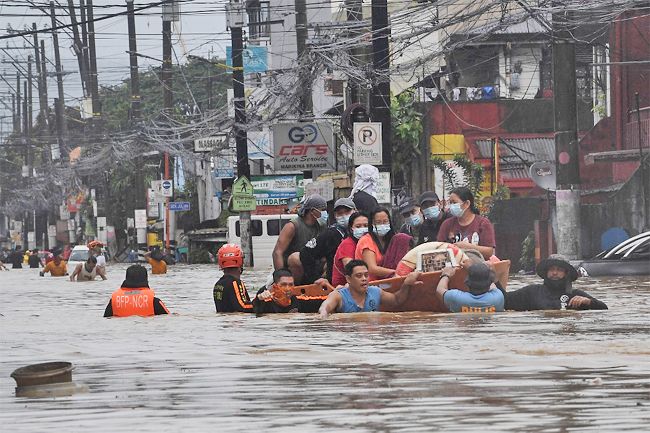
The Philippines is pursuing a strategic partnership with Singapore to modernise its approach to flood disaster management, reflecting growing recognition that technological solutions must complement traditional infrastructure investments. Undersecretary Charles Calima of the Department of Public Works and Highways announced that his agency will evaluate which Singaporean flood control technologies are viable for implementation across the archipelago, while simultaneously assessing the financial implications of such large-scale adoption.
The assessment initiative emerged from the 2026 Stormwater Summit held in Makati City, where Singaporean enterprises displayed an array of innovative flood mitigation measures. These demonstrations ranged from real-time natural hazard monitoring systems to advanced rainwater harvesting and recycling infrastructure. For the Philippines, a nation of at least 112 million inhabitants scattered across numerous islands, the exposure to water-related disasters remains perpetually acute. The country experiences an annual average of approximately 20 cyclones originating from the Pacific Ocean, compounded by seasonal monsoon patterns that regularly inundate low-lying communities and urban centres.
Among the technologies presented, the Tethys platform developed by Flexi Systems and FloodX captured particular attention for its integrated approach to flood forecasting and response. Founder and chief executive officer April Yang explained that the system simultaneously monitors five distinct data streams in real time: water quality measurements and turbidity levels, rainfall duration and meteorological forecasts, blockage identification and silt accumulation alerts, live flood elevation readings with trend analysis, and tidal variations affecting drainage efficiency. This comprehensive data aggregation enables authorities and communities to respond proactively rather than reactively, shifting the paradigm from crisis management to anticipatory decision-making.
Yang emphasised that access to timely, accurate information fundamentally alters how communities prepare for and navigate flood events. The psychological dimension of knowing precise flood risks allows households and businesses to plan migration patterns, secure valuables, and arrange alternative shelter arrangements with greater confidence. For developing nations struggling with rapid urbanisation and informal settlements in flood-prone zones, such predictive capability represents a significant advance in disaster preparedness.
Singapore's experience managing water resources offers particular relevance for Southeast Asian nations. Ryan Yuen, representing PUB Consultants—the international consulting arm of Singapore's Public Utilities Board—outlined five decades of cumulative infrastructure investment focused on reservoir regulation, drainage system optimisation, and innovative rainwater management techniques including rain gardens. These engineered landscapes capture and filter stormwater runoff, reducing both flooding risk and strain on conventional drainage networks whilst simultaneously recharging groundwater supplies.
Singapore's water recycling strategy, termed "NEWater" domestically, represents a paradigm shift in resource management that Yuen highlighted as integral to long-term sustainability. Rather than permitting harvested rainwater and treated wastewater to drain away unutilised, the city-state recycles every available drop for non-potable applications including industrial processes, irrigation, and toilet flushing. This philosophy of circular water economy holds considerable potential for the Philippines, where monsoon seasonality creates extreme variations between abundance and scarcity.
However, both Yang and Yuen acknowledged a critical limitation inherent in technology-centric approaches: engineering solutions alone cannot fully resolve flood vulnerability. The most sophisticated real-time monitoring systems and advanced drainage infrastructure must operate in tandem with community-level resilience, local knowledge, and institutional preparedness. This recognition reflects lessons learned across Southeast Asia, where expensive infrastructure projects have occasionally failed to reduce vulnerability when communities lacked training, resources, or institutional support for proper operation and maintenance.
Actor Dingdong Dantes, representing the Office of Civil Defense, articulated this human dimension during the summit, reframing resilience not as passive survival capacity but as active adaptation capability. His documentary work following the story of a flood-affected Manila resident named "Nanay Evelyn" illuminated the psychological and social costs of recurring disasters. Nanay Evelyn's daily reality—navigating floodwaters to purchase necessities, sleeping on upper floors whilst her ground level remained perpetually submerged—represented normalised catastrophe rather than temporary crisis.
Dantes' intervention shifted the conversation beyond hardware to the character required of individuals and communities facing chronic disaster exposure. He defined resilience as comprising four interdependent elements: the courage required to fundamentally alter one's daily existence and expectations; the discipline to maintain preparedness despite familiarity breeding complacency; the humility to recognise that collective action surpasses individual effort; and the determination to sustain forward momentum despite the recognition that pre-disaster normality may prove permanently unattainable.
For Malaysia and other regional economies similarly vulnerable to monsoon flooding and tropical cyclone systems, the Philippines' assessment process offers instructive value. Technology transfer from developed Singapore to developing Philippines requires careful adaptation to vastly different fiscal capacities, institutional sophistication, and community demographics. Moreover, the emphasis on combining engineering solutions with community resilience building suggests that Southeast Asian flood management must evolve beyond infrastructure procurement alone.
The Philippines' willingness to undertake systematic evaluation of Singaporean approaches also signals broader recognition that climate change is intensifying hydrological extremes across the region. Previous cyclone and monsoon patterns no longer reliably predict future precipitation distributions and intensity, necessitating more responsive management systems capable of rapid adaptation to evolving conditions.
Calima's commitment to assessing implementation costs reflects the budgetary realities constraining Philippine public works investment. The DPWH's careful evaluation process—determining not merely technological feasibility but economic viability—acknowledges that flood management exists within broader competition for limited development resources. Yet the summit's successful knowledge exchange suggests that regional cooperation mechanisms, potentially including technical assistance and shared infrastructure financing arrangements, might accelerate adoption of proven solutions across Southeast Asian economies facing comparable vulnerability profiles.

