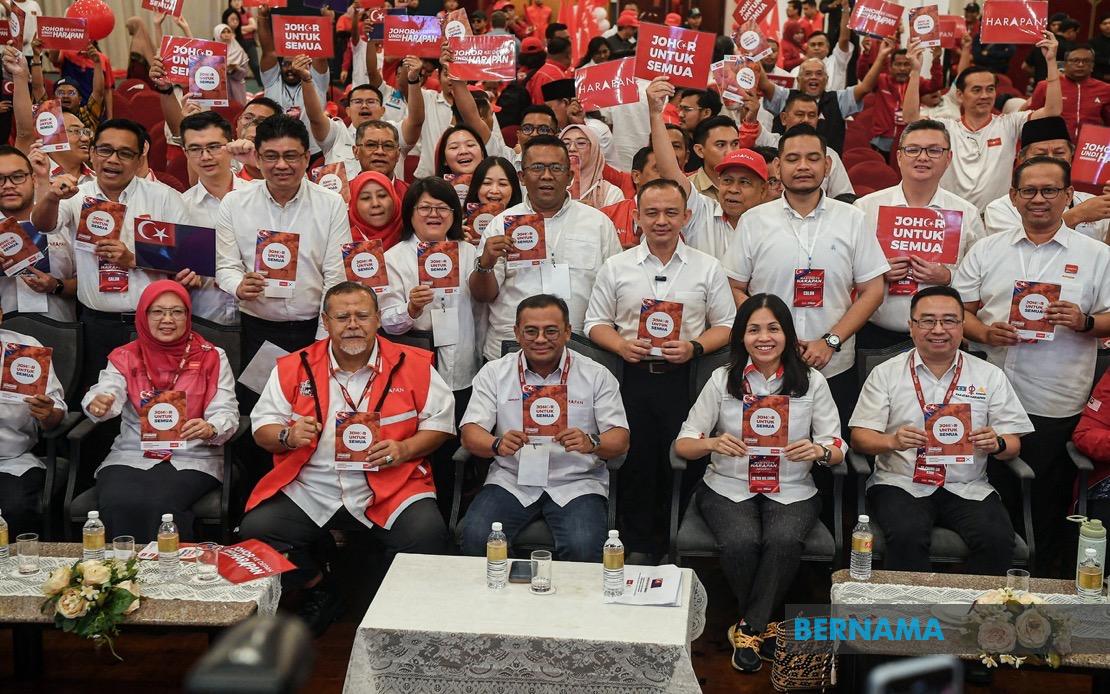
Pakatan Harapan presented its 'Johor Untuk Semua' (Johor For All) manifesto on July 3 for the forthcoming 16th Johor state election, positioning the document as a substantive blueprint rather than mere political theatre. According to Johor DAP chairman and Deputy Communications Minister Teo Nie Ching, the platform directly reflects tangible concerns raised by residents and is calibrated to address the state's specific economic circumstances. This framing signals an effort to move beyond abstract campaign promises and ground electoral commitments in demonstrable local challenges and opportunities.
Teo voiced particular confidence that the manifesto's proposals can materialise given adequate backing from federal authorities and collaborative governance mechanisms. The emphasis on federal-state coordination reflects the political reality that many policy levers—particularly those touching border management, home affairs, and intergovernmental financing—require alignment across multiple governance tiers. Such interdependencies often determine whether state-level pledges translate into on-the-ground delivery or remain aspirational.
The manifesto positions itself as holistic, spanning demographic cohorts from young adults to mothers and children. This broad-based framing suggests an attempt to construct an inclusive political coalition rather than targeting narrow voter segments. In Malaysian state elections, where demographic competition between urban and rural interests, generational concerns, and family-centred welfare expectations often shape outcomes, a multi-generational appeal carries strategic weight.
Education stands among the platform's central pillars, reflecting long-standing community agitation around schooling standards, infrastructure, and accessibility. Johor, as Malaysia's second-largest state by population and an increasingly competitive economic hub, faces persistent anxieties about educational quality relative to federal territories. By prominently foregrounding this domain, PH signals responsiveness to parental and student concerns that have animated local discourse.
The manifesto commits to reducing border crossing waiting times between Johor and Singapore by 50 per cent—a pledge with immediate practical implications for thousands of daily commuters and for the state's cross-border economic relationships. Teo's confidence in achieving this target hinges on coordination with the Home Ministry, underscoring that such operational improvements depend on security protocols, infrastructure investment, and bilateral arrangements rather than state action alone. Success here would deliver tangible improvements to quality of life for a politically salient constituent base.
A proposed Johor Health Scheme forms a signature pledge. Teo drew explicit parallels with Selangor's existing health insurance programme, suggesting that replicating a neighbouring state's model provides both technical precedent and political reassurance. By invoking Selangor's track record, the manifesto attempts to counter scepticism about implementation feasibility while implying that health security—a high-stakes concern post-pandemic—will receive substantive resources rather than rhetorical emphasis.
The manifesto incorporates deposit assistance for first-time homebuyers, addressing housing affordability pressures that have intensified across Malaysian urban and semi-urban regions. Johor's rapid urbanisation, coupled with population inflow from other states seeking lower property costs relative to Selangor and federal territories, has created particular housing demand dynamics. Targeting first-time purchasers signals attention to younger residents and families forming households—demographically important voting blocs.
A RM500 million youth development fund represents one of the platform's most substantial monetary commitments. Youth unemployment, skills gaps, and underutilisation of potential in technical and vocational pathways have preoccupied policymakers nationally. By ringfencing substantial capital for this cohort, PH positions itself as forward-looking and responsive to generational aspirations for economic participation and upward mobility.
The 10-pronged structure of the manifesto suggests an attempt to balance specificity with breadth. Rather than concentrating pledges in narrow domains, PH distributes commitments across education, health, housing, youth development, and border efficiency—implying comprehensive rather than partial governance ambition. This approach mirrors successful electoral strategies elsewhere in the region, where manifestos addressing multiple voter concerns outperform narrowly focused platforms.
Contextually, the manifesto's emphasis on economic realities and practical implementation reflects a maturing discourse around electoral accountability in Malaysian state politics. Earlier generations of state manifestos often foregrounded ideology or aspiration; contemporary platforms increasingly highlight delivery mechanisms and financial sustainability. This evolution suggests voters and party strategists alike have absorbed lessons about the gap between promise and execution, driving demand for more granular policy detail.
The election timeline—polling on July 11 with early voting on July 7—meant the manifesto launch occurred during the most intense campaign period. By front-loading detailed policy commitments rather than maintaining ambiguity, PH bet that specificity would mobilise supporters and pressure-test opposition claims, while giving journalists and analysts substantive content to scrutinise and disseminate.
For Malaysian politics more broadly, the Johor campaign serves as a barometer of coalition health, federal-state dynamics, and voter appetite for alternative governance. Johor's size, economic significance, and demographic diversity make election outcomes there consequential for national trajectory. The manifesto's design thus reflects calculations extending beyond state boundaries into national competition dynamics.

