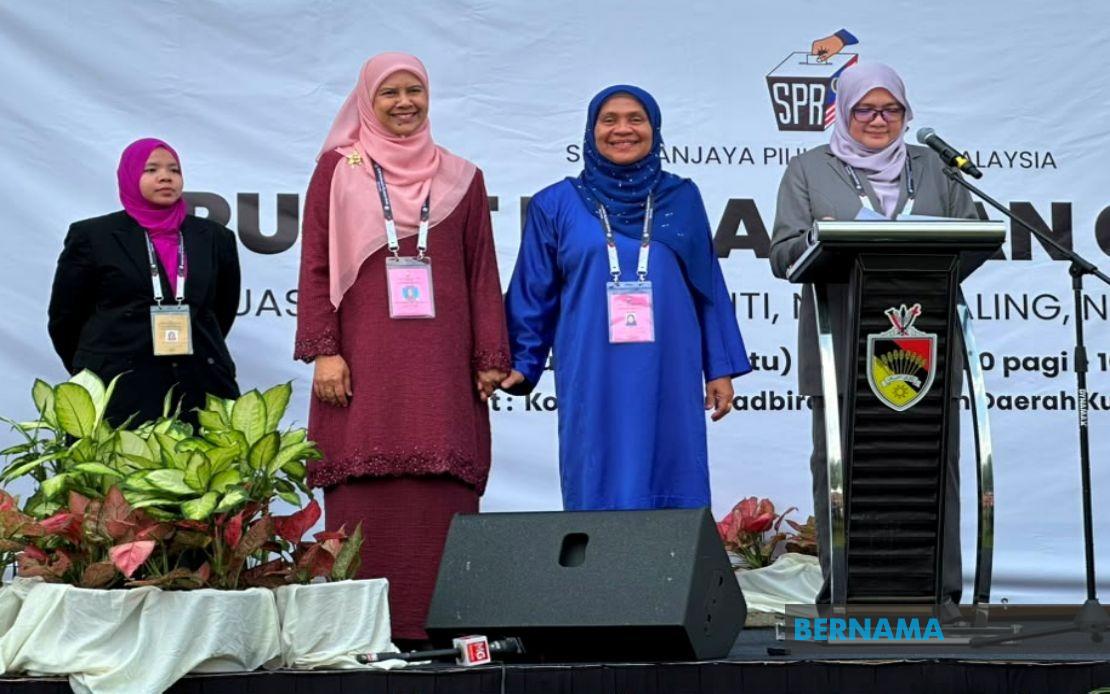
The Pilah state seat in Negeri Sembilan will feature an all-female contest when voters head to the polls on August 1, pitting the constituency's sitting representative against a fresh challenger from the opposing coalition. Incumbent Datuk Noorzunita Begum Mohd Ibrahim of Pakatan Harapan will defend her position against Barisan Nasional's S. Leza Md Yasin in what officials have confirmed as a two-candidate race. The announcement came after the nomination process concluded on July 18 at the District and Land Office in Kuala Pilah, with returning officer Nawal Mohammed Amin officiating the event. Noorzunita Begum filed her candidacy papers at 9.03 am, with her rival submitting hers just six minutes later at 9.09 am.
The Pilah matchup represents a notable development in an election cycle that will see multiple formats of contests across Negeri Sembilan. While Pilah will witness a direct two-person fight, other state constituencies are shaping up for more complex electoral battles. The Johol seat will also feature a straight contest, with Pakatan Harapan's Mohd Zailan Mohd Munawar taking on Barisan Nasional incumbent Datuk Saiful Yazan Sulaiman. Three additional constituencies—Juasseh, Seri Menanti, and Senaling—are set for three-cornered contests that will fragment voter attention across multiple candidates representing different political camps.
Three-way fights carry distinct strategic implications for all participants. In Juasseh, Pakatan Harapan's Mohd Aidil Abdullah faces competition from both Barisan Nasional's incumbent Datuk Ismail Lasim and Bersatu's Mohd Zuhami Md Yusof. This configuration requires all three camps to mobilise their respective voter bases effectively, as the winning margin may hinge on which coalition can suppress the opposition vote more successfully. Similarly, Seri Menanti's contest brings together Pakatan Harapan's Mohd Kamarul Arifin Mohd Wafa, incumbent Muhammad Sufian Maradzi of Barisan Nasional, and Bersatu's Datuk Seri Megat D. Shahriman Zaharuddin. The Senaling seat features Mohd Hanis Mohd Alimin representing Pakatan Harapan, Mohamad Qayyum Abd Jalil for Barisan Nasional, and Bersatu's Mohd Izzafi Khan.
The presence of Bersatu candidates across multiple constituencies reflects the party's strategic positioning within the broader Malaysian political landscape. Despite its smaller parliamentary representation compared to the major coalitions, Bersatu's participation in state-level contests demonstrates its continued relevance in regional politics. The party's decision to field candidates in Juasseh, Seri Menanti, and Senaling suggests targeted efforts to contest areas where it believes it can command meaningful support or where it aims to prevent one coalition from consolidating electoral dominance. For Negeri Sembilan's voters, this fragmentation means that the traditional binary choice between the two major coalitions will be complicated by a third option in certain constituencies.
High-ranking officials from both coalitions made public appearances during the nomination process, underscoring the significance both Pakatan Harapan and Barisan Nasional attach to these elections. Education Minister and PKR Wanita chief Fadhlina Sidek accompanied Pakatan Harapan's candidates, signalling strong party backing for the campaign effort. She was joined by Youth and Sports Minister Dr Mohammed Taufiq Johari, who leads Angkatan Muda Keadilan, and Deputy Investment, Trade and Industry Minister and Bayan Baru MP Sim Tze Tzin. Their participation emphasised the federal government's stakes in securing a favourable outcome in a state contest that will shape Negeri Sembilan's governance for the next electoral cycle.
Barison Nasional similarly mobilised senior figures to demonstrate its commitment to reclaiming or strengthening its position in the state. Deputy Home Minister and UMNO Supreme Working Council member Datuk Seri Dr Shamsul Anuar Nasarah attended the nomination proceedings alongside Perak Menteri Besar and Perak UMNO chairman Datuk Seri Saarani Mohamad. The presence of a Perak leader at a Negeri Sembilan state election illustrates how closely integrated these regional contests are within the broader framework of interstate political strategy. UMNO's involvement across different state borders reflects the party's role as the dominant force within Barisan Nasional's leadership structure.
The electoral calendar established by the Election Commission provides campaigns with a compressed timeline to build momentum. Early voting has been scheduled for July 28, giving supporters unable to vote on polling day an opportunity to cast ballots in advance. The main election on August 1 will determine the composition of the Negeri Sembilan State Assembly and, by extension, which coalition controls the state government. This rapid succession between the nomination deadline and voting represents a significant condensing of the usual campaign period, potentially limiting the window for candidates to conduct extensive grassroots engagement and voter persuasion activities.
For Negeri Sembilan voters, the composition of this election is consequential at multiple levels. State elections directly determine who sits in the state assembly and wields control over state resources, development priorities, and administrative appointments. The outcomes may also send signals about voter sentiment regarding the national coalition governments and their policies. In Pilah specifically, the all-female contest adds a distinctive dimension to the electoral dynamic, as both candidates will likely campaign on their individual credentials, vision, and representational capacity rather than leaning heavily on coalition identity. This personalisation of the contest could potentially engage voters in ways that more routine coalition-based campaigns might not achieve.
The straight fights in Pilah and Johol contrast sharply with the three-way contests elsewhere, creating different campaign dynamics and voter calculation problems. In two-person races, the stakes are crystalline: victory goes to whoever secures the most votes, with no possibility of the winning candidate achieving less than 50 percent support. This clarity can sometimes encourage higher voter turnout, as the binary choice appears more consequential. Conversely, three-way contests may depress turnout if voters perceive the outcome as uncertain or if candidates fail to build sufficiently broad support coalitions. The mixed format across different constituencies means that Negeri Sembilan's overall election result will reflect a combination of these distinct competitive environments.
The Negeri Sembilan state election also occurs within the context of Malaysia's broader political realignment following recent federal government changes. The balance between Pakatan Harapan and Barisan Nasional in state capitals influences the overall distribution of power across the federation and affects how federal and state governments coordinate on policy matters. A state government controlled by one coalition while the federal government is led by another can create productive tension or political friction, depending on how leaders choose to manage intergovernmental relations. These state-level contests therefore carry implications that extend beyond Negeri Sembilan's borders and contribute to the ongoing negotiation of power within Malaysia's federal structure.

