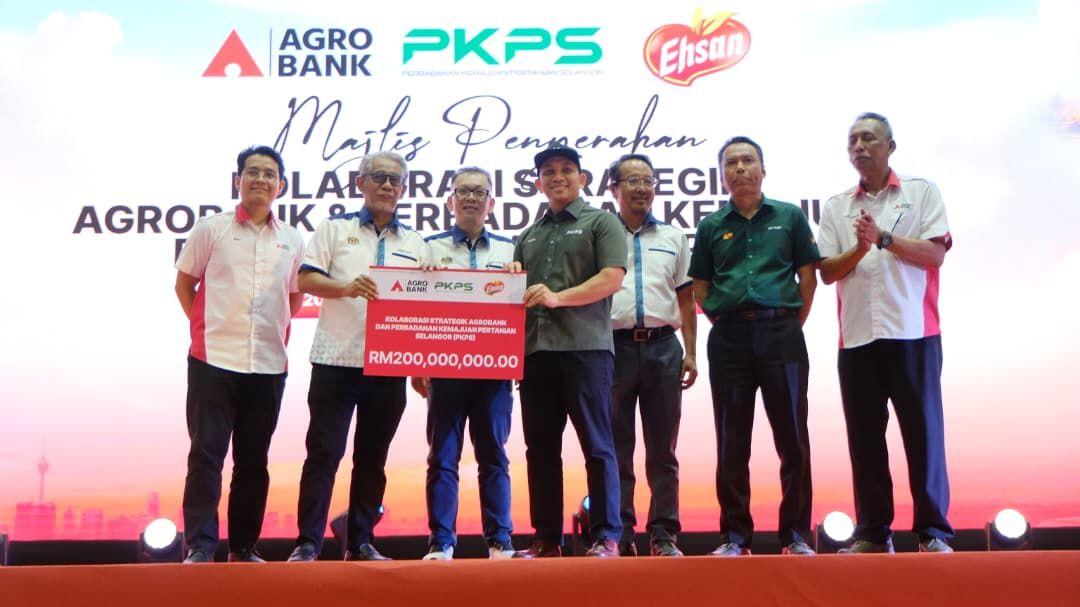
Selangor's agricultural sector has received a significant boost with the establishment of a RM200 million financing facility between the Selangor Agricultural Development Corporation (PKPS) and Agrobank, marking a watershed moment in the state's efforts to modernise its food supply chain and strengthen long-term food security. The strategic collaboration will channel resources into critical infrastructure projects, replenish PKPS's operational working capital, and expand the state's agrifood production capabilities—a multifaceted approach designed to address vulnerabilities in Selangor's food distribution networks and support the region's growing demand for locally-sourced provisions.
The partnership was officially announced at MAHA 2026 during a formal ceremony held on August 29 at Malaysia Agro Exposition Park (MAEPS) Serdang, where Agrobank Group President and Chief Executive Officer Datuk Tengku Ahmad Badli Shah Raja Hussin presented a symbolic mock cheque to PKPS Group Chief Executive Officer Datuk Dr Mohamad Khairil Mohamad Razi. The handover was witnessed by Deputy Agriculture and Food Security Minister Datuk Chan Foong Hin, underscoring the government's commitment to leveraging financial partnerships to bolster agricultural resilience. The timing of this announcement at MAHA Go Global, which carries the theme "Value Creation for Food Security," signals a deliberate alignment between the initiative and Malaysia's broader agricultural modernisation agenda.
The inaugural project under this financing arrangement will be the construction of Selangor's halal food warehouse, conceived as a centralised storage and logistics facility to streamline the state's food supply chain operations. This warehouse will serve multiple functions—acting as a temperature-controlled repository, a consolidation point for distribution to retailers, and a quality assurance checkpoint for halal-certified products. For Malaysian consumers increasingly conscious of halal compliance and food traceability, this facility represents a critical infrastructure investment that bridges production gaps and ensures consistent product availability across Selangor's diverse population centres.
Beyond the flagship warehouse, the RM200 million facility extends its reach across several complementary infrastructure initiatives that collectively form a comprehensive agrifood ecosystem. Plans include the establishment of a dedicated halal chicken processing centre, addressing the substantial domestic demand for processed poultry products that currently relies heavily on imports or distant suppliers. An Ehsan product processing centre will capitalise on PKPS's proprietary brand to manufacture value-added agricultural goods, while a network of central distribution warehouses strategically positioned across Selangor's districts will eliminate logistical bottlenecks and reduce post-harvest losses that typically plague developing agricultural economies.
The financing framework is structured as a trade facility that disburses capital in alignment with project milestones, ensuring disciplined cash flow management and preventing wasteful expenditure. Disbursements will be triggered upon verified project progress, adhering to rigorous standard operating procedures that prioritise transparency and accountability. This methodical approach mitigates financial risk for Agrobank while simultaneously assuring PKPS stakeholders and state government officials that funds are deployed efficiently. The facility is scheduled to formally commence operations in March 2027, allowing PKPS adequate time to finalise project documentation, secure necessary regulatory approvals, and mobilise procurement processes.
Operational and research dimensions form an equally vital component of the collaboration. PKPS will leverage portions of the financing to establish and maintain the Ehsan Agricultural Research Centre, a dedicated facility to advance smart agriculture technologies—including precision irrigation, soil sensors, and data-driven crop management systems. Simultaneously, the Ehsan Agricultural Training Centre will cultivate human capital by equipping farmers, technicians, and agribusiness professionals with contemporary skills required to operate sophisticated agricultural enterprises. These investments in knowledge and capability represent a long-term competitive advantage for Selangor's farming community, particularly smallholder producers who often lack resources for independent upskilling.
The Ehsan brand itself—encompassing ready-to-eat and ready-to-heat food products—occupies an emerging market segment increasingly demanded by urban Malaysian consumers seeking convenient, nutritionally-balanced meal solutions. By financing Ehsan product development and marketing, PKPS positions itself to capture market share in this high-margin category, generating revenue streams that offset operational costs and create sustainable value for the corporation. This commercial dimension transforms PKPS from a purely infrastructure-focused entity into an integrated agrifood enterprise capable of competing with private sector operators.
Complementary agritourism initiatives, including the Ehsan Resort and Convention Centre, further diversify PKPS's revenue base while promoting Selangor's agricultural heritage to domestic and international visitors. Agritourism developments have proven effective in rural economies globally by diversifying income sources, encouraging preservation of agricultural landscapes, and creating employment in hospitality and tourism services. For Selangor, positioning agrifood tourism as a distinctive economic driver could attract investment and talent to rural areas, counterbalancing urban migration patterns that have historically depressed agricultural regions.
The collaboration reflects broader regional trends wherein financial institutions increasingly recognise agriculture's strategic importance to national food security and economic resilience. Agrobank's involvement signals growing appetite among Malaysian development finance institutions to underwrite large-scale agrifood transformation projects. For regional observers, this partnership demonstrates a viable model for public-private collaboration: state development corporations supply land, regulatory relationships, and operational expertise, while specialised agricultural banks contribute financial resources and technical capabilities in project assessment and monitoring.
Selangor's geographic proximity to the Klang Valley and its role as Malaysia's primary economic engine make its food security status disproportionately consequential. Any disruption to Selangor's agricultural supply chains reverberates throughout national food systems and consumer price indices. By investing in warehouse infrastructure, processing capacity, and cold chain systems, PKPS and Agrobank are effectively constructing buffers against supply shocks—whether from climatic events, disease outbreaks, or regional trade disruptions. This defensive posture becomes increasingly prudent given mounting climate volatility and globalisation's twin vulnerabilities to both overspecialisation and external dependencies.
From a macroeconomic perspective, the RM200 million commitment represents measured risk-taking by Agrobank, reflecting confidence in PKPS's institutional capacity and the fundamental soundness of investments in food infrastructure. Successful execution could catalyse additional financing from other development finance institutions, creating a multiplier effect across Selangor's agricultural sector. Conversely, project delays or cost overruns could dampen institutional appetite for similar initiatives, underscoring the importance of rigorous project management and transparent progress reporting throughout the partnership's operational phase.
The facility's emphasis on working capital support acknowledges a critical constraint facing agricultural development corporations throughout Southeast Asia: operational cash flow challenges arising from seasonal production cycles, extended payment terms from distributors, and inventory management complexities. By securing reliable access to working capital financing, PKPS gains flexibility to maintain optimal inventory levels, negotiate better purchasing terms with suppliers, and weather temporary revenue disruptions without jeopardising ongoing operations or employee welfare.
As this financing facility transitions from ceremonial announcement to operational deployment in March 2027, success will ultimately be measured by tangible improvements in Selangor's food supply chain efficiency, product quality, and farmer profitability. The infrastructure investments may take years to realise full returns; the research and training initiatives may require sustained commitment to generate measurable impact. Nevertheless, the strategic partnership between PKPS and Agrobank represents a substantive governmental commitment to transforming Selangor's agricultural foundation—essential groundwork for building the food-secure, resilient economy that Malaysia's growing population increasingly demands.

