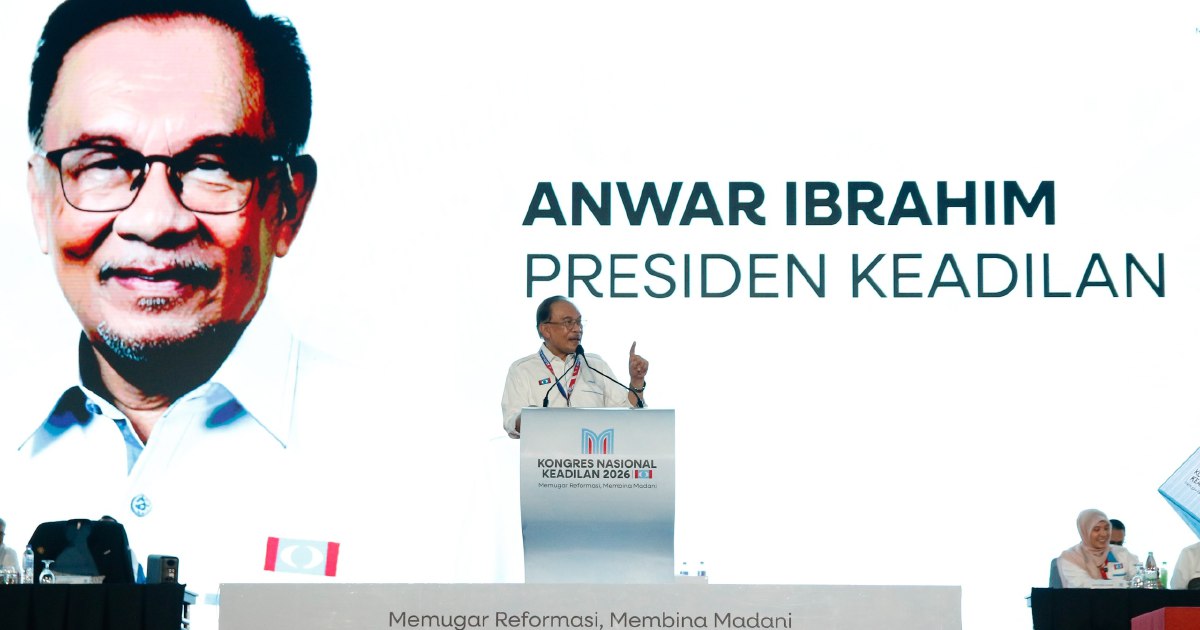
PKR will maintain its working relationship with Barisan Nasional and Umno at the federal level while honouring its obligations to Pakatan Harapan allies DAP and Amanah, party president Datuk Seri Anwar Ibrahim clarified in a statement made in Ayer Keroh today. The remarks underline PKR's complex position within Malaysia's fragmented political landscape, where the party has emerged as a critical bridge between competing blocs since the 2022 elections.
Anwar's confirmation comes amid persistent scrutiny from political observers and supporters who have questioned the coherence of maintaining simultaneous commitments to different coalitions. Since the formation of the unity government following the 2022 general election, PKR has navigated an intricate balancing act—collaborating with Umno-dominated Barisan Nasional in government while preserving formal alliance structures with DAP and Amanah, the other major components of Pakatan Harapan.
The party's dual-alignment strategy reflects deeper structural shifts in Malaysian politics following the political earthquake of 2022. The traditional binary opposition between Barisan Nasional and Pakatan Harapan has given way to more fluid arrangements, with PKR positioning itself as a stabilising force capable of building consensus across ideological divides. This approach has proven contentious within opposition circles, with critics arguing it represents political pragmatism bordering on opportunism.
For observers in Southeast Asia tracking Malaysian political developments, PKR's strategy carries implications for coalition stability and governance predictability. The arrangement has thus far held despite periodic tensions, suggesting that maintaining multiple partnership frameworks may be sustainable under current political conditions. The party's ability to juggle these relationships without triggering outright ruptures with either bloc has surprised some analysts who anticipated more rapid realignment.
Anwar's explicit reaffirmation serves multiple strategic purposes. It reassures DAP and Amanah that their partnership with PKR remains substantive rather than merely nominal, addressing concerns that federal-level collaboration with Umno might gradually erode commitment to Pakatan structures. Simultaneously, it signals to Barisan Nasional and Umno that PKR's participation in the unity government reflects genuine engagement rather than reluctant accommodation.
The timing of these remarks also matters within the context of ongoing governance challenges. Federal-level decision-making increasingly requires consensus-building across the three main partners—PKR, Barisan Nasional, and Pakatan Harapan components—particularly on legislative matters. Clear public statements about commitment levels help manage expectations and reduce ambiguity when contentious issues arise, whether involving economic policy, social legislation, or security matters.
Politically, PKR's position as coalition linchpin grants it substantial leverage in both government and parliamentary negotiations. The party's representatives occupy key ministerial positions, while parliamentary arithmetic increasingly depends on PKR votes for passing government legislation. This influence, however, comes with corresponding pressure to maintain equilibrium—losing either coalition's trust would significantly diminish PKR's bargaining power.
The statements also reflect PKR's calculated response to competing internal pressures. The party's membership includes ideological diversity, with some members more comfortable with Barisan Nasional collaboration while others retain strong Pakatan Harapan commitments. By publicly emphasising dual loyalty, Anwar attempts to accommodate these different factions and prevent internal fragmentation along coalition preference lines.
For Malaysian businesses and investors, PKR's stable positioning offers some reassurance regarding policy continuity and coalition durability. Coalition instability creates governance uncertainty that typically undermines business confidence and investment planning. By anchoring itself between competing blocs, PKR helps provide the stability necessary for medium-term policy implementation.
Regional implications also warrant consideration. Southeast Asian governments and investors tracking Malaysian developments view coalition stability as linked to effective governance and predictable decision-making on regional issues. PKR's role in maintaining federal-level coalition cohesion therefore carries indirect significance for the region's broader political-economic landscape.
Looking forward, the sustainability of this balancing act will depend on several factors. Electoral calculations will shift approaching the next general election, potentially pressuring PKR to emphasise one coalition over another. Additionally, major policy disputes—particularly those touching religious, ethnic, or economic distribution issues—might eventually force clearer coalition alignment choices.
Anwar's commitment to both coalitions ultimately reflects the reality that contemporary Malaysian politics cannot accommodate simple binary choices. The three-way split between ruling coalitions creates genuine requirements for constructive engagement across former opponent boundaries. Whether this arrangement represents a permanent shift toward more pluralistic coalition politics or merely a transitional phase remains to be seen, but for the present, PKR's dual-alignment strategy appears to be the operative reality of Malaysian governance.

