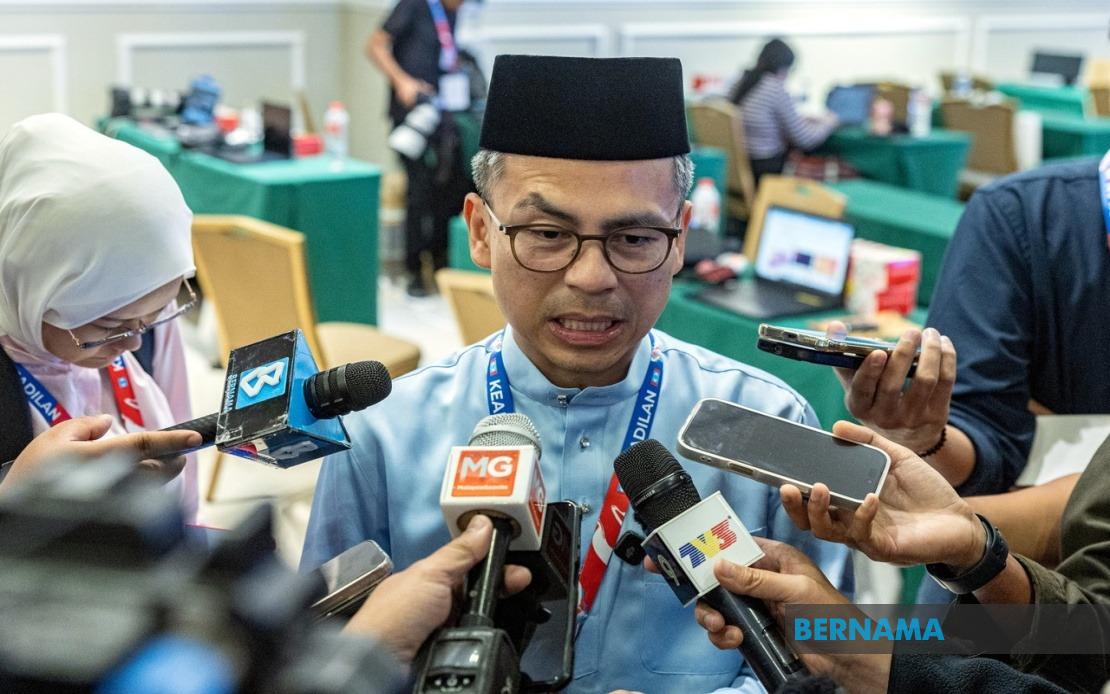
Parti Keadilan Rakyat has pledged to revamp its communication infrastructure following widespread feedback at its National Congress 2026, acknowledging that despite tangible government accomplishments, the party's messaging apparatus has failed to translate these achievements into narratives that resonate at the grassroots level. The strategic reckoning, articulated by PKR Information Chief and Communications Minister Datuk Seri Fahmi Fadzil at the gathering in Melaka, reflects growing internal recognition that the ruling coalition's communications footprint requires structural reinforcement to bridge the yawning gap between policy execution and household-level perception.
Fahmi's remarks, delivered after consultations with party delegates at the Melaka International Trade and Exhibition Centre during the ongoing congress, zeroed in on a persistent challenge plaguing Malaysia's ruling administration: the disconnect between macroeconomic progress and lived experience among ordinary citizens. Even as the government points to improvements in fiscal management and economic indicators, voters have struggled to perceive tangible benefits filtering down to their daily lives, a messaging failure that threatens to undermine political capital ahead of electoral cycles. The Communications Minister framed this not as a policy deficiency but as a communication one, suggesting the government's narrative machinery has simply failed to function with sufficient clarity or penetration.
The congress itself served as a sounding board for grassroots frustration with PKR's existing information dissemination channels. Multiple delegates raised concerns about the effectiveness of current mechanisms for amplifying government accomplishments and countering adverse narratives in the public domain. Rather than dismissing these critiques, party leadership has signalled receptiveness, with Fahmi indicating that recommendations emerging from the congress would feature prominently during the concluding session. This openness represents a departure from typical top-down party management and suggests PKR recognises that revitalising its communication strategy demands genuine consultation with branch-level operatives who interact directly with constituents.
Fahmi elaborated on the proposed structural changes, indicating that PKR intends to formalise communication channels that previously operated in ad hoc fashion. The existing infrastructure, he acknowledged, has proven insufficient to ensure that legislative developments, policy announcements, and government achievements circulate with sufficient urgency through party networks to reach decision-makers in the capital. By establishing more systematic protocols, PKR aims to create feedback loops wherein ground-level intelligence regarding public concerns can flow upward to federal policymakers, enabling faster responses and more targeted information campaigns. This bidirectional approach contrasts with the traditional broadcast model where government messages simply cascade downward without meaningful reciprocal engagement.
The broader context for this communications overhaul lies in the Pakatan Harapan coalition's ongoing struggle to maintain political momentum after years in government. The coalition's initial honeymoon period has long since evaporated, replaced by voter fatigue and heightened scrutiny of its economic record. While inflation, cost-of-living pressures, and wage stagnation have battered household finances, the government has attempted to frame its tenure through the lens of structural reform and long-term fiscal stabilisation. However, this technocratic framing has failed to gain purchase with voters grappling with immediate economic hardship. PKR's communication strategy review implicitly acknowledges that the government must either improve its messaging or risk further electoral erosion.
Fahmi's dual role as Communications Minister and party Information Chief positions him at the nexus of government and partisan messaging apparatus. His observations at the congress suggest he recognises the need for greater integration between official government communications and ruling-party narratives. The distinction between these two spheres has sometimes created confusion, with government achievements obscured by inadequate party-level amplification. A strengthened PKR communication apparatus could theoretically enhance the visibility of government successes while simultaneously shoring up the party's internal cohesion and messaging discipline.
The timing of this communications initiative carries political significance given Malaysia's electoral calendar. Constitutional term limits mean the federal government faces mandatory elections within the next two years, during which communication effectiveness will directly influence voting behaviour. Opposition coalitions are already mobilising their own messaging infrastructure, and PKR recognises that allowing them to control the narrative landscape would prove strategically catastrophic. By prioritising communication strategy now, the party is essentially undertaking pre-campaign preparation designed to ensure that government achievements receive sustained, coherent, and persuasive articulation throughout the electoral period.
The proposed changes also reflect recognition within PKR leadership that digital communication channels and social media have fundamentally altered political messaging dynamics. Traditional hierarchical communication structures, where party officials controlled information flow through party publications and formal channels, have become inadequate in an environment where citizens access news and political information through fragmented digital ecosystems. A modernised communication strategy would necessarily account for this fragmentation, leveraging multiple platforms and empowering local-level party activists to engage directly with constituents through digital means.
Implementing these changes will require substantial internal investment in training, technology infrastructure, and resource allocation. PKR's Central Leadership Council will need to translate its stated receptiveness to proposals into concrete budgetary commitments and organisational restructuring. This transformation process cannot be rushed; premature or poorly executed initiatives risk generating confusion rather than clarity. However, the explicit commitment articulated at the congress suggests party leadership recognises the stakes involved and is prepared to dedicate resources toward rebuilding the party's communication capacity.
The broader implications for Malaysian politics extend beyond PKR's organisational interests. As the dominant component within Pakatan Harapan, PKR's communication effectiveness materially influences the coalition's overall political viability. Should the party succeed in clarifying government messaging and improving public perception of the coalition's record, it could stabilise electoral support and influence the trajectory of Malaysia's political landscape. Conversely, failure to execute this strategic pivot would likely accelerate voter disaffection and strengthen opposition narratives. The congress decisions thus represent a potential inflection point in Malaysia's ongoing political evolution.

