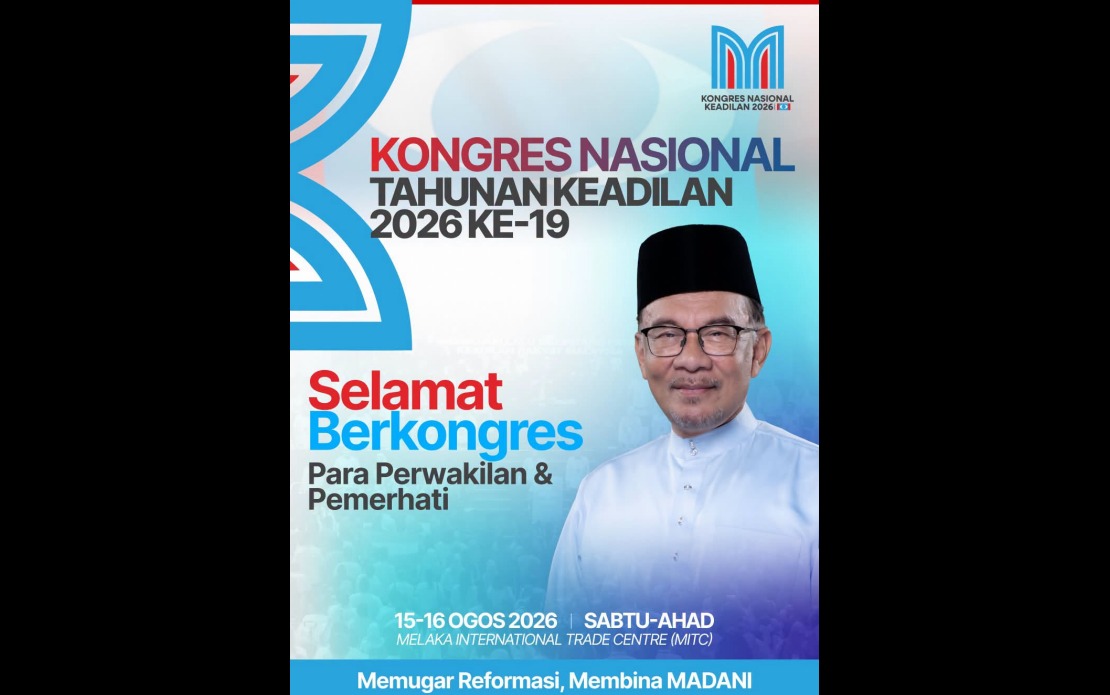
Parti Keadilan Rakyat must transcend its role as a mere electoral vehicle and instead operate as a genuine mass movement grounded in principles of integrity, social justice and unity, Prime Minister Datuk Seri Anwar Ibrahim has stated ahead of the party's major biennial gathering. The declaration, shared via Facebook as PKR prepares for its National Congress 2026, underscores the tension many larger political coalitions face between their foundational missions and the practical demands of campaigning and governance. Anwar's comments suggest he views the upcoming congress as a moment for PKR to reaffirm its original purpose and recalibrate its relationship with the Malaysian electorate.
The congress, beginning tomorrow at the Melaka International Trade Centre in Ayer Keroh, carries significant weight for a party that has undergone substantial transformation since its founding amid the Reformasi movement of the late 1990s. Spanning two days under the theme "Memugar Reformasi, Membina MADANI" (Revitalising Reformasi, Building MADANI), the gathering provides an opportunity for delegates to assess what the party has accomplished and plot a course through Malaysia's increasingly fragmented political landscape. Anwar's emphasis on introspection rather than triumphalism suggests PKR recognises the need to deepen its connections with the grassroots rather than rely solely on incumbency and institutional advantages.
PKR's trajectory has been unconventional among Malaysian political parties. From its emergence as a vehicle for democratic reform during the Anwar Ibrahim crisis of the 1990s, it has evolved into a component of the federal government, holding key ministerial portfolios and playing a stabilising role in the Pakatan Harapan coalition. This evolution has brought both opportunities and challenges—the party commands significant organisational resources and influence at the highest levels of government, yet must contend with rising expectations from supporters who joined during its opposition days when reformist zeal was at its peak. The congress therefore serves as both celebration of institutional progress and an accountability exercise.
The Prime Minister's insistence that electoral victory should not be PKR's primary motivation reflects broader concerns about political party health in Malaysia. When parties become primarily machinery for winning power, they risk losing the volunteer activism, policy innovation and moral authority that sustain movements over generations. PKR's founders understood that sustainable political change required more than winning elections—it required building a culture of accountability, fostering intellectual engagement with policy questions, and maintaining the trust of ordinary Malaysians who might otherwise view politics cynically. Anwar's message appears designed to remind party members, particularly younger delegates, why PKR was founded and what distinguishes it from purely transactional political operators.
The emphasis on upholding the people's trust holds particular resonance in the Malaysian context, where public confidence in institutions including political parties has eroded significantly over the past decade. Surveys consistently show declining trust in government and concerns about corruption, patron-client networks and the capture of state resources by political elites. For PKR, which emerged partly in reaction to these pathologies, maintaining credibility as a reform-minded organisation becomes essential for long-term viability. Parties that lose public trust struggle to recruit talented candidates, mobilise volunteers effectively and withstand periodic electoral setbacks. Anwar's intervention suggests he recognises that PKR's competitiveness depends less on tactical manoeuvring than on genuine differentiation from rival political coalitions.
The congress agenda also implicitly addresses tensions within the broader coalition that sustains Malaysia's current government. Pakatan Harapan comprises parties with distinct histories, constituencies and ideological orientations, and maintaining coalition cohesion requires periodic reaffirmations of shared purpose alongside management of differences. By positioning PKR as a movement rather than merely a coalition component, Anwar may be signalling that the party will maintain independent thinking and advocacy even while participating in government. This could prove important as Malaysia confronts economic challenges, unresolved questions about institutional reform, and the political dynamics surrounding eventual leadership succession.
Anwar's scheduled policy speech during tomorrow's opening session will command significant attention both within PKR and among rival political leaders monitoring the party's strategic direction. Such speeches typically serve multiple audiences simultaneously—party loyalists seeking reassurance and direction, potential supporters evaluating whether to align with the party, coalition partners assessing PKR's trajectory, and the broader media ecosystem interpreting signals about political intentions. The Prime Minister's advance framing emphasising introspection and strengthening commitment to Reformasi principles establishes the tone he intends for these remarks.
The concept of Reformasi itself requires unpacking for those who joined PKR after its early struggles. The movement emerged from specific historical circumstances—judicial interference, abuse of executive power, and perceived corruption—that crystallised around Anwar Ibrahim's dismissal and imprisonment in the late 1990s. Over subsequent decades, the Reformasi agenda broadened to encompass constitutional reform, institutional independence, transparency in governance, and more equitable distribution of resources. Revitalising this agenda in the contemporary context requires demonstrating concrete achievements while acknowledging what remains incomplete.
For Malaysian political observers and regional analysts, PKR's internal dynamics matter because the party's health directly affects the stability and trajectory of Malaysia's government. If PKR loses coherence, splits into factions or alienates significant portions of its support base, the broader coalition governing Malaysia could fracture, with potentially destabilising consequences. Conversely, if PKR successfully renews its foundational commitments while delivering effective governance, it could model how Southeast Asian political parties maintain legitimacy across generations. Anwar's emphasis on returning to fundamentals suggests he recognises these stakes and views the congress as an opportunity to address them directly through engagement with party activists rather than top-down directives.

