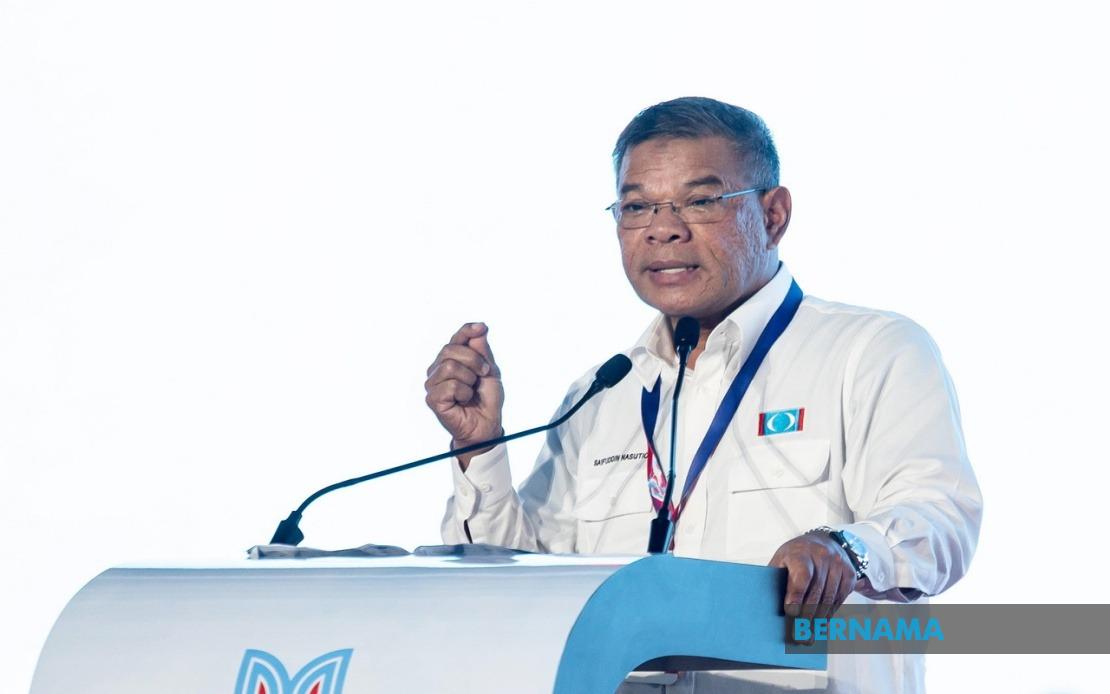
Pakistan's PKR party is signalling a decisive shift in political messaging, with party leadership rejecting what it frames as divisive identity-based politics in favour of economic performance metrics and shared national prosperity. The call came from PKR vice-president Datuk Seri Saifuddin Nasution Ismail, who is currently discharging the duties of deputy president, during his closing address at the 2026 PKR National Congress in Melaka on August 16. His remarks represent an attempt to reposition the MADANI Government's narrative ahead of the next election, particularly as Malaysia navigates persistent economic pressures and rising youth disengagement from politics.
Saifuddin Nasution characterised identity and racial politics as fundamentally unproductive, describing them as a "zero-sum game" in which all participants ultimately lose. The Home Minister argued that political competition framed around identity markers—whether ethnic, religious, or regional—yields no tangible benefits for the nation and instead diverts attention and resources away from the genuine challenges facing ordinary Malaysians. This positioning directly challenges the traditional political playbook in Malaysia, where appeals to communal interests and cultural identity have long served as central campaign strategies across the political spectrum.
The core of PKR's alternative proposal rests on three interconnected pillars that the party believes should govern MADANI Government policy and resource allocation. First, the party advocates for deliberate economic expansion designed to enlarge the overall "pie of prosperity," ensuring that the benefits of growth are distributed across all demographic segments rather than concentrated among any single group. This framing deliberately sidesteps zero-sum calculations about which communities receive what share, instead arguing that proportional gains for all groups become possible when the total economy expands sufficiently. The metaphor of expanding rather than dividing the economic pie reflects a conscious strategic choice to move debates away from redistribution towards growth.
The second plank involves a fundamental reorientation of assistance programmes from identity-based allocation towards needs-based distribution. Under this approach, government support—whether subsidies, welfare payments, educational grants, or development funds—would be determined by demonstrable economic need rather than ethnic background, religious affiliation, or geographic origin. This represents a significant departure from Malaysia's existing affirmative action framework, which has historically recognised bumiputera status as a primary eligibility criterion. The proposal acknowledges the reality that poverty, vulnerability, and educational disadvantage cut across all Malaysian communities, and that targeting assistance at those most in need, regardless of background, may yield both more efficient resource use and broader political legitimacy.
Good governance and anti-corruption efforts constitute the third strategic priority outlined by Saifuddin Nasution, reflecting growing recognition within PKR that misappropriation and institutional decay undermine public confidence in government capacity. He contended that corruption represents a direct extraction of national wealth that could otherwise fund development, welfare programmes, or infrastructure investment. For Malaysian voters evaluating government performance, visible progress on reducing corrupt practices and improving institutional transparency may carry considerable weight, particularly among younger and urban constituencies increasingly disenchanted with traditional patronage politics.
Central to the PKR vice-president's argument is the assertion that Malaysia's ethnic and religious diversity constitutes an unchangeable demographic reality that ought to be accepted rather than instrumentalised for political advantage. He explicitly acknowledged the legitimacy of Malay, Islamic, Chinese, Indian, Sabah, and Sarawak identities as authentic dimensions of Malaysian society. However, he drew a critical distinction between recognising these identities as sociological facts and weaponising them to generate fear, suspicion, or zero-sum competition between communities. This framing attempts to depoliticise identity itself while containing its political expression within bounds that do not promote interethnic antagonism.
Saifuddin Nasution further redirected attention towards what he characterised as genuine threats to all Malaysian communities: poverty, social dysfunction, and the scourge of drug abuse among younger generations. By reframing the primary challenge not as interethnic competition but as shared vulnerability to socioeconomic breakdown, he sought to reorient political discourse towards problems that ostensibly affect all groups and thus demand collaborative rather than adversarial solutions. This rhetorical move implicitly critiques opposition parties and other political actors who, in his view, exploit identity anxiety to mobilise voters rather than addressing concrete welfare concerns.
The timing and context of these remarks carry particular significance for Malaysian politics. PKR has sought to position itself as a reform-oriented party committed to institutional modernisation, and the move away from identity-based appeals aligns with that broader brand positioning. However, the proposal also reflects genuine tensions within PKR's own coalition, particularly regarding how to balance competing demands from different constituencies while maintaining the interethnic and interreligious character that the party has cultivated. By advocating for needs-based rather than identity-based assistance, PKR may be attempting to appeal to middle-class urban voters and younger Malaysians who express frustration with what they perceive as divisive politics, while simultaneously avoiding direct confrontation with bumiputera-based interests that remain politically salient.
The practical implementation of such a policy reorientation would, however, encounter substantial obstacles. Malaysia's constitutional framework, federal structure, and existing social contracts embed bumiputera rights and protections for Malay-Muslim interests across numerous domains, from education to business licensing to land ownership. Movements to substantially dilute these protections have historically triggered backlash from Malay-Muslim communities who view them as fundamental safeguards. PKR's rhetorical commitment to needs-based assistance thus faces a tension between aspirational messaging and the institutional and political constraints that govern actual policy reform in Malaysia.
Saifuddin Nasution emphasised that PKR members must intensify efforts to publicise the MADANI Government's achievements and direct particular attention towards younger voters, whose participation will prove decisive in the next electoral cycle. This emphasis on youth engagement reflects broader awareness that demographic and technological shifts have altered how political messages circulate and resonate. Younger Malaysians, increasingly educated and exposed to diverse information sources, may be more receptive to arguments emphasising economic competence and institutional integrity than to traditional appeals based on ethnic or religious identity, though this assumption remains contested empirically.
The PKR leadership's attempt to reframe Malaysian politics around performance metrics and shared prosperity, rather than identity-based competition, represents an important strategic signal about how at least one major coalition party envisions the nation's political future. Whether this repositioning will influence broader political discourse or merely represent aspirational rhetoric from a party facing electoral pressure remains an open question. The success of such messaging depends partly on whether the MADANI Government can demonstrate tangible economic improvements that benefit substantial portions of the population, and partly on whether other political actors accept or reject the implicit invitation to move away from identity-inflected campaigns.

