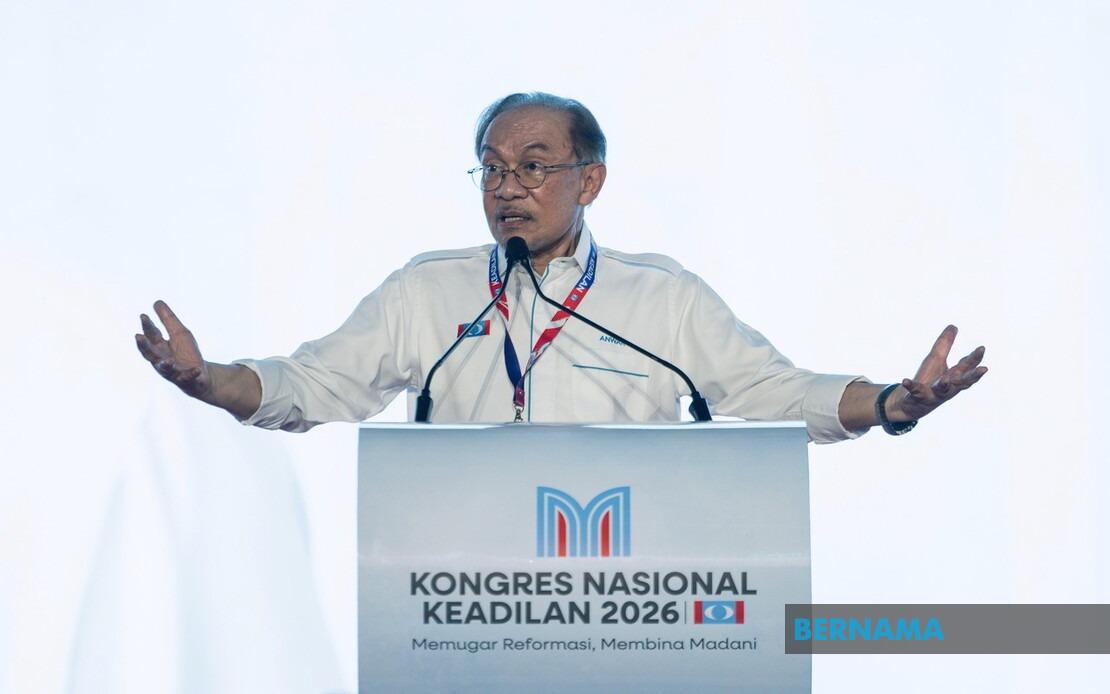
Prime Minister Datuk Seri Anwar Ibrahim has unveiled a substantial boost to constituency-level spending, committing an additional RM1 million to every parliamentary constituency across the country. The announcement, delivered during his closing remarks at the 2026 PKR National Congress in Melaka, signals the government's push to devolve financial decision-making away from central ministries and place resources directly into the hands of local representatives who can address immediate community concerns.
The fresh funding represents a significant shift in how the MADANI Government intends to tackle welfare provision and infrastructure gaps at the grassroots. By circumventing traditional administrative channels that often slow project approval, the allocation aims to enable parliamentary constituencies to respond swiftly to pressing local matters—from basic amenities and community infrastructure to emergency welfare interventions. Anwar, who doubles as Finance Minister, framed the move as part of his administration's broader philosophy of translating national economic gains into tangible improvements for ordinary Malaysians, particularly those in lower income brackets.
This additional injection of funds does not represent a reduction in existing allocations, Anwar stressed, but rather an expansion of the government's commitment to neighbourhood-level development. The timing of the announcement at a party congress underscores PKR's effort to consolidate support among party grassroots and demonstrate tangible benefits flowing to local communities, a particularly important message as the party seeks to maintain momentum ahead of future electoral contests. The symbolism carries weight in Malaysian politics, where proximity to government resources and ability to deliver visible projects remain crucial currency for elected representatives seeking re-election.
The new initiative sits alongside Malaysia's existing social protection architecture, which already encompasses the Sumbangan Tunai Rahmah (STR) and Sumbangan Asas Rahmah (SARA) programmes. These two schemes alone command a combined RM16 billion budget and have become cornerstones of the government's cost-of-living relief strategy. Rather than replacing these national programmes, the constituency-level allocation functions as a complementary layer, allowing local representatives to plug gaps and address context-specific challenges that broad-brush national schemes might not capture. The dual approach reflects growing recognition that effective poverty alleviation requires both nationwide social safety nets and hyperlocal responsiveness.
The Prime Minister highlighted that Malaysia's hardcore poverty rate has fallen to 0.09 per cent, a figure the government credits to its comprehensive welfare apparatus spanning multiple income groups. Whether targeting the B40 (lowest forty per cent) or M40 (middle forty per cent) households, the government has implemented school assistance programmes, Rahmah sales initiatives pegging food prices, and subsidised housing financing schemes. Anwar's argument is that these layers of intervention—national in scope, varied in design—demonstrate commitment to poverty reduction without cultural or community exclusion.
Yet the success of this additional RM1 million per constituency hinges substantially on implementation capacity and local leadership quality. Parliamentary constituencies vary dramatically in geographic size, population density, and administrative sophistication. Rural constituencies spread across vast territories may struggle to deploy funds effectively, while densely populated urban constituencies might find the allocation insufficient for identified needs. The government's effectiveness will depend on how it establishes clear guidelines for fund deployment, prevents misuse, and ensures transparency in allocation decisions.
Anwar's exhortation to party leaders and grassroots machinery to explain government programmes to constituents reflects an underlying concern that many Malaysians remain unaware of available assistance. Information asymmetry—where potential beneficiaries do not know they qualify for aid—undermines the impact of even well-funded schemes. This awareness-raising responsibility, placed squarely on PKR party structures, highlights the intertwining of political mobilisation and social service delivery in Malaysia's governance model. Party machinery becomes an extension of state communication infrastructure, blurring lines between political organisation and administrative function.
For Southeast Asian observers, the Malaysian government's emphasis on decentralisation and reducing bureaucratic friction offers interesting contrasts to governance models elsewhere in the region. Singapore's more centralised, technocratic approach differs markedly from Malaysia's attempt to balance national policy coherence with local responsiveness. Indonesia's experience with devolution following democratisation provides cautionary lessons about ensuring accountability in decentralised spending. The Malaysian model suggests an attempt at a middle path—maintaining central coordination while granting constituencies meaningful discretion.
The RM1 million per constituency initiative also reflects changing political expectations in Malaysia. Voters increasingly expect elected representatives to deliver concrete local improvements, not merely legislative participation. This funding mechanism empowers parliamentarians to function more like development executives, capable of greenlighting local projects without lengthy petition cycles to federal ministries. Whether this translates into genuine acceleration of project delivery or merely shifts the bottleneck to the local level remains to be seen.
For Malaysian businesses and contractors, the announcement potentially signals expanded opportunities in small-scale infrastructure and service provision at constituency level. Rather than large federal tender processes, opportunities may proliferate for local suppliers and service providers capable of responding to constituency-identified needs. This could foster more distributed economic activity and reduce regional imbalances, though ensuring equitable access to such opportunities across different constituencies presents administrative challenges.
The broader economic context matters here too. With Malaysia's economy facing structural challenges and fiscal constraints, the government must balance new spending commitments with debt sustainability concerns. The RM1 million per constituency represents roughly RM505 million nationally (assuming 505 parliamentary seats), a significant but manageable annual commitment that must be accommodated within the existing budget envelope rather than expanding the deficit.
As implementation proceeds, the true measure of this initiative's success will depend less on announcement rhetoric and more on whether the devolved funds reach intended beneficiaries, whether local leaders deploy resources efficiently, and whether visible improvements in community welfare emerge within reasonable timeframes. The political stakes are high, as successful delivery strengthens the government's credibility while failures invite criticism of patronage-driven misuse.

