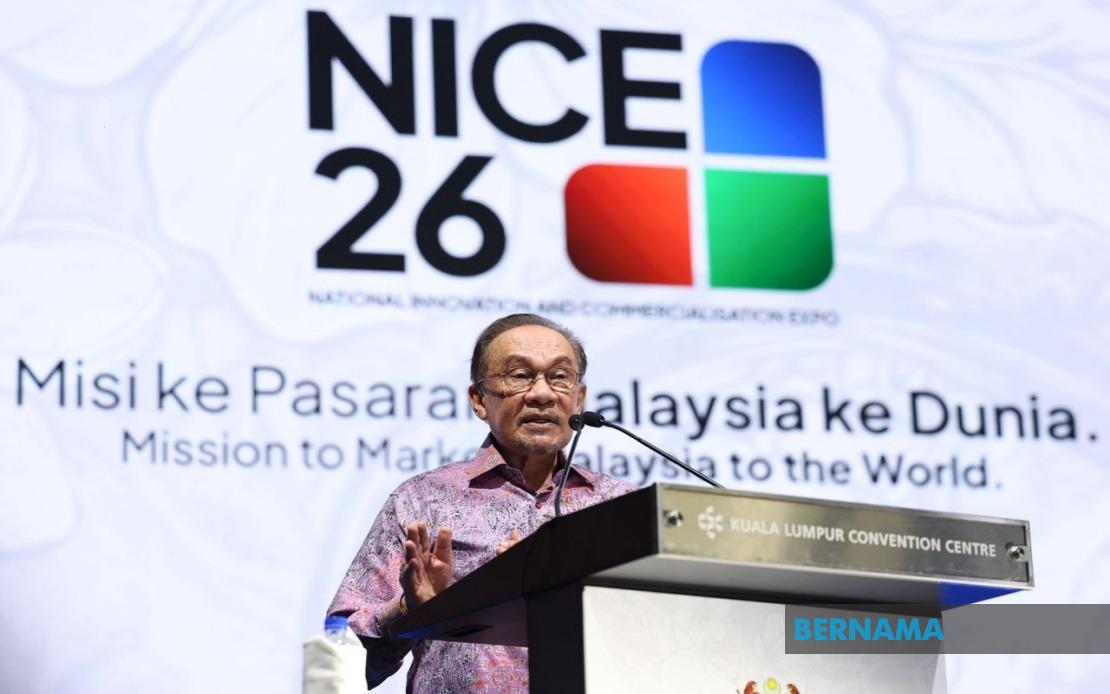
Prime Minister Datuk Seri Anwar Ibrahim has issued a stark warning that Malaysia cannot afford to maintain outdated administrative procedures if it hopes to compete in the rapidly evolving global innovation landscape. Speaking at the National Innovation and Commercialisation Expo (NICE) 2026 at the Kuala Lumpur Convention Centre, Anwar emphasised that the nation's future prosperity depends on streamlining government processes to match the pace demanded by modern technology sectors and commercial enterprises.
The Prime Minister framed the challenge in stark terms: the contemporary world of innovation operates at speeds incompatible with traditional approval mechanisms that have governed Malaysian bureaucracy for decades. Where flexibility and rapid decision-making are essential, lengthy hierarchical review processes create bottlenecks that disadvantage Malaysian researchers, entrepreneurs, and institutions competing against more agile international counterparts. This structural mismatch between bureaucratic timelines and market realities threatens to widen Malaysia's technological gap with leading innovation hubs across Asia and globally.
Anwar pointed to a concrete success story demonstrating what becomes possible when bureaucratic constraints are loosened. The establishment of Artificial Intelligence faculties at several Malaysian universities was accomplished in just three months—a remarkable compression compared to the conventional timeline, which typically stretched to twelve months or longer. This achievement serves as both proof of concept and an implicit critique of historical procedures. The three-month accomplishment required bypassing multiple layers of review: the traditional approach demanded sequential approvals through various senate committees and council meetings, each adding weeks or months to the overall timeline.
The acceleration of AI faculty development illustrates a broader principle that Anwar believes must now guide government thinking. Speed and efficiency are not luxuries or exceptions in the post-pandemic world; they are operational necessities. Markets evolve, technological capabilities advance, and competitive advantages shift with unprecedented velocity. Malaysian institutions cannot wait twelve months to establish faculties when the field itself may have transformed fundamentally during that waiting period. Prospective students may enrol elsewhere; faculty expertise may be recruited by foreign universities; corporate partnerships may materialise with competitors offering faster pathways to commercialisation.
Calling directly on colleagues within the Ministry of Science, Technology and Innovation (MOSTI) and related government departments, Anwar urged institutional acceptance of a fundamental shift in how the government must operate. This represents more than incremental efficiency gains; it requires conceptual reorientation about the purpose and function of bureaucratic review processes. Traditional safeguards and approval mechanisms often assume stability, predictability, and gradual change. Innovation ecosystems operate on opposite principles: disruption, uncertainty, and acceleration characterise healthy technology sectors.
The Prime Minister's remarks carry implications extending far beyond individual government agencies. Malaysia's competitiveness increasingly depends on its capacity to incubate talent, support research commercialisation, and attract international investment in technology sectors. When government processes move at conventional speeds while global competitors operate in accelerated timeframes, the nation effectively handicaps its own institutions. Researchers grow frustrated with delays and seek opportunities abroad; startups relocate to jurisdictions offering faster regulatory pathways; multinational corporations concentrate innovation activities in countries with responsive government environments.
Anwar's intervention signals recognition that structural barriers within government itself represent genuine impediments to national innovation objectives. While policy statements and funding announcements grab headlines, the actual day-to-day friction created by administrative procedures often determines whether ambitious goals translate into measurable outcomes. The three-month AI faculty achievement demonstrates that different results become possible when bureaucratic friction is consciously reduced. This success story provides cover for advocating broader institutional change without appearing radical or reckless about governance standards.
The context of NICE 2026 itself underscores the urgency of Anwar's message. National innovation expos serve as showcases for emerging technologies, entrepreneurial ventures, and research breakthroughs. They function as stages where Malaysia presents its innovation credentials to potential investors, international partners, and prospective talent. Yet these showcases carry limited impact if the institutions behind them operate through creaking bureaucratic machinery. International observers comparing Malaysia's innovation ecosystem with competitors in Singapore, South Korea, or India will inevitably note not just research quality but also systemic efficiency.
For Malaysian universities and research institutions, Anwar's remarks provide political cover for pursuing more entrepreneurial governance models. Faculties and departments can cite the Prime Minister's explicit endorsement when seeking to compress approval timelines and reduce administrative friction in their own operations. This top-level support for institutional flexibility creates space for experimentation with faster decision-making structures, potentially benefiting not just technology sectors but other disciplines as well.
The broader challenge remains implementation. Calling for bureaucratic modernisation is politically straightforward; actually transforming entrenched administrative cultures proves considerably more difficult. Government officials accustomed to risk-averse procedures may resist acceleration as reckless. Budget allocation processes, accountability mechanisms, and audit requirements often encode the very slowness Anwar critiques. Genuine transformation would require aligning not just ministerial directives but also financial systems, human resources practices, and performance evaluation metrics with innovation timelines.
Yet Anwar's explicit framing of bureaucratic conservatism as a competitive liability rather than a virtue represents a significant rhetorical and conceptual shift. By elevating this issue to the Prime Minister's office and articulating it as a matter of national economic survival, the government acknowledges that administrative modernisation ranks alongside funding, infrastructure, and talent recruitment as critical enablers of innovation capacity. Whether this recognition translates into sustained institutional change will determine whether Malaysia's innovation ambitions remain aspirational or become embedded in operational reality.

