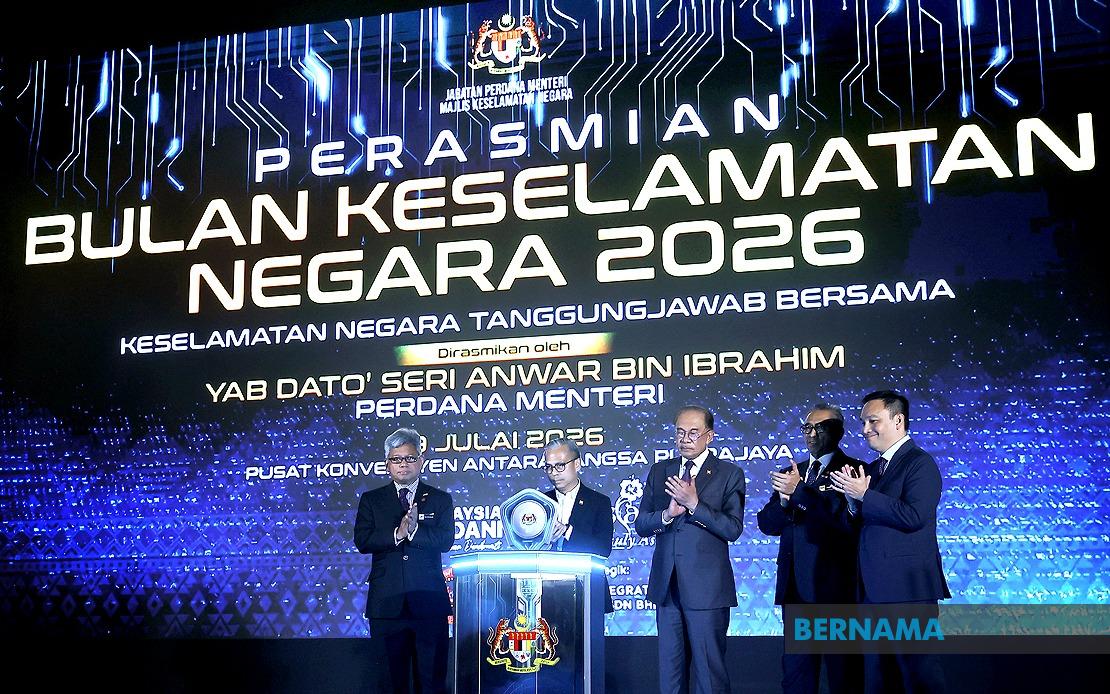
Prime Minister Datuk Seri Anwar Ibrahim has cautioned against the persistent use of identity-based and divisive rhetoric in Malaysian political discourse, arguing that such contentious narratives threaten to distract the nation from more pressing security imperatives. Speaking during the official launch of National Security Month 2026 in Putrajaya, Anwar emphasised that preoccupation with long-standing political grievances rooted in state, racial and religious lines leaves the country vulnerable to sophisticated contemporary dangers that demand urgent attention and coordinated action.
The Prime Minister's remarks, delivered alongside Communications Minister Datuk Fahmi Fadzil, Chief Secretary to the Government Tan Sri Shamsul Azri Abu Bakar and National Security director-general Datuk Raja Nurshirwan Zainal Abidin, reflect growing frustration within government circles about the persistence of sectarian and identity-focused debates in parliamentary proceedings. Anwar noted that colleagues continue to rehash conventional political disputes even as the country grapples with multifaceted security challenges that transcend traditional factional boundaries. This disconnect between legislative focus and actual threat landscapes, he suggested, represents a fundamental misalignment of priorities that could jeopardise national cohesion.
The security environment facing Malaysia has undergone dramatic transformation in recent years, evolving well beyond the conventional threats that historically dominated policy discussions. Anwar identified technological disruption and digital vulnerabilities as particularly acute challenges demanding sophisticated governmental responses. Cyber-attacks, information warfare, artificial intelligence misuse and data breaches now constitute existential risks to state infrastructure, economic systems and social stability. Yet these emergent dangers remain insufficiently integrated into mainstream political discourse, overshadowed instead by recycled arguments about communal identities and regional grievances.
The Prime Minister's intervention signals concern that Malaysia's political culture remains trapped in historical patterns of contestation that, while emotionally resonant for certain constituencies, do little to address the real vulnerabilities threatening national security. The proliferation of online disinformation, coordination across digital platforms and the weaponisation of technology by state and non-state actors demand leadership responses that transcend traditional party lines and communal boundaries. Anwar's emphasis on this disconnect suggests that he views the nation's security posture as compromised by a political system unable to marshal unified responses to these novel threats.
Central to Anwar's message is an appeal for governmental leadership at all levels to adopt what he characterised as a more proactive rather than reactive stance toward emerging security challenges. Rather than waiting for crises to materialise before developing responses, officials across government departments, agencies and ministries must anticipate developments and position institutions to respond with agility and foresight. This requires rapid institutional learning, continuous technology assessment and the cultivation of expertise in domains where Malaysian government capacity remains underdeveloped. Bureaucratic inertia and conventional operational frameworks, Anwar implied, are fundamentally inadequate to the task.
The invocation of National Security Month 2026 as a platform for these remarks underscores the government's intention to reframe public conversation around security away from identity politics toward technocratic and systems-based approaches. By convening senior ministers and security officials, Anwar signalled that security concerns occupy the highest levels of government attention and demand comprehensive institutional response rather than compartmentalised handling. The event itself becomes a statement about priorities and values—a reassertion that communal harmony requires not endless rehearsal of historical divisions but rather collective focus on threats that imperil all Malaysians regardless of ethnic or religious background.
Anwar's warnings carry particular resonance given Southeast Asia's vulnerability to transnational security challenges that recognise no state boundaries. Cybercriminal networks, organised trafficking rings and terrorist organisations exploit digital interconnectedness to operate across the region, targeting multiple jurisdictions simultaneously. Malaysia's open economy and position as a regional financial hub amplify these exposures. Divisive domestic politics that prevents coherent national responses to such threats effectively transfers advantage to hostile actors operating beyond conventional political constraints. Security, in this framing, becomes a precondition for rather than consequence of political unity.
The imperative Anwar articulated also reflects Malaysia's experience with how sectarian narratives and identity-based mobilisation can be weaponised to destabilise societies and erode state capacity. The government has observed how extremist movements exploit communal grievances and historical narratives to recruit adherents and legitimise violence. Conversely, societies that successfully transcend identity-based politics demonstrate greater resilience against such infiltration and radicalisation. National harmony thus emerges not as an abstract political goal but as a concrete security requirement that enables effective governance responses to complex threats.
Moving forward, the government's challenge involves translating Anwar's rhetorical emphasis into institutional mechanisms that genuinely privilege security-focused responses over identity-based contestation. This demands reform of parliamentary procedures to allow greater focus on security briefings and threat assessments, expansion of bureaucratic expertise in emerging technological domains, and cultivation of cross-party consensus on fundamental security matters. Whether Malaysia's fractious political culture, with its deep roots in identity-based competition, can sustain such reorientation remains an open question. What is clear is that the Prime Minister has made clear his assessment that the cost of failure—in terms of national security and social stability—has become prohibitively high.

