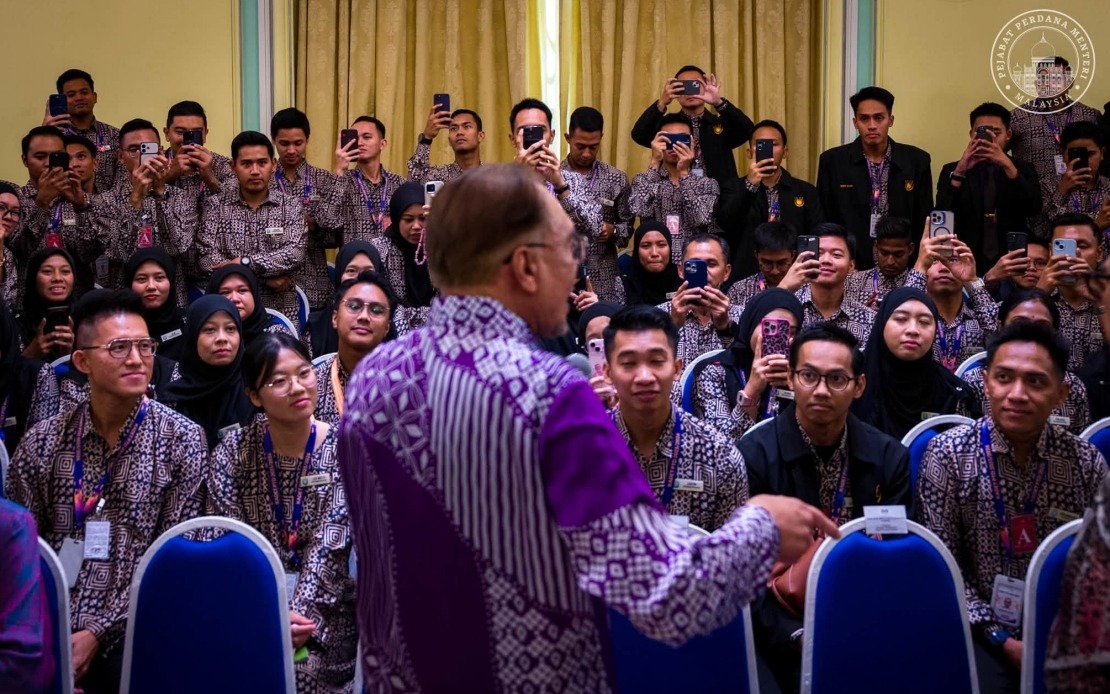
Prime Minister Datuk Seri Anwar Ibrahim has stressed that the nation's trajectory hinges upon a public service equipped not merely with competence but with an unshakeable ethical foundation. Speaking to a cohort of Administrative and Diplomatic Service (PTD) officer cadets pursuing the Postgraduate Diploma in Public Management at his Putrajaya office on July 16, Anwar underscored a message central to his administration's vision: that governance excellence emerges from the intersection of adaptive thinking and principled leadership.
The emphasis placed on change represents a significant statement from Malaysia's chief executive. Rather than treating institutional reform as optional or peripheral, Anwar framed it as integral to public service competence. His remarks to the PTD cadets—among the nation's future administrative elite—signal that the government expects its bureaucratic machinery to remain responsive and innovative rather than calcified by routine. This injunction comes against a backdrop of persistent calls within Malaysian policy circles for modernisation of government operations, digitalisation of services, and streamlining of procedures that frequently frustrate citizens and businesses alike.
Yet Anwar's formulation deliberately pairs transformative capacity with ethical guardrails. Integrity, he suggested, forms the indispensable counterweight to reform enthusiasm. Without it, change becomes merely expedient shuffling—potentially serving factional interests rather than the public good. This dual imperative reflects lessons from bureaucratic reform efforts globally, where unchecked organisational restructuring divorced from ethical moorings has sometimes exacerbated corruption or widened inequities. For Malaysia, where public trust in institutions has weathered numerous challenges, the articulation of integrity as non-negotiable appears designed to reassure citizens that reform will strengthen rather than compromise accountability.
The prime minister's invocation of efficiency alongside integrity and change signals recognition that public service cannot be purely principled in the abstract. Citizens and businesses interact with government through specific services—permit processing, tax administration, social support delivery. These encounters demand not just honesty but responsiveness and speed. Malaysian civil servants operating under cumbersome legacy systems or unclear procedures often struggle to serve effectively despite best intentions. By elevating efficiency as an explicit expectation, Anwar positioned streamlining institutional processes as compatible with ethical practice, not antagonistic to it.
Addressing PTD cadets specifically carries symbolic weight. The Administrative and Diplomatic Service represents the apex of Malaysia's career civil service hierarchy. Officers from this cohort populate permanent secretary positions, head major policy divisions, and steer long-term institutional strategy. By directly engaging this leadership pipeline, Anwar sought to ensure that his expectations cascade throughout the bureaucracy. The venue—his own office in the federal administrative seat—underscored the message's seriousness and personalised the appeal from Malaysia's highest political authority.
The postgraduate diploma programme itself reflects evolving expectations of public management. Structured training in contemporary management approaches, policy analysis, and governance frameworks marks a shift from traditional civil service recruitment models. That Anwar chose this cohort to emphasise his integrated vision of change, integrity, and people-centred service suggests he views the formal education and socialisation of civil servants as crucial to reshaping institutional culture. Public management education can either reinforce existing hierarchical patterns or introduce evidence-based practices, stakeholder engagement methodologies, and performance measurement frameworks that encourage officials to question inherited assumptions.
The broader context matters for Malaysian readers. The nation has experienced multiple cycles of governance reform promise followed by incomplete implementation. Anwar's previous roles—including his tenure as Finance Minister—have intersected with efforts to strengthen public financial management and combat institutional malfeasance. His current positioning thus carries particular expectations. Civil servants encountering his message will likely interpret it through the lens of his administration's stated anti-corruption agenda and its pledges to restore institutional credibility eroded by earlier scandals. The call for change might therefore resonate as a commitment to root out entrenched practices that shield wrongdoing or perpetuate inefficiency.
For Southeast Asia more broadly, Anwar's framing offers interesting contrast to reform models elsewhere in the region. Some governments pursue modernisation through heavy-handed hierarchical imposition and rapid, destabilising restructuring. Others defend existing systems as culturally appropriate while resisting efficiency improvements. Anwar's formulation—change grounded in integrity and popular interest—attempts a middle path that respects institutional stability while enabling genuine transformation. Whether Malaysia's civil service proves capable of sustaining this balance while navigating political pressures and resource constraints remains an open question.
The emphasis on placing national and popular interests above all else carries particular significance given Malaysia's plural society. Civil servants implement policies affecting diverse communities with different priorities and vulnerabilities. An administrative apparatus animated by genuine commitment to collective wellbeing rather than parochial faction-building becomes essential to maintaining social cohesion. Anwar's articulation thus reaches beyond managerial concerns toward fundamental questions of state legitimacy and social contract. Public servants who internalise this message might approach controversial decisions with greater consciousness of their broader impact.
Implementing such principles requires supporting infrastructure. Institutional reforms, training programmes, performance evaluation systems, and transparent promotion criteria must all align with the integrity and change mandate. Without such reinforcement, exhortations from senior leadership risk becoming ceremonial without reshaping actual practice. The quality of Anwar's engagement with the PTD cohort may therefore prove less consequential than whether his administration systematically embeds these expectations throughout recruitment, development, and advancement of civil servants. Malaysian observers might reasonably ask what concrete mechanisms will ensure that the prime minister's ideals translate into transformed governance on the ground.

