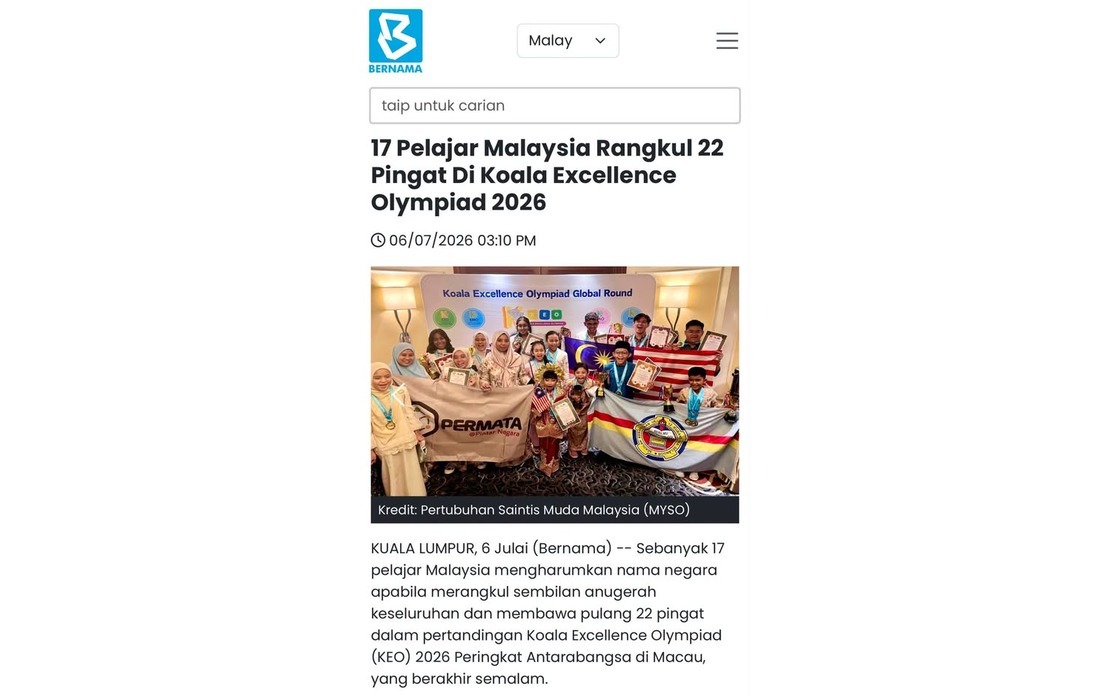
Prime Minister Datuk Seri Anwar Ibrahim has extended his commendations to a delegation of 17 Malaysian students following their impressive medal haul at the 2016 Koala Excellence Olympiad (KEO) Global Finals held in Macau. The competition, which concluded recently, saw the Malaysian contingent secure a combined tally of nine overall awards alongside 22 individual medals, marking a significant achievement for the nation's young scholars in international academic competition.
In remarks shared across social media platform X, Anwar acknowledged the dedication and capabilities demonstrated by the young Malaysians, urging them to maintain their trajectory toward academic excellence. His message reflected broader governmental support for youth participation in international scholastic competitions, recognising such endeavours as instrumental in building intellectual capital and enhancing Malaysia's standing in global educational forums.
According to Aidah Misran, who coordinated Malaysia's participation and headed the delegation dispatched to Macau, the medal breakdown comprised five gold awards, six silver medals, and eleven bronze medals. This distribution underscores a well-rounded performance across the competition's various categories, demonstrating that Malaysian students possessed competitive strength not concentrated in a single discipline but spread meaningfully across the board.
The Koala Excellence Olympiad represents a multi-disciplinary international platform designed to evaluate student proficiency across English, Mathematics, Science, and Arts. Developed by a consortium of Australian educational specialists and university graduates, the competition framework integrates rigorous academic assessment with an international dimension that exposes participating students to peers from different cultural and educational backgrounds. This exposure carries particular significance for Southeast Asian participants, as it provides practical experience in cross-border intellectual collaboration.
Malaysia's involvement in KEO has been facilitated through the Malaysia Young Scientists Organisation (MYSO), which serves as the national coordinating body. MYSO's role extends beyond mere logistical support; the organisation actively scouts and prepares talented students from across the country to represent Malaysia at such global forums. This institutional infrastructure has proven effective in identifying and nurturing young scholars capable of performing at international standards.
The competition framework encompasses four distinct knowledge domains, each reflecting core competencies considered essential in contemporary global education. By spanning English language proficiency, mathematical reasoning, scientific understanding, and creative arts, KEO acknowledges that intellectual development requires breadth alongside depth. Malaysian students' success across these varied disciplines indicates that the nation's education system is producing graduates with interdisciplinary capabilities—a quality increasingly valued in knowledge-driven economies.
Participation in international olympiads carries implications extending well beyond medal counts and accolades. For the Malaysian students involved, the experience provides invaluable exposure to rigorous comparative evaluation against international peer groups, building confidence and perspective that often proves transformative for academic trajectories. Such competitions frequently serve as launchpads for student advancement into elite tertiary institutions and later professional distinction across various sectors.
The performance at KEO 2026 also reflects broader trends within Malaysia's educational landscape, where increasing emphasis on science, technology, and skills-based learning has been complemented by continued investment in humanities and languages. The balance evident in Malaysia's medal distribution suggests that national education policies are yielding results across multiple fronts, though challenges undoubtedly remain in scaling such excellence beyond elite student cohorts.
For Southeast Asian regional context, Malaysia's showing at such competitions contributes to the region's collective intellectual standing. Educational excellence and participation in global academic forums enhance not only national prestige but also support the region's positioning in an increasingly competitive global knowledge economy. As nations across Southeast Asia prioritise skills development and human capital investment, achievements like those of these 17 Malaysian students provide encouraging evidence that regional students can compete effectively at world level.
The Prime Minister's public acknowledgment of these achievements signals governmental recognition that such success requires continued support infrastructure, including funding for preparation programs, identification of talented students, and coordination with international bodies. Sustaining Malaysia's competitive edge in international academic competitions will require maintaining or enhancing such support systems, even as educational budgets face competing demands.
Looking forward, the experience gained by this cohort of Malaysian students positions many for deeper engagement with international academic networks. Some may pursue advanced studies abroad, others may become mentors to younger Malaysian students aspiring toward similar achievements. The multiplier effect of such exposure throughout Malaysia's educational system remains significant, particularly in encouraging younger students from diverse backgrounds to view international academic competition as an accessible and worthwhile aspiration.

