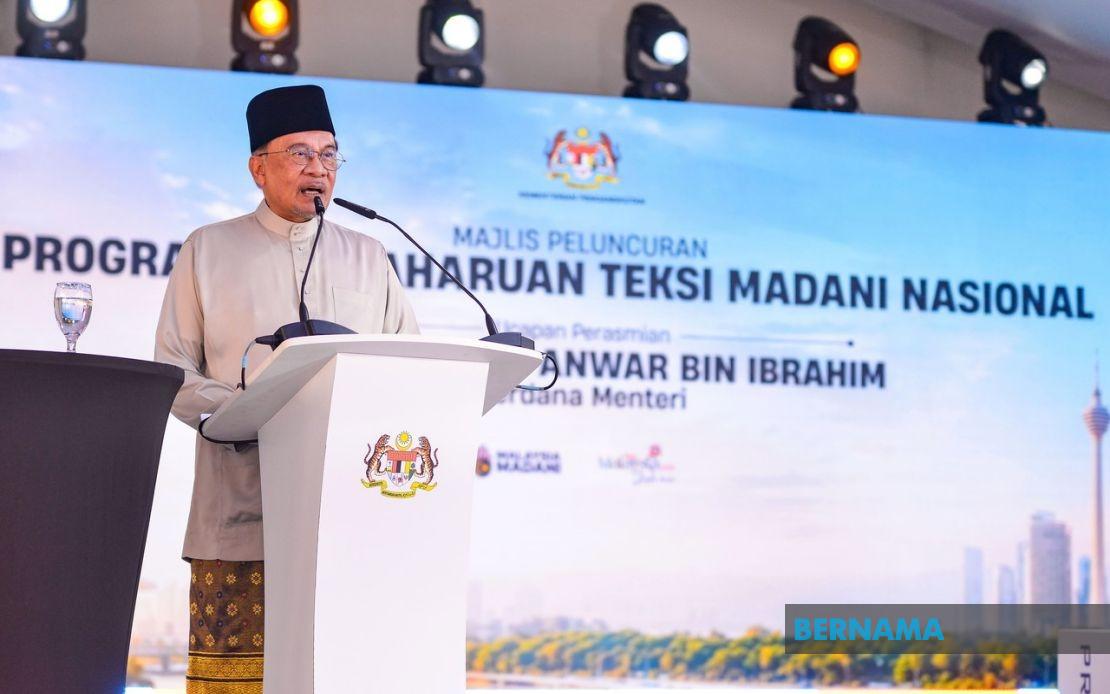
Malaysia's push to modernise its taxi fleet received a significant financial boost yesterday when Prime Minister Datuk Seri Anwar Ibrahim announced an extra RM10 million injection into the Vehicle Replacement Matching Grant Programme. The allocation doubles the government's initial commitment to taxi industry reform, signalling intensified efforts to address the long-standing issue of ageing vehicles operating across the country's transportation network. The announcement came during the formal launch of the National MADANI Taxi Reform Programme at Dataran Merdeka in Kuala Lumpur, attended by Transport Minister Anthony Loke and Chief Secretary to the Government Tan Sri Shamsul Azri Abu Bakar.
Anwar, who holds the dual portfolio of Prime Minister and Finance Minister, described the decision to accelerate funding as a direct response to overwhelmingly positive reception of the original RM10 million provision outlined in Budget 2026. The brisk uptake among taxi operators for the initial tranche demonstrated genuine appetite within the industry to transition away from vehicles that have become increasingly costly to maintain and operate efficiently. Rather than allowing momentum to stall, the government moved decisively to capitalise on this enthusiasm by immediately expanding financial resources available to drivers seeking to replace their vehicles through formal government-backed channels.
The timing of this expansion reflects broader recognition within Malaysia's policy apparatus that the taxi sector, long marginalised in infrastructure and modernisation discussions, warrants strategic investment commensurate with its role as a backbone of public transportation in urban and suburban areas. Approximately 60,000 taxis operate nationwide, serving millions of daily commuters and representing a critical component of the broader mobility ecosystem. Many vehicles in operation have surpassed their economically viable lifespan, creating operational inefficiencies and potentially compromising passenger safety and driver earnings. By channelling additional resources through the matching grant mechanism, the government attempts to align commercial incentives with modernisation objectives.
A particularly significant development accompanying the funding announcement involves a tripartite agreement among the government, national automotive manufacturer Proton, and the Transport Ministry to establish a dedicated financing programme specifically designed around the Proton S70 model. This partnership represents a strategic convergence of industrial and transportation policy, leveraging Malaysia's domestic automotive capability to address sectoral challenges while simultaneously supporting a homegrown manufacturer. The S70, launched in recent years with competitive specifications and pricing, positions itself as an accessible option for individual drivers seeking to upgrade from ageing vehicles, provided financing terms remain reasonably affordable.
The financing scheme development addresses one of the principal barriers preventing wider vehicle replacement among taxi drivers. Many operators, particularly those operating independently rather than within organised fleet arrangements, struggle to access conventional bank financing at favourable terms due to income volatility, informal record-keeping, and perceived lending risks associated with the sector. By designing a bespoke financing mechanism through government coordination, authorities aim to remove friction in the purchase process and make the transition to newer, more efficient vehicles economically viable for broader segments of the driving population. This approach acknowledges that simple subsidy provisions, while helpful, require complementary mechanisms addressing the full ecosystem of constraints facing potential adopters.
The National MADANI Taxi Reform Programme represents a comprehensive policy initiative extending beyond vehicle replacement alone. The broader framework encompasses service quality improvements, fare regulation discussions, driver welfare considerations, and integration of taxi services with emerging mobility solutions across Malaysian cities. The MADANI acronym, signifying the government's broader development philosophy centred on inclusive and sustainable growth, underscores the administration's positioning of taxi modernisation as integral to its overarching governance agenda. By anchoring sectoral reforms within this larger framework, policymakers signal commitment to addressing structural challenges rather than implementing temporary palliatives.
Minister in the Prime Minister's Department (Federal Territories) Hannah Yeoh's presence at the launch highlights the government's recognition that taxi reform carries implications extending across multiple policy domains and administrative jurisdictions. Federal Territories, encompassing Kuala Lumpur, Labuan, and Putrajaya, accommodate substantial concentrations of taxi operations and represent key testing grounds for pilot initiatives that may subsequently roll out nationwide. Her participation suggests coordination mechanisms are functioning across government silos, a prerequisite for coherent policy implementation in areas where transportation, finance, and regional development considerations intersect.
For Malaysian taxi drivers, the expanded allocation and newly unveiled financing partnership offer tangible pathways toward vehicle modernisation that previously remained difficult to navigate. Drivers operating older vehicles face escalating repair costs, fuel inefficiencies, and potential difficulties meeting emerging environmental standards that several state and federal authorities have begun contemplating. The combination of matching grants and preferential financing through Proton effectively reduces the net cost of vehicle acquisition, potentially shortening payback periods and improving financial viability of replacement decisions. Industry observers note that psychological barriers—anxiety about debt, unfamiliarity with formal financing processes, and risk aversion common among small operators—may prove as significant as financial obstacles, suggesting the government must complement funding mechanisms with outreach, education, and institutional support services.
Regionally, Malaysia's commitment to taxi fleet modernisation reflects broader Southeast Asian trends toward upgrading urban transportation infrastructure and addressing mobility challenges in rapidly urbanising societies. Countries including Thailand, Indonesia, and the Philippines grapple with similar issues surrounding ageing public transport fleets and informal sector dynamics. Malaysia's approach—combining direct financial support, partnerships with domestic manufacturers, and integration within comprehensive reform frameworks—may offer instructive precedents for neighbouring governments considering parallel initiatives. The model demonstrates how state resources, private sector capability, and sectoral organisations can be mobilised around shared modernisation objectives.
The RM10 million supplementary allocation, while substantial, remains modest relative to the full modernisation challenge across Malaysia's 60,000-strong taxi fleet. Assuming average replacement costs of RM100,000 to RM150,000 per vehicle, the government's total commitment of RM20 million accommodates replacement of merely 133 to 200 vehicles—a fraction of total operational stock. Consequently, the funding should be understood as catalytic rather than comprehensive, designed to demonstrate programme viability, establish implementation processes, and generate momentum that attracts additional financing from banks, leasing companies, and industry stakeholders. Success will ultimately depend on whether this initial commitment successfully unlocks broader private sector participation and voluntary industry participation in structured modernisation pathways.
As taxi drivers navigate the application and financing processes in coming months, several implementation challenges warrant close monitoring. Ensuring transparent, corruption-resistant allocation of matching grant funds remains imperative, particularly given historical difficulties in distributing subsidies equitably across informal sectors characterised by limited formal registration and documentation. The government must also manage expectations surrounding vehicle delivery timelines, as Proton's production capacity may face constraints if demand significantly exceeds anticipated levels. Additionally, policymakers should anticipate resistance from certain segments operating ageing vehicles, whether due to financial constraints, attachment to existing vehicles, or informal arrangements that formal programmes may disrupt. Addressing these implementation complexities will ultimately determine whether yesterday's announcement catalyses genuine sectoral transformation or represents another policy initiative that falters during execution.

