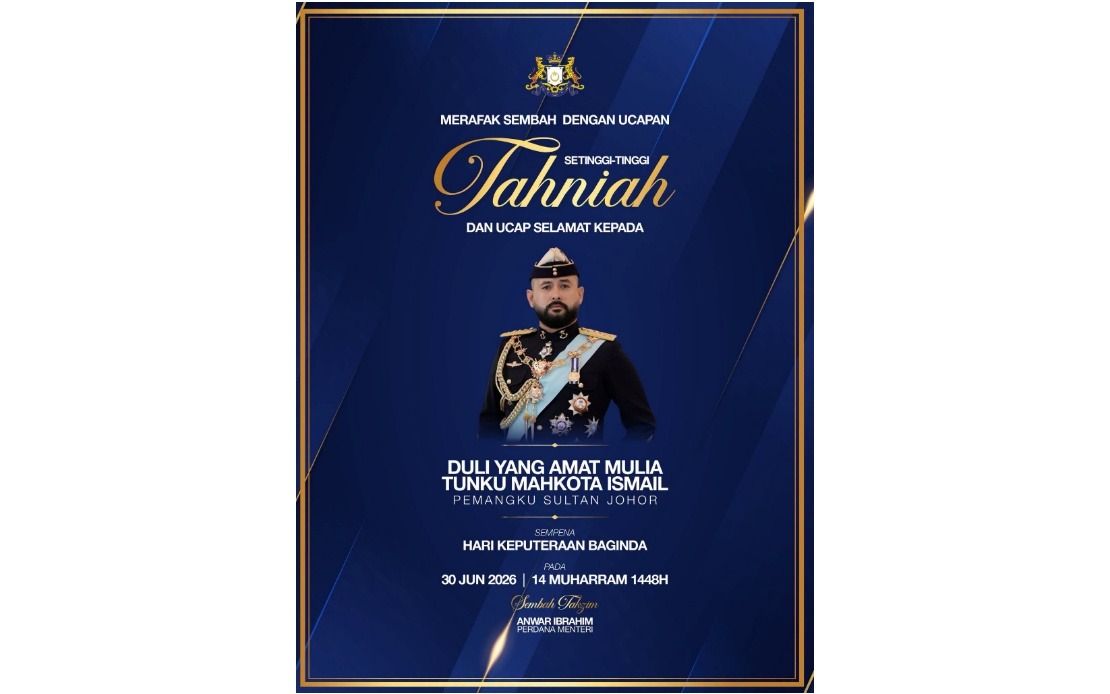
Prime Minister Datuk Seri Anwar Ibrahim and Deputy Prime Minister Datuk Seri Dr Ahmad Zahid Hamidi have both marked the birthday of Tunku Mahkota Ismail, the Regent of Johor, with public expressions of goodwill shared across social media platforms on June 30. The simultaneous gestures from the nation's top two leaders underscore the formal protocols and courtesies that characterise Malaysia's federal relationship with its constituent states, particularly those with hereditary rulers.
Anwar's acknowledgement, posted on Facebook, extended congratulations alongside prayers for the Johor Regent's continued good health and well-being. The Prime Minister's message, reflecting the customary tone adopted during royal celebrations, invoked blessings upon the royal household while emphasising the spiritual dimensions of such observances. These public acknowledgements serve as visible affirmations of the federal government's respect for Johor's institution of monarchy and its constitutional role within Malaysia's unique system of governance.
Dr Ahmad Zahid Hamidi similarly utilised his social media presence to convey his sentiments, structuring his message around a formal prayer for divine blessings upon the Regent. His statement specifically referenced the Regent's responsibility in overseeing Johor Darul Ta'zim and the Johor people, framing the birthday greeting within the broader context of the state's leadership and governance. The invocation of wisdom in the context of reigning over Johor reflects the ceremonial importance attached to the state's monarchy and its custodial role in regional affairs.
These birthday greetings represent more than mere ceremonial formalities. In Malaysia's constitutional framework, the relationship between the federal government and the states with hereditary rulers involves carefully calibrated protocols that acknowledge the sovereignty and cultural significance of traditional monarchies. Johor, as one of the nation's most economically significant states and home to a historically prominent royal house, occupies a particularly important position within this hierarchy. The public nature of these messages from Anwar and Zahid demonstrates the government's commitment to maintaining harmonious relations with the state's ruling institution.
For Malaysian observers, such exchanges provide a window into the functioning of the country's dual system of federal and state authority. The deliberate inclusion of references to the Regent's role in governing Johor and serving the Johor people underscores how federal leaders acknowledge the distinct jurisdiction and responsibilities of state rulers. This delicate balance between respecting royal prerogatives and federal oversight remains a defining characteristic of Malaysian politics and governance.
The timing and nature of these greetings also reflect broader patterns in Malaysian political culture, where significant dates and celebrations involving members of the royal households receive formal acknowledgement from government officials across multiple levels. Such practices serve to reinforce social cohesion and demonstrate respect for institutions that many Malaysians regard as integral to national identity and stability. In the context of Johor specifically, which has a particularly influential role in national affairs due to its economic importance and historical significance, these gestures carry additional weight.
The use of Facebook as the platform for these messages is noteworthy, indicating how contemporary Malaysian political communication increasingly intersects with digital spaces while maintaining traditional protocols. By sharing these sentiments on social media, both Anwar and Zahid ensured wider reach beyond formal government channels, making the gestures accessible to the general public and demonstrating the government's engagement with modern communication methods. This approach reflects the evolving nature of how Malaysian political leaders maintain relationships with institutions and communicate with citizens.
For those following Malaysian politics and inter-governmental relations, such public acknowledgements carry significance beyond their surface courtesy. They indicate the current state of relations between federal leadership and the states, subtle indicators of harmony or potential tensions within Malaysia's federal structure. In this instance, the simultaneous and similarly respectful nature of both messages suggests a stable and cordial relationship between Putrajaya and Johor's palace, an important indicator for understanding the broader political landscape during the current parliamentary term.
Tunku Mahkota Ismail's position as Regent places him at the forefront of Johor's governance and representation during a period when the state continues to play a crucial economic and political role in Malaysia. The federal government's formal recognition of his birthday, particularly through messages emphasising his leadership responsibilities, reflects an understanding of Johor's continued importance within the national framework. These acknowledgements serve to reinforce the government's commitment to working constructively with the state administration on matters of mutual concern.

