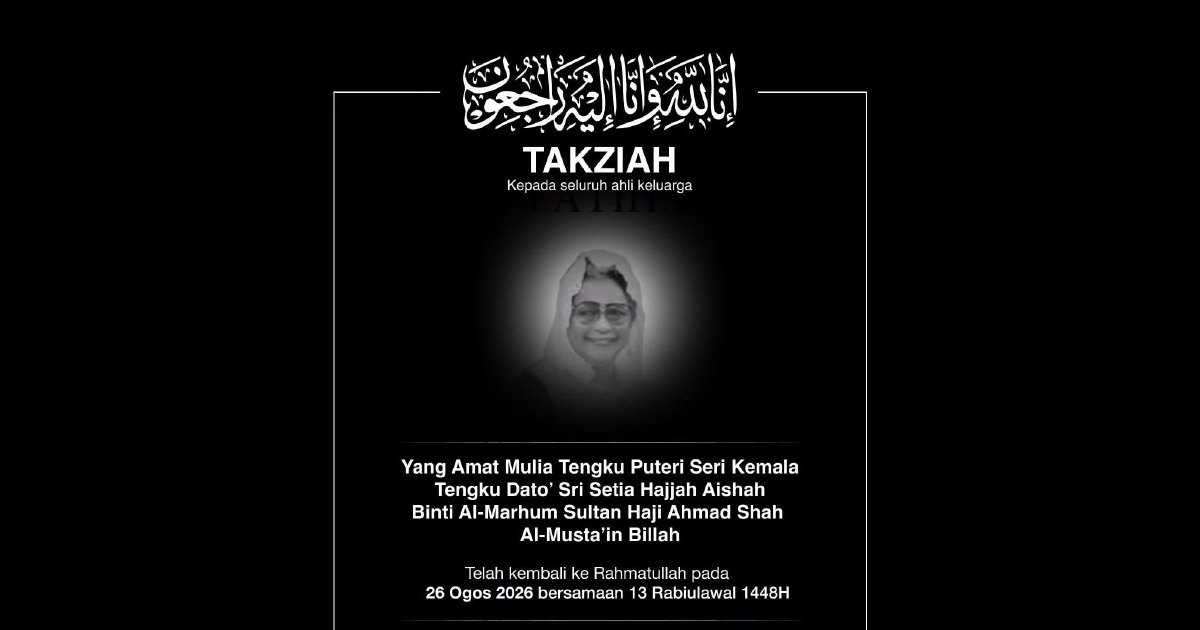
Prime Minister Datuk Seri Anwar Ibrahim has conveyed formal condolences to Al-Sultan Abdullah Ri'ayatuddin Al-Mustafa Billah Shah and members of the Pahang Royal Family following the passing of Tengku Puteri Seri Kemala Tengku Datuk Seri Aishah Almarhum Sultan Ahmad Shah, the Sultan's elder sister.
The expression of sympathy from Malaysia's head of government underscores the significance of maintaining ceremonial and diplomatic relations between the federal administration and state-level royalty, a foundational element of the constitutional monarchy system that has governed the nation since independence. Such formal acknowledgements by the Prime Minister serve both as personal gestures of respect and as affirmations of the government's recognition of the institution of the Sultanate itself.
Tengku Puteri Seri Kemala's position within the Pahang Royal Family carried particular historical weight, as she was the elder sister of the reigning Sultan. Members of the immediate royal circle, particularly siblings of ruling Sultans, often maintain prominent roles in state affairs and cultural preservation. The death of such a figure typically prompts reflection on the continuity and legacy of the royal house, particularly in a state with Pahang's historical prominence within the Malaysian federation.
The timing of such expressions of condolence reflects established protocols within Malaysia's political and ceremonial framework. When significant members of any state's royal family pass away, it is customary for the Prime Minister to formally acknowledge the loss, reinforcing the bonds of mutual respect that characterise relations between the federal government and the sultanates. These gestures, while ceremonial in nature, carry symbolic importance in maintaining the delicate balance of federalism that underpins Malaysia's constitutional structure.
Pahang, the largest state on peninsular Malaysia by land area, holds particular significance within the Malaysian monarchy system. As the seat of one of the kingdom's most historically rooted sultanates, developments within the Pahang Royal Family are often viewed with broader national attention. The state has produced major figures in Malaysian political and cultural life across generations, and the royal household continues to play a custodial role in preserving Pahang's distinct heritage and traditions.
The Sultan of Pahang occupies a unique position not only as a regional ruler but also as a constituent member of the Council of Rulers, the body collectively responsible for selecting Malaysia's Yang di-Pertuan Agong every five years. This national-level responsibility means that the wellbeing and circumstances of the Pahang sultanate carry implications that extend beyond the state's borders. Family matters within the royal household, including bereavements, thus acquire a dimension of significance that touches on the entire constitutional framework.
Condolence messages from national political leadership typically reflect not merely personal sympathy but an acknowledgement of the deceased's position within Malaysia's social and political hierarchy. For a member of a reigning Sultan's immediate family, such recognition from the Prime Minister affirms that the individual's life and status have been duly noted at the highest levels of government. This is particularly important in a system where the monarchy is constitutionally embedded and where respect for royal institutions remains a cornerstone of national identity.
The passing of elder family members within royal households often prompts consideration of succession planning and the evolving roles that remaining family members may assume. In the case of Pahang's sultanate, the loss of an elder sister of the reigning Sultan may trigger discussions about the royal family's administrative and ceremonial responsibilities, particularly those relating to cultural and historical preservation efforts that the deceased may have been involved in during her lifetime.
Malaysia's system of constitutional monarchy, which distinguishes it from many other Commonwealth realms, places considerable emphasis on the conduct and visibility of state-level royalty. The Pahang Royal Family, like all sultanates within the federation, operates within parameters defined by both federal and state constitutions, yet maintains substantial autonomy in matters of cultural significance and ceremonial function. The death of prominent family members thus represents moments when the stability and continuity of these institutions receive public and official attention.
The conveyance of condolences by the Prime Minister also reflects broader diplomatic courtesies that characterise Malaysia's political culture. Beyond the formal expressions required by protocol, such gestures demonstrate the government's commitment to honouring the diverse constituencies and power structures within the nation's federal system. The Pahang sultanate's historical role in Malaysian federation makes such acknowledgements particularly weighty, as they affirm the enduring partnership between the federal centre and the states.
In the contemporary Malaysian context, where regional stability and inter-institutional harmony remain central concerns, the maintenance of these ceremonial and diplomatic courtesies carries practical significance. Strong working relationships between the federal government and state-level royalty facilitate smoother governance and prevent the emergence of institutional tensions that could complicate policy implementation or threaten social cohesion. The Prime Minister's expression of sympathy therefore functions on multiple levels: as a personal acknowledgement of loss, as a formal recognition of the deceased's status, and as an affirmation of institutional respect within Malaysia's carefully balanced constitutional framework.

