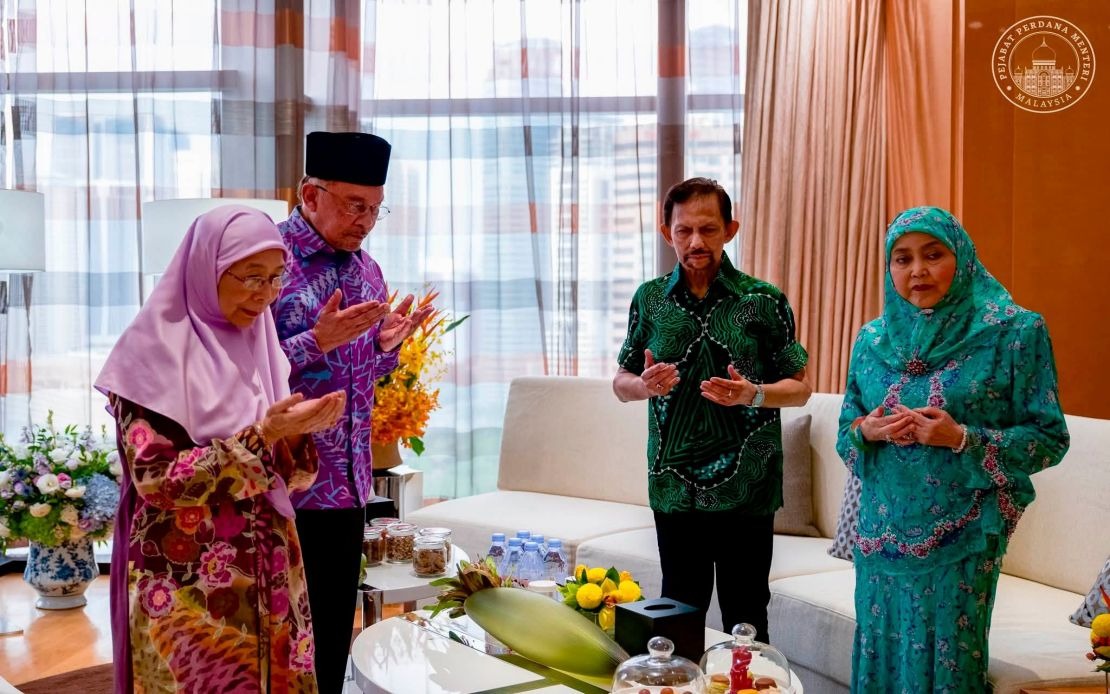
Prime Minister Datuk Seri Anwar Ibrahim has formally conveyed Malaysia's felicitations to Sultan Hassanal Bolkiah on his milestone 80th birthday celebration, underscoring the importance of the enduring relationship between Kuala Lumpur and Bandar Seri Begawan. The gesture, announced through a Facebook post on July 15, represents the customary diplomatic courtesy extended between the two closest regional neighbours in Southeast Asia.
In his message, Anwar spoke not merely on his own behalf but representing the entire Malaysian Government and citizenry, offering prayers that the Brunei monarch would continue to exercise his reign with the wisdom and judicious governance that have characterised his decades on the throne. This rhetorical framing reflects the protocol-conscious nature of bilateral relations between Malaysia and Brunei, where ceremonial acknowledgments carry weight in maintaining the foundation of regional diplomacy.
The Prime Minister's remarks explicitly addressed the paramount objective of deepening cooperation between the two nations. His expression of hope that bilateral ties would be further consolidated suggests an active agenda for intensified engagement across multiple domains—whether economic, cultural, or security-related—that benefit both the Malaysian and Bruneian populations. Such language reflects the contemporary reality that Malaysia and Brunei, though distinct sovereign entities, share interconnected interests in a rapidly evolving Southeast Asian landscape.
Sultan Hassanal Bolkiah's ascension to the throne occurred in 1967, when he was proclaimed the 29th Sultan of Brunei Darussalam, establishing a reign that has now spanned more than five decades. Born on July 15, 1946, in Bandar Brunei, which would later be renamed Bandar Seri Begawan, the Sultan has witnessed unprecedented transformations in his nation and the broader region. His early reign coincided with Brunei's emergence as an independent nation and its evolution into a significant regional economic force, particularly through its substantial petroleum and liquefied natural gas resources.
What renders Sultan Hassanal Bolkiah's milestone particularly notable in the contemporary global context is his distinction as the world's longest-reigning monarch still actively ruling. This status was acquired following the death of Queen Elizabeth II in September 2022, an event that fundamentally recalibrated the international hierarchy of reigning monarchs. The British queen's passing ended a reign of exceptional longevity, transferring that distinction to the Brunei sovereign and thereby elevating his significance within global monarchical circles and Commonwealth structures.
The relationship between Malaysia and Brunei, whilst built on the foundation of shared Islamic heritage and geographical proximity, has navigated complex historical and contemporary considerations. The two nations maintain robust diplomatic channels and participate together in regional organisations and multilateral forums. Brunei's position as a smaller, resource-wealthy state contrasts with Malaysia's larger population and more diversified economy, yet both countries share mutual interests in maintaining regional stability and prosperity.
From Malaysia's perspective, cultivating strong ties with Brunei serves multiple strategic purposes. Beyond the symbolic significance of acknowledging royal milestones, substantive cooperation extends to maritime security, energy partnerships, and the coordination of regional policy positions. The oil and gas sectors represent particularly important vectors for engagement, given Malaysia's own energy interests and Brunei's substantial reserves. Educational and cultural exchanges further cement the people-to-people connections that underpin diplomatic relationships.
Sultan Hassanal Bolkiah's longevity as a reigning monarch has allowed him to accumulate considerable experience in navigating geopolitical shifts, technological transformation, and social change. His leadership during the Cold War era, the post-Cold War reconfiguration of Asia-Pacific geopolitics, and the subsequent emergence of China as a regional power demonstrates adaptive governance across dramatically different international contexts. For neighbouring Malaysia, such stability and continuity in leadership across the border represents a reassuring element in an increasingly complex regional environment.
The birthday acknowledgment also carries subtle implications for how Malaysia positions itself within regional hierarchies and alliance structures. By emphasising the partnership with Brunei and invoking collaborative aspirations, Anwar's message reinforces Malaysia's commitment to maintaining harmonious relations with all neighbours, regardless of their size or economic weight. This approach aligns with Malaysia's broader diplomatic philosophy of seeking inclusive regionalism and avoiding the formation of exclusive blocs that might create friction within ASEAN or broader Southeast Asian frameworks.
Looking forward, the deepened cooperation between Malaysia and Brunei that Anwar referenced will likely encompass evolving challenges and opportunities. Climate change, digital transformation, and the geopolitical realignment triggered by great power competition all present domains where Malaysia and Brunei can leverage their partnership for mutual advantage. The Sultan's advanced years and continued active stewardship suggest that institutional continuity and institutional relationships will remain central to regional stability in coming years.
The exchange of birthday greetings at the level of prime ministers and monarchs represents more than ceremonial nicety in international relations. It serves as a public affirmation of bilateral commitment, a reaffirmation of diplomatic continuity, and a signal to the broader international community that key relationships remain on solid footing. For Malaysia, such gestures towards Brunei reinforce the nation's reputation as a constructive regional partner committed to maintaining and strengthening the bonds that hold Southeast Asia together despite occasional differences in perspective or interest.

