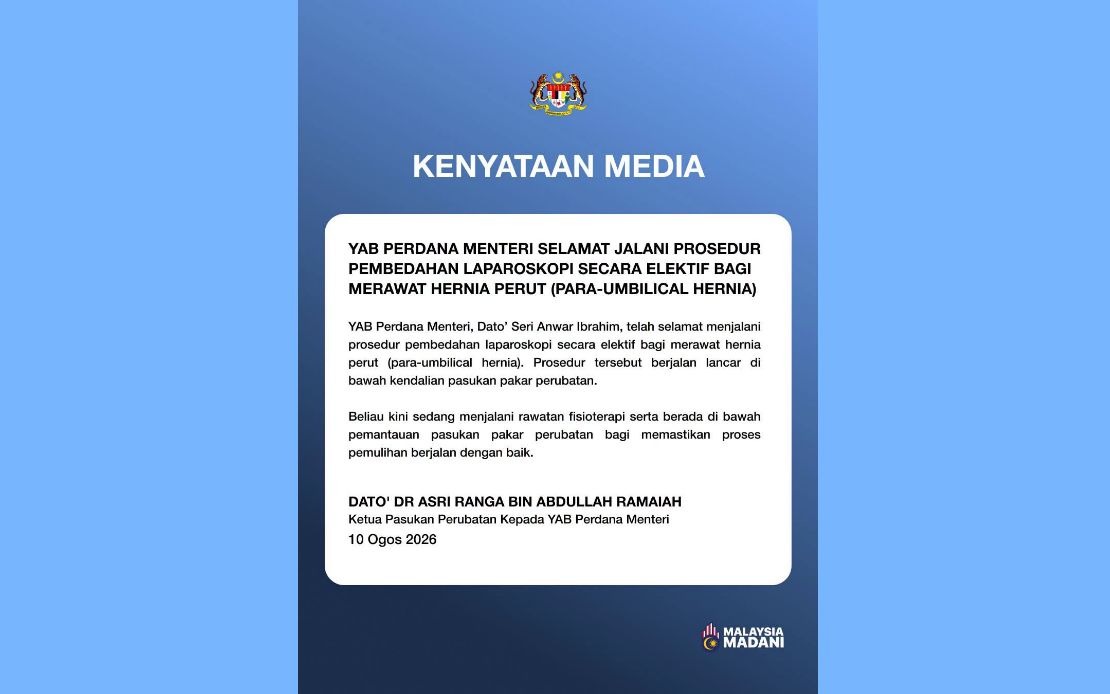
Prime Minister Datuk Seri Anwar Ibrahim has successfully completed an elective surgical procedure to address a para-umbilical hernia, a relatively common abdominal condition in which tissue protrudes through a weakness in the abdominal wall near the navel. The minimally invasive laparoscopic approach employed represents standard contemporary practice for such interventions, reducing recovery time and post-operative discomfort compared to traditional open surgery. The procedure was conducted by a dedicated team of medical specialists who oversaw every phase of the operation.
Heading the Prime Minister's medical team, Datuk Dr Asri Ranga Abdullah Ramaiah confirmed that the surgical process unfolded without incident, reflecting the quality of care and preparation that preceded the intervention. In a statement disseminated through official channels, he indicated that the operation met all clinical objectives and that no complications were encountered during the procedure itself. This represents a positive outcome for the nation's chief executive, whose health remains a matter of national interest given the demands of his office.
Following the completion of surgery, Anwar Ibrahim has been engaged in structured physiotherapy to facilitate optimal healing and restore full functional capacity. The medical specialists overseeing his care have maintained continuous observation protocols to monitor his progress and respond promptly to any clinical developments. This rehabilitation phase is crucial to ensuring that the Prime Minister regains his physical conditioning and can resume the demanding schedule inherent to his position without constraint.
The recovery process has been designed with meticulous attention to detail, incorporating regular assessments and interventions tailored to the Prime Minister's specific requirements. The medical team's close supervision extends across all aspects of his post-operative care, from pain management to infection prevention and tissue healing. Such comprehensive oversight is standard practice in high-profile cases where public confidence in the patient's full recovery is essential both for institutional stability and for maintaining continuity of government operations.
Tunku Nashrul Abaidah, the Prime Minister's senior press secretary, disclosed prior to the surgery that Anwar Ibrahim would remain hospitalized for approximately two days of observation following the intervention. This timeframe aligns with established clinical protocols for elective laparoscopic hernia repair, during which patients are typically monitored for any immediate post-operative complications and assessed for their readiness to continue recovery in less acute settings. The decision to maintain this observation window reflects medical best practice rather than suggesting any underlying concerns about his condition.
The timing and execution of the procedure demonstrate the Prime Minister's commitment to addressing health matters proactively rather than allowing potential complications to develop. By opting for elective surgery to repair the hernia, Anwar Ibrahim has prioritized preventive healthcare, reducing the risk of more serious complications such as incarceration or strangulation of hernia tissue, which could prove far more serious and require emergency intervention. This measured approach to medical management reflects sound judgment regarding personal health governance.
For Malaysia's political establishment and the broader public, the successful completion of the surgery provides reassurance regarding continuity of executive leadership during a period when the nation is navigating complex domestic and international challenges. The transparent communication from his medical team and press office demonstrates a commitment to keeping the public informed while respecting the Prime Minister's medical privacy, striking an appropriate balance between legitimate public interest and personal dignity.
The Prime Minister's office has requested public prayers and well-wishes for his continued recovery and sustained good health, framing the surgical intervention within a broader narrative of national concern and collective support. Such calls for public participation in wishes for recovery serve both spiritual and social functions, reinforcing the interconnection between the nation's leadership and its citizenry. The emphasis on the importance of his full and swift return to normal duties underscores the centrality of executive function to the operation of government during a period of significant policy development.
Abdominal hernias, while not uncommon among middle-aged and older individuals, can impact quality of life and physical capability if left untreated. The para-umbilical variant specifically affects the area around the navel and can develop through a combination of factors including strain, pregnancy, previous surgery, or genetic predisposition. The choice to address this condition through surgical repair represents a sensible health management decision that should enable the Prime Minister to maintain full physical capacity for the foreseeable future.
Looking ahead, the focus will rest on ensuring that Anwar Ibrahim's recovery proceeds according to clinical expectations and that he achieves complete restoration of his functional abilities within the anticipated timeframe. The expertise of his medical team and the availability of contemporary surgical techniques suggest that this outcome is highly probable. For Malaysia, the successful resolution of this routine yet necessary medical procedure affirms the availability of world-class healthcare and the capacity of national institutions to maintain effective governance even when senior leadership requires temporary medical attention.

