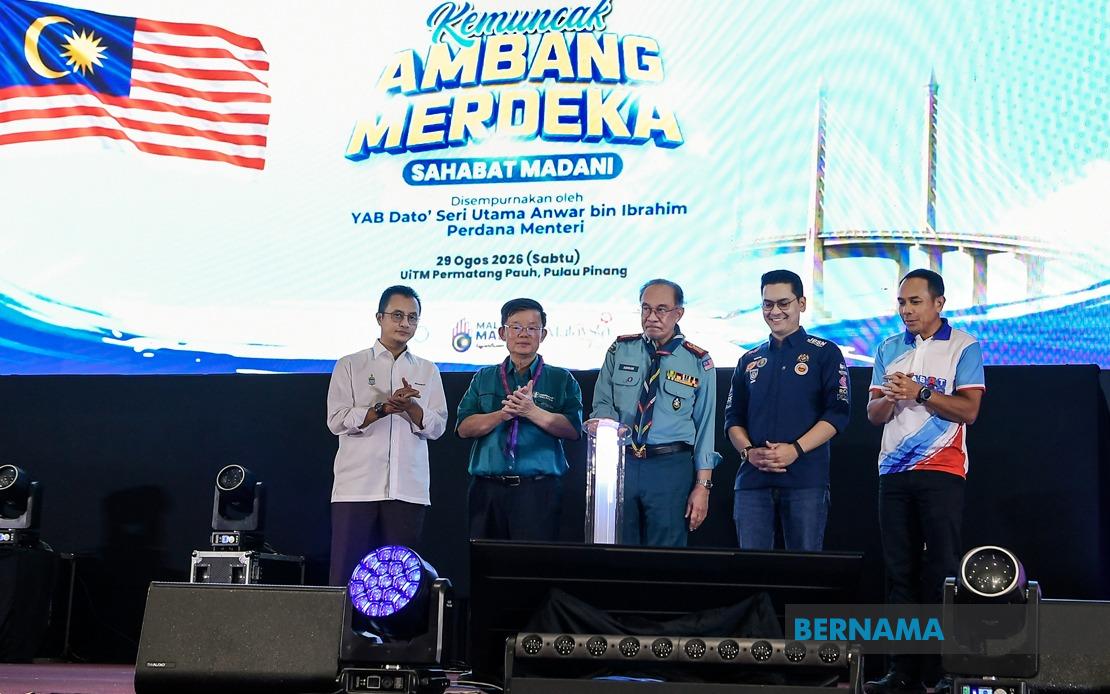
Prime Minister Datuk Seri Anwar Ibrahim has formally launched Sahabat MADANI, an ambitious nationwide volunteer programme designed to harness grassroots civic engagement across Malaysia's diverse communities. The initiative, unveiled at Universiti Teknologi MARA (UiTM) Permatang Pauh during the Ambang Merdeka Sahabat MADANI 2026 highlight programme, has already mobilised 11,060 volunteers who have registered to participate in the movement, according to the Implementation Coordination Unit of the Prime Minister's Department (ICU JPM).
The Sahabat MADANI framework represents a deliberate attempt to translate the government's Malaysia MADANI vision—centred on shared prosperity and inclusive development—into concrete community action. Rather than relying solely on top-down bureaucratic intervention, the programme establishes a three-tier collaborative structure uniting government agencies, volunteer networks, and local communities in coordinated service delivery. This structural approach reflects a recognition that sustainable social progress requires sustained engagement from citizens themselves, not merely state provision.
The volunteer network concentrates on service categories with immediate practical impact. Supporting vulnerable populations stands foremost among these priorities, addressing Malaysia's persistent pockets of poverty and economic marginalisation. The initiative also targets educational disengagement, specifically assisting young people who have abandoned formal schooling—a demographic challenge that intersects with youth unemployment and limited economic mobility. Additionally, the programme creates pathways for entrepreneurship and employment among young Malaysians, acknowledging the critical importance of economic opportunity in combating social fragmentation and preventing radicalisation.
Crisis response capabilities form another operational pillar of Sahabat MADANI. Given Malaysia's exposure to natural disasters, economic shocks, and public health emergencies, embedding volunteer capacity for rapid disaster relief and emergency support represents genuine institutional learning. The network's distributed structure means assistance can be mobilised swiftly at community level rather than awaiting centralised deployment, potentially reducing response times and tailoring aid to localised circumstances.
The ideological underpinning of Sahabat MADANI emphasises cross-cutting participation that transcends the ethnic, religious, and socioeconomic divides that historically structure Malaysian social organisation. By deliberately encouraging volunteers from different backgrounds to serve together, the initiative seeks to build what scholars term "bonding social capital" across traditional cleavage lines. This reflects an implicit theory that sustained personal contact through shared purposeful activity can erode prejudice and strengthen the social cohesion necessary for democratic stability and inclusive governance.
For Malaysia's leadership, the timing and framing of Sahabat MADANI carries particular significance. Launched as the nation marks its independence anniversary, the programme connects contemporary volunteering to foundational nationalist values of service and mutual obligation. This rhetorical move attempts to reposition the concept of national unity—often invoked in official discourse—as a dynamic, lived practice rather than abstract constitutional principle. The emphasis on citizens actively choosing to serve neighbours across differences implicitly counters narratives of communal division that periodically surface in Malaysian public discourse.
The programme's emphasis on transparency and results-driven delivery responds to persistent public concerns about governance effectiveness and corruption. By explicitly committing Sahabat MADANI to transparent operations and measurable outcomes, the ICU JPM signals alignment with broader reform objectives within Anwar Ibrahim's administration. The 11,060 initial registrations suggest meaningful public appetite for structured volunteer engagement, though scaling operations and maintaining momentum over time will present significant implementation challenges.
Young Malaysians occupy a central place in Sahabat MADANI's strategic narrative. The government explicitly urges younger citizens to reject divisive rhetoric and channel their skills toward nation-building through voluntary service. This messaging implicitly acknowledges generational anxieties about economic prospects, social polarisation, and national direction. By offering structured pathways for youth contribution, the initiative attempts to convert potential dissatisfaction into productive engagement with state-sponsored collective projects.
The volunteer movement also reflects evolving thinking about what constitutes effective social policy in contemporary Malaysia. Rather than exclusively through cash transfers or bureaucratic service provision, development increasingly operates through mobilising volunteer effort and community capacity. This approach offers financial advantages for resource-constrained governments whilst simultaneously generating social outcomes—increased interpersonal trust, community cohesion, and civic participation—that economic metrics alone cannot capture.
Sustaining volunteer enthusiasm over extended periods remains the fundamental test confronting Sahabat MADANI. Initial registration numbers can generate momentum, but retention rates and the quality of volunteer service activities will ultimately determine whether the initiative delivers tangible benefits to target populations. Volunteer burnout, inadequate coordination, and the difficulty of measuring social outcomes present persistent implementation risks that many volunteer programmes encounter.
Regionally, Malaysia's Sahabat MADANI initiative reflects broader Southeast Asian patterns of governments attempting to deepen civic participation whilst maintaining coherent national direction. Similar volunteer movements across the region pursue comparable objectives of strengthening social bonds, addressing service delivery gaps, and mobilising citizen agency in development efforts. The comparative success or challenges of Sahabat MADANI will likely influence how neighbouring governments approach analogous civic engagement initiatives.
The programme's long-term significance will depend on whether volunteer activity translates into measurable improvements in the lives of vulnerable Malaysians whilst simultaneously generating the interpersonal trust and civic commitment that strong democracies require. If Sahabat MADANI successfully bridges service delivery with genuine relationship-building across Malaysia's plural communities, it could demonstrate an alternative model for inclusive development. Conversely, should volunteering become tokenistic or fail to produce concrete benefits for target populations, the initiative risks becoming merely another bureaucratic programme rather than the transformative civic movement its architects envision.

