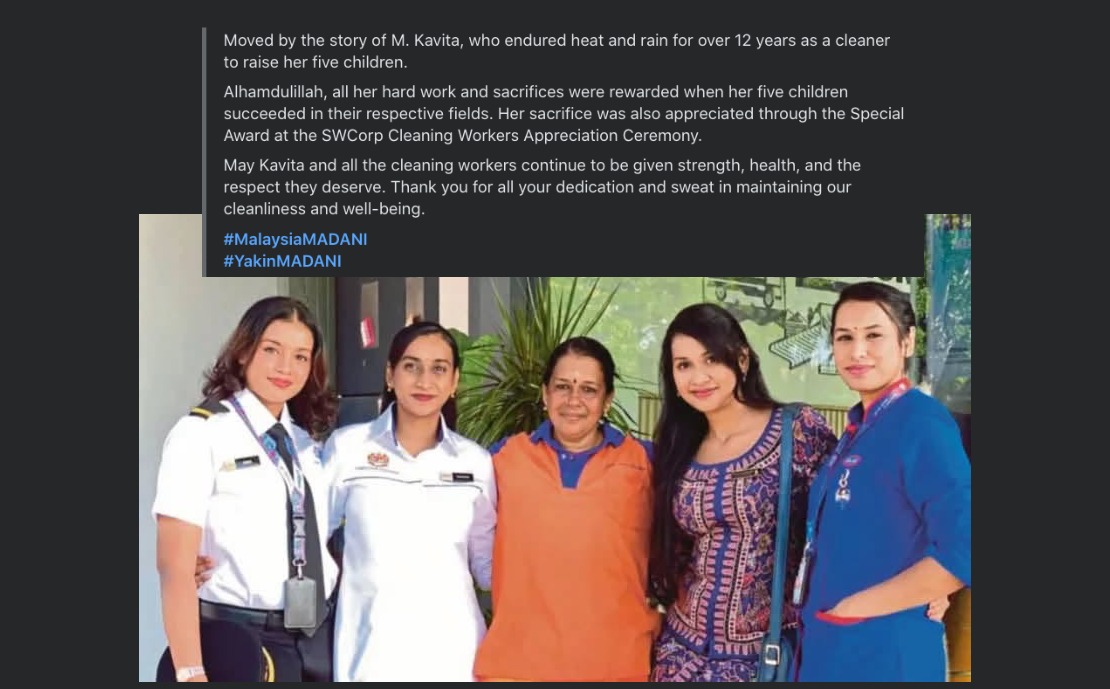
Prime Minister Datuk Seri Anwar Ibrahim has publicly honoured the contributions of M. Kavita, a street sweeper whose decade-spanning commitment to her family and work has become a source of inspiration across Malaysia. In remarks shared on social media, Anwar acknowledged the profound impact of Kavita's dedication, noting how her relentless efforts through varying weather conditions and challenging circumstances have culminated in the success of all five of her children across different professional fields.
Kavita's story gained widespread attention on social media platforms last month when her four daughters orchestrated a surprise birthday celebration at her workplace to mark her 50th birthday. The emotional moment was amplified when the daughters appeared in their respective professional uniforms—including a pilot, cabin crew member, and staff nurse—creating a poignant demonstration of the fruits of their mother's labour. The unexpected appearance left Kavita deeply moved, as she witnessed tangible evidence of how her years of sacrifice had enabled her children to pursue meaningful careers.
The recognition extended beyond the Prime Minister's acknowledgement. SWCorp, the entity overseeing cleaning services, formally recognised Kavita's exemplary service by presenting her with a Special Award during their Cleaning Workers' Day Appreciation ceremony. This institutional recognition underscores the broader significance of acknowledging sanitation and cleaning workers whose daily contributions often go unnoticed despite their essential role in maintaining public health and environmental standards across the nation.
Anwar's tribute carries particular weight given Malaysia's ongoing discourse regarding the dignity and respect afforded to workers in the service and sanitation sectors. The Prime Minister explicitly called for continued blessings upon Kavita and her fellow sanitation workers, specifically invoking the values of strength, good health, and deserved respect. Such public affirmation from the country's highest office serves to elevate the social standing of an occupational category that frequently operates beyond the visibility of mainstream society.
The narrative presented by Kavita's circumstances reflects broader socioeconomic realities facing many Malaysian families. Single-income households dependent on manual labour must navigate systemic challenges including limited wage growth, demanding physical work conditions, and the constant balancing act between generating sufficient income and providing adequate parental presence and guidance. Kavita's success in this regard—evidenced by her children's professional accomplishments—suggests resilience and determination that transcends typical economic constraints.
From a policy perspective, Kavita's story invites consideration of how Malaysia's education and social mobility systems function for families operating at lower income levels. The fact that all five children achieved professional success despite their mother's modest income raises questions about the quality of educational opportunities available, access to mentorship, and the role of community or institutional support systems in enabling upward mobility. Understanding these mechanisms could inform efforts to replicate such positive outcomes more systematically.
The viral nature of Kavita's social media moment reveals evolving public consciousness regarding the validation of manual labour contributions. In societies undergoing rapid economic development and tertiary sector growth, sanitation and street-cleaning roles can become culturally invisible or perceived as undesirable. The outpouring of online support for Kavita suggests a counter-narrative emerging among Malaysian social media users, one that recognises and celebrates the sacrifices inherent in such work.
The timing of official recognition through SWCorp's Cleaning Workers' Day Appreciation ceremony demonstrates institutional awareness of workforce morale and retention challenges within the sanitation sector. Formal acknowledgement programs serve multiple functions: they boost worker dignity and job satisfaction, they communicate to the broader public that such roles merit respect, and they potentially strengthen organisational culture within service agencies. For SWCorp, highlighting exceptional individuals like Kavita contributes to workforce engagement strategies.
Kavita's story also intersects with contemporary discussions about gender, labour, and family structures in Malaysia. As a woman navigating single parenthood or independent breadwinning, her circumstances reflect demographic shifts in family composition and the increasing prevalence of female-headed households relying on service sector employment. The success of her daughters, who have entered professional fields including aviation and healthcare, suggests pathways for intergenerational economic progression within these demographic contexts.
The Prime Minister's message emphasising gratitude for Kavita's dedication to keeping surroundings clean and safeguarding community well-being frames sanitation work within a public health and social responsibility paradigm. This framing acknowledges how individual workers contribute to collective welfare, a perspective that can help reshape cultural narratives around essential service roles. In an era of heightened health consciousness following global pandemic impacts, such messaging gains additional resonance.
Looking forward, Kavita's recognition may serve as a catalyst for broader examination of workplace policies affecting sanitation workers across Malaysia. Questions regarding fair compensation, occupational health and safety, career development opportunities, and work-life balance for this labour category could gain renewed attention in policy discussions. Individual stories of perseverance and achievement, when elevated through official channels, often trigger systemic assessments of whether existing frameworks adequately support worker welfare and advancement.
The contrast between Kavita's modest employment circumstances and her children's professional achievements underscores the complex relationship between family aspirations, educational access, and intergenerational outcomes in Malaysia. Her narrative suggests that parental commitment and family values, while essential, interact with broader institutional and economic factors that determine whether such dedication translates into measurable success for subsequent generations.

