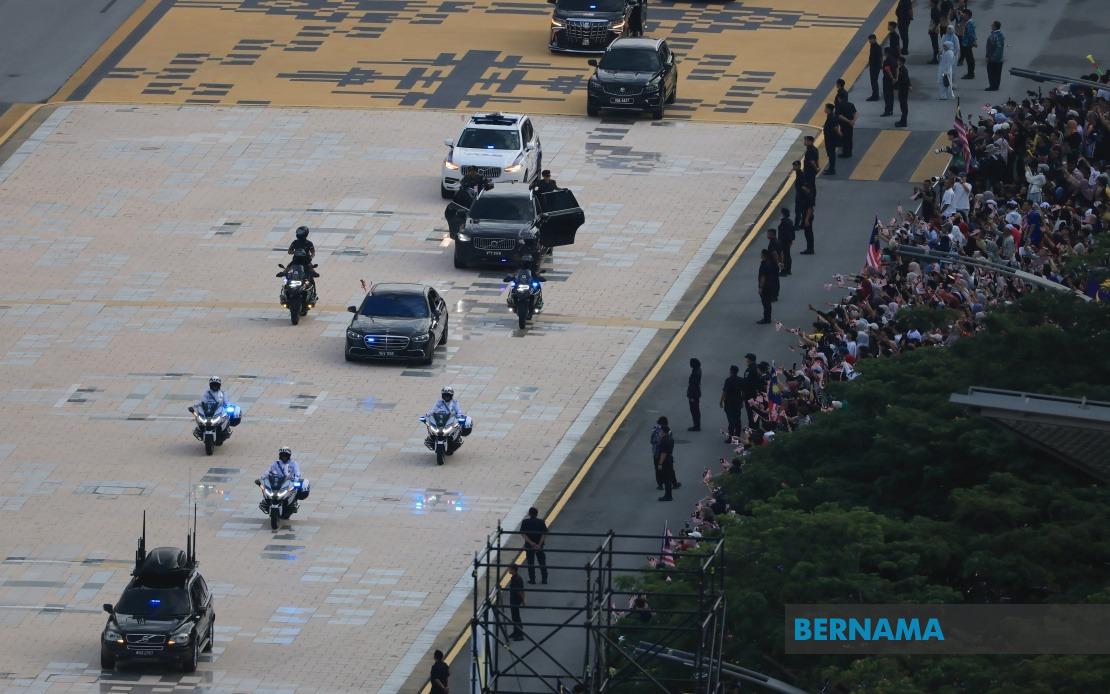
Malaysia's political leadership gathered at Dataran Putrajaya on August 31 to mark the nation's 69th National Day, with Prime Minister Datuk Seri Anwar Ibrahim presiding over one of the year's most significant ceremonial events. The Prime Minister, accompanied by his wife Datuk Seri Dr Wan Azizah Wan Ismail, ascended the royal stage at 7.53 am to the strains of Hormat Perdana, signalling the commencement of festivities that would draw thousands of Malaysians and international dignitaries to the administrative capital.
The full breadth of Malaysia's federal government was represented at the proceedings, underscoring the national importance attached to independence commemorations. Deputy Prime Minister Datuk Seri Dr Ahmad Zahid Hamidi arrived eight minutes earlier to ensure ceremonial readiness, whilst key portfolio holders including Communications Minister Datuk Seri Fahmi Fadzil, Home Minister Datuk Seri Saifuddin Nasution Ismail, and Defence Minister Datuk Seri Mohamed Khaled Nordin positioned themselves prominently throughout the event. The ministerial turnout reflected the government's commitment to projecting unity and organised national celebration at a time when political cohesion remains central to administrative effectiveness.
This year's celebrations operated under the thematic framework of "Malaysia MADANI: Kesejahteraan Dinikmati"—translating to shared prosperity and well-being—a motif that extends beyond ceremonial rhetoric to encompass the broader policy direction the administration intends to communicate domestically and internationally. The choice of theme carries particular weight given Malaysia's recent political transitions and the government's emphasis on inclusive development and social welfare initiatives. By anchoring National Day messaging around collective prosperity, the administration reinforces its governance narrative centred on equitable growth and enhanced quality of life across demographic segments.
The scale of the pageantry demonstrated considerable logistical coordination and resource mobilisation. Organisers assembled 10,819 participants distributed across 76 distinct contingents, representing governmental bodies, educational institutions, community organisations, and private sector entities. This participatory breadth transforms National Day from a state function into a genuine cross-societal gathering, enabling diverse Malaysians to embody national identity through active involvement rather than passive observation. The inclusion of 22 marching bands added cultural vibrancy to proceedings whilst reinforcing Malaysia's multicultural character through musical representation.
The parade's material composition reflected the modern, technologically progressive nation-state Malaysia seeks to project internationally. A total of 328 land, sea, and air assets moved through Dataran Putrajaya, showcasing military capabilities and emergency response infrastructure. The incorporation of 112 working animals—traditionally featured in National Day celebrations—maintained continuity with established ceremonial practice, providing visual connection to Malaysia's natural heritage and rural dimensions often backgrounded in urbanised governance discussions. Meanwhile, the deployment of 22 electric vehicle assets signalled the government's commitment to environmental sustainability, integrating ecological consciousness into national celebration and potentially influencing public perception of official environmental policies.
International representation at the event carried diplomatic significance beyond ceremonial courtesy. Foreign delegates attended the celebrations, providing an external audience for Malaysia's self-presentation as a stable, organised, and forward-thinking nation. Such attendance reinforces Malaysia's positioning within regional and global networks, demonstrating that the country maintains diplomatic relationships sufficiently robust to warrant international participation in national commemorations. For neighbouring Southeast Asian nations and distant trading partners alike, observing how Malaysia conducts its largest annual civic gathering offers insights into administrative capacity and political stability—intangible but consequential factors influencing investment decisions and diplomatic engagement.
Communications Minister Fahmi Fadzil's dual role as chairman of the main committee for the 2026 National Day and Malaysia Day (HKHM) celebrations suggests continuity in strategic planning and thematic development across successive years. This forward-planning orientation indicates the government's intention to build incremental narrative coherence around national celebrations, potentially strengthening their pedagogical and cohesive functions within Malaysian society. The appointment of a senior communications figure to oversee multi-year celebration architecture underscores recognition that National Day ceremonies constitute significant instruments of state communication and national identity reinforcement.
For Malaysian citizens observing the proceedings either in person or through media coverage, the spectacle serves multiple functions simultaneously. Beyond patriotic sentiment invocation, National Day celebrations provide occasions for reflecting on national progress, articulating collective aspirations, and reinforcing the institutional frameworks through which Malaysian identity finds expression. The visible presence of Cabinet ministers—the executive face of governmental authority—grounds abstract notions of statehood in human forms recognisable to ordinary citizens, personalising governance structures that otherwise operate at considerable institutional remove from daily experience.
The attendance of deputy ministers alongside Cabinet principals reflected a hierarchical yet inclusive approach to governmental representation, acknowledging the intermediate administrative tier whilst maintaining clear delineation of authority concentration at ministerial level. This structural visibility reaffirms for Malaysian bureaucracy the value placed on institutional participation in national celebration, potentially motivating administrative efficiency and morale through explicit acknowledgment of governmental personnel's contributions to national functioning. The broader invitation to dignitaries and foreign representatives extended Malaysia's National Day celebration beyond inward-facing commemoration into an outward projection of national character and international standing, transforming ceremonial practice into diplomatic expression.
The 69th National Day celebrations represented more than temporal commemoration of independence achievement; they functioned as periodic reaffirmation of Malaysia's political institutions, administrative capacity, and continued commitment to organised national endeavour. By gathering diverse contingents, deploying substantial resources, coordinating complex logistical operations, and positioning political leadership prominently, the Malaysian state engaged in what political scientists term "state performance"—the deliberate demonstration through ceremony of institutional legitimacy and governing competence. Such performances prove particularly consequential during periods of political transition or institutional challenge, when visible assertion of governmental stability and organisational capability reassures both domestic constituencies and international observers.

