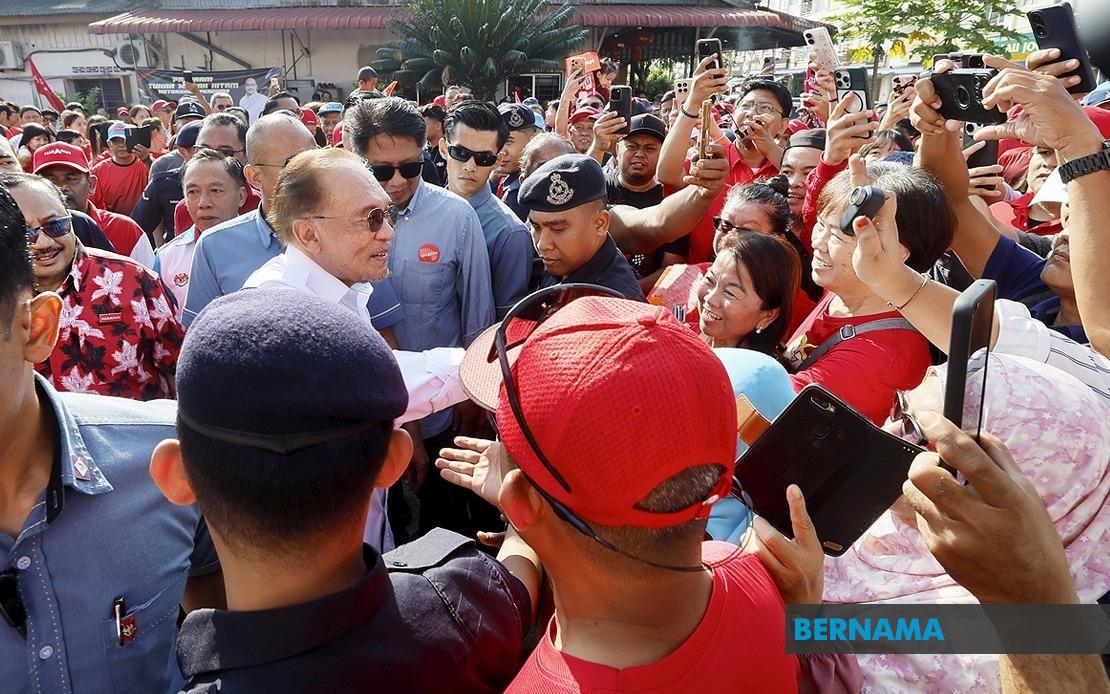
Prime Minister Datuk Seri Anwar Ibrahim reconnected with an elderly couple whose determination to meet him made headlines, when they rode a trishaw across their neighbourhood during a campaign event in Senggarang, Batu Pahat, on Tuesday. The reuniting moment took place as Anwar attended the "Yok! Meriahkan Johor! Undi Harapan" programme in the constituency, just days before Johor's state election polls opened to voters.
The couple in question—Abdul Razak Pelangga, aged 86, and his wife Jamilah Samsudin, 64—had captured public imagination when local media documented their journey the previous Sunday. Their story embodied a poignant symbol of civic engagement: an octogenarian physically pedalling a traditional three-wheeled taxi nearly one kilometre through the streets simply to fulfil his spouse's wish of greeting the nation's leader during a brief breakfast visit to a local eatery.
When the two finally stood before Anwar, the encounter took on a warmth that transcended typical political theatre. The Prime Minister engaged in good-natured banter with Abdul Razak, remarking with evident humour about the elderly man's physical stamina and cycling prowess—a joking reference to his pedalling of the trishaw. Beyond the pleasantries, Anwar expressed genuine gratitude towards the couple for their support and the effort they had invested in the encounter, acknowledging the symbolic weight their actions carried.
The event itself drew together key figures within the Pakatan Harapan coalition machinery. Datuk Fahmi Fadzil, who holds dual roles as Communications Director of the coalition and Minister of Communications, was present throughout the programme. The gathering also included three parliamentary hopefuls contesting under the PH banner: Onn Abu Bakar representing Senggarang, Mohd Khuzzan Abu Bakar standing for Semerah, and Felicia Poh Rui Ling contesting Penggaram—all constituencies within the broader Johor electoral landscape.
The encounter gained significance given the electoral context in which it occurred. The Johor state election was scheduled for Saturday, marking a critical juncture for the coalition's political fortunes in a state that has historically been competitive ground. Early voting mechanisms had already commenced the preceding Tuesday, meaning that voters were actively exercising their franchise even as Anwar conducted his campaign rounds through various community stops.
Abdul Razak and Jamilah's story resonates particularly within Malaysian political culture, where such displays of civic participation by ordinary citizens—especially elderly voters—often become emblematic of broader engagement narratives. The trishaw itself carries cultural weight in Malaysian towns, representing a form of transport deeply woven into the fabric of working-class and retired communities, particularly in smaller urban centres and townships across the peninsula.
The viral nature of their initial journey underscores how social media and grassroots communication can amplify human-interest narratives within electoral campaigns. Rather than formal political messaging, the couple's voluntary effort to traverse their locality to witness a prime ministerial visit generated organic engagement that no conventional advertising campaign could replicate. This phenomenon illustrates the evolving dynamics of political storytelling in the digital age, where authenticity and personal motivation often resonate more powerfully than scripted political theatre.
For the Pakatan Harapan coalition, such moments serve multiple strategic purposes. They humanise party leadership by demonstrating accessibility and genuine appreciation for constituent support. They also provide substantive evidence of grassroots enthusiasm that can be leveraged in campaign communications, suggesting that political commitment extends beyond formal party structures into the everyday lives of ordinary Malaysians across different age groups and socioeconomic backgrounds.
The timing of this reunion, occurring mere days before the Johor state election, positioned it strategically within the campaign calendar. By visibly honouring citizens who had made voluntary efforts to support the coalition's leadership, Anwar reinforced messaging centred on people-centric governance and accessibility—core themes within his broader political brand since assuming office. Such symbolic moments accumulate throughout campaign periods, collectively constructing a narrative arc that voters absorb during the lead-up to polling day.
For Malaysian readers and observers across Southeast Asia, the incident also illustrates broader themes about political participation among elderly populations in regional democracies. In many Southeast Asian contexts, older voters represent a crucial electoral demographic, yet their concerns and engagement levels sometimes receive insufficient campaign attention. The fact that Abdul Razak's determination to participate garnered sympathetic media coverage and prime ministerial recognition suggests evolving awareness of this demographic's importance to electoral outcomes and democratic health more broadly.
The reunion between Anwar and the couple also reflects the personalisation of politics in Malaysian electoral contexts, where face-to-face encounters between leaders and voters—even spontaneous or informal ones—carry disproportionate cultural and political weight. Such interactions generate word-of-mouth communication networks that extend far beyond the immediate participants, influencing perceptions of political leaders and their commitment to constituents. In Johor's competitive political landscape, these accumulated positive impressions can meaningfully influence voter behaviour, particularly among older, community-embedded populations who maintain strong local networks and cultural ties.

