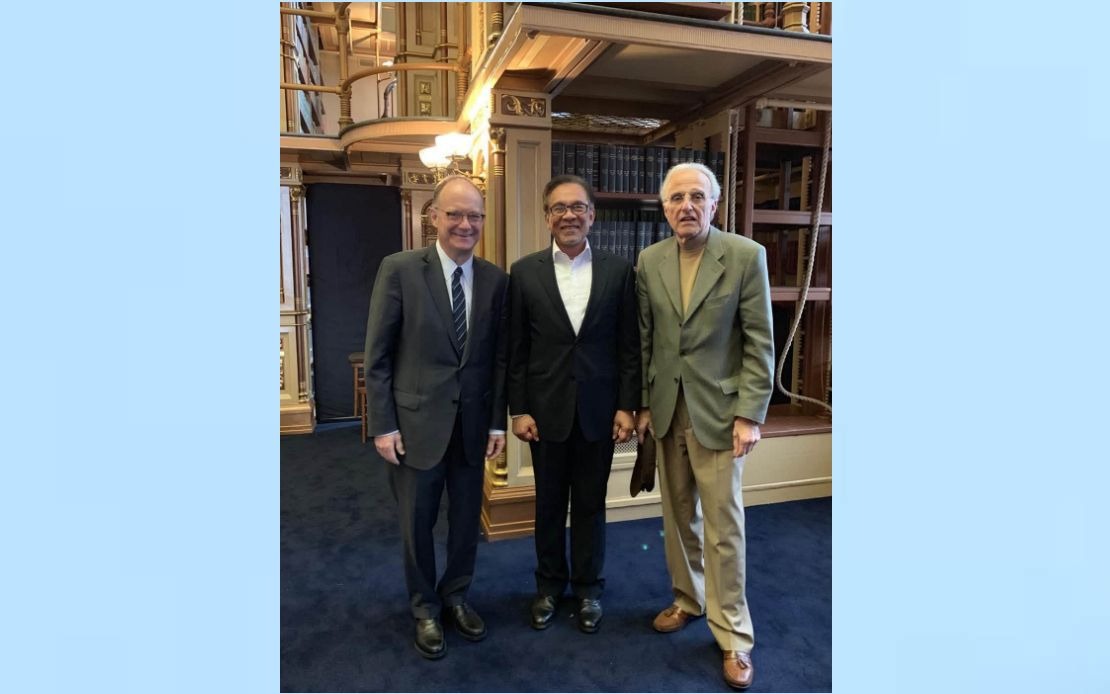
Prime Minister Datuk Seri Anwar Ibrahim has expressed profound grief at the death of Professor John L. Esposito, one of the world's most influential scholars of Islamic studies. Anwar, who announced his condolences through a Facebook post on July 16, remembered Esposito not only as an eminent academic but as a cherished personal friend whose intellectual contributions fundamentally reshaped Western perceptions of Islam over several decades.
The relationship between the Malaysian leader and the American scholar traces back more than fifty years, with their acquaintance beginning in the early 1970s. This extended friendship provided Anwar with a unique vantage point from which to appreciate Esposito's scholarly evolution and personal character. Beyond the formality of academic credentials, the Prime Minister emphasised how deeply Esposito's wisdom and counsel had influenced his own thinking over the decades, a testament to the scholar's ability to forge meaningful personal relationships alongside his professional endeavours.
Esposito's most enduring institutional contribution came through his establishment of Georgetown University's Centre for Muslim-Christian Understanding, a pioneering initiative that created dedicated space for sustained interfaith dialogue and scholarly exchange. This centre became a beacon for those seeking to bridge theological divides and foster genuine mutual comprehension between two of the world's largest faith traditions. The centre's existence represented more than administrative infrastructure—it embodied a commitment to the possibility of meaningful understanding across religious boundaries during an era when such dialogue was far less commonplace than it is today.
In characterising Esposito's scholarly legacy, Anwar noted the scholar's gift for translating complex academic concepts into language accessible to general readers. Works such as "What Everyone Needs to Know About Islam" and "Who Speaks for Islam?" deliberately eschewed the insularity of academic jargon, reaching beyond university walls to address public audiences grappling with profound questions about Islamic faith and practice. This accessibility proved particularly vital in the years following September 11, 2001, when widespread ignorance and fear regarding Islam threatened to poison global relations. Esposito's lucid writing offered intellectual ballast to those seeking understanding rather than reinforcing prejudices.
The Prime Minister specifically highlighted Esposito's collaborative work on "Makers of Contemporary Islam", which examined the lives and thought of influential Islamic figures shaping the modern Muslim world. This project exemplified Esposito's broader scholarly philosophy—treating Islam not as a monolithic entity but as a dynamic civilisation encompassing diverse voices, movements, and interpretations worthy of serious intellectual engagement. Such nuanced treatment challenged reductive Western narratives that had long dominated international discourse.
Anwar's characterisation of Esposito as someone who "built bridges where others were content to build civilisational barriers" crystallises the scholar's fundamental philosophical orientation. Rather than accepting the premise that different faith traditions must exist in perpetual competition or conflict, Esposito dedicated his career to demonstrating the possibilities for dialogue, mutual respect, and collaborative intellectual work. This bridge-building extended across multiple registers—institutional, scholarly, and deeply personal—creating networks of understanding that outlasted any single conflict or controversy.
The Prime Minister's recollection of Esposito's private character—describing him as "generous in private conversation as he was rigorous on the page"—reveals a scholar whose integrity extended beyond published work. The consistency between Esposito's public intellectual positions and his personal conduct suggested someone genuinely committed to the principles he advocated. His willingness to stand steadfastly beside those he called friends, particularly Muslim leaders navigating complex international circumstances, demonstrated commitment to principle over expedience.
For Malaysia and the broader Southeast Asian region, Esposito's passing represents the loss of a scholar who significantly influenced how Muslims themselves understood their faith traditions within global contexts. His work provided intellectual resources for Muslim intellectuals and leaders seeking to articulate Islamic positions that were simultaneously deeply rooted in traditional teachings and responsive to contemporary challenges. His scholarship legitimised the pursuit of interfaith understanding as intellectually rigorous rather than as capitulation to external pressure.
Anwar's official mourning reflects broader recognition across the Muslim world of Esposito's distinctive contributions to Islamic discourse. Unlike critics who dismissed such dialogue as inherently compromising, or Western scholars who approached Islam with orientalist assumptions, Esposito maintained both scholarly rigor and genuine respect for Islamic intellectual traditions. His career trajectory—spanning from the 1970s through the early twenty-first century—captured the evolution of Islamic studies as an academic discipline, yet his fundamental commitments remained consistent.
The Prime Minister's formal condolences extend to Esposito's wife Jean and his extended family, colleagues, and students—a recognition that the scholar's influence extended across multiple constituencies. His students, in particular, continue spreading his methodological approaches and philosophical commitments throughout academic institutions globally. The intellectual lineage he established ensures that his advocacy for serious, respectful engagement with Islamic thought continues influencing generations of scholars and public intellectuals.
Looking forward, Anwar expressed hope that Esposito's scholarly legacy and the interfaith dialogue infrastructure he devoted his life to building would continue generating insights and mutual understanding. The Prime Minister's statement implicitly argues that the world's need for precisely the kind of intellectual work Esposito championed remains as urgent today as during the post-9/11 era when his books reached their widest audiences. In characterising Esposito as "to the end, a true friend to the Muslim world," Anwar suggests a model of scholarship and engagement that transcends traditional disciplinary boundaries and national borders, rooted instead in genuine commitment to human understanding and peaceful coexistence.

