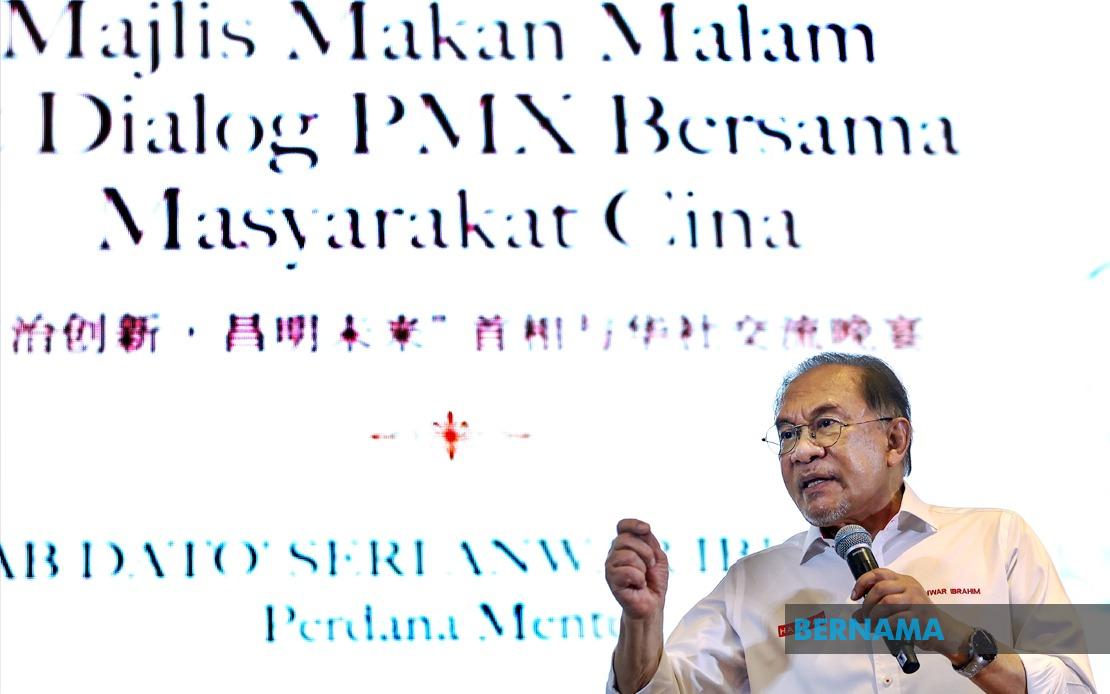
Prime Minister Datuk Seri Anwar Ibrahim used an engagement with the Chinese community in Johor Bahru on July 4 to reaffirm his vision for Malaysia as a thriving, unified nation. The event highlighted the government's continued effort to maintain direct dialogue with different ethnic and community groups across the country, reflecting a broader strategy of inclusive political engagement during a period of significant economic and social transition.
Anwar's remarks centred on the concept of legacy—a theme that carries particular weight given Malaysia's complex political history and the delicate balance required to maintain cohesion among its diverse population. At this stage of his political career, the Prime Minister indicated that his priorities have shifted from immediate policy ambitions towards establishing a foundation of governance principles he hopes will endure beyond his tenure. This articulation of long-term vision serves to reassure communities that leadership is oriented towards stability and principled administration rather than short-term political advantage.
The Prime Minister stressed that every citizen, irrespective of ethnic background or religious affiliation, deserves equal representation and protection under his administration. This universalist framing of leadership responsibility is significant in a Malaysian context where communal concerns and identity politics have historically dominated electoral discourse. By positioning his legacy around equitable service delivery, Anwar seeks to navigate between respecting Malaysia's constitutional recognition of indigenous and Islamic primacy while also addressing minority communities' expectations of fair treatment and representation.
Anwar's emphasis on clean governance carries particular resonance given Malaysia's recent history of high-profile corruption cases and institutional failures that eroded public confidence in state institutions. The corruption scandals of previous administrations, including the 1Malaysia Development Berhad (1MDB) episode and various other financial improprieties, created a governance deficit that the current administration has been attempting to rebuild. By explicitly naming clean leadership as a central legacy aspiration, Anwar positions his government as committed to restoration of institutional integrity and accountability.
The reference to his advancing age and imminent retirement represents a deliberate effort to depersonalise political competition and position leadership as custodial rather than personal. This rhetorical move attempts to shift focus from individual political survival to collective national interest, a framing that appeals to voters fatigued by personalised political rivalries. For Malaysian observers, this language also signals a generational transition within leadership, as Anwar contemplates succession and the longer-term stability of the political system.
Anwar's appeal for citizens to regard the nation as their collective responsibility reflects an understanding that Malaysia's cohesion ultimately rests on voluntary civic participation and mutual commitment across communities. The Prime Minister's message implicitly acknowledges that governance cannot be imposed solely through institutional mechanisms but requires cultivation of shared national identity and purpose. This appeals to the middle-ground consensus that has historically held Malaysia together despite communal differences.
The presence of Parti Keadilan Rakyat (PKR) vice president and Selangor Menteri Besar Datuk Seri Amirudin Shari at the event underscores the government's investment in coordinated messaging across federal and state levels. This coordination indicates efforts to present a unified vision of governance that extends beyond the federal administration into state-level implementation, ensuring that principles of inclusive leadership translate into tangible policy action at different tiers of administration.
Engagements with specific community groups like the Chinese community represent a strategic approach to political consolidation that acknowledges Malaysia's plural society. Such events provide platforms for direct communication beyond media filters, allowing leaders to address community-specific concerns while simultaneously reinforcing broader national narratives. For the Chinese community specifically, such engagement signals recognition of their continued economic and social importance to national development.
The language of mutual love between leader and people, while emotionally resonant, also contains a political dimension. In Malaysian politics, this formulation seeks to establish relationship bonds that transcend transactional governance and instead rest on personal regard and demonstrated commitment. For voters sceptical of political promises, repeated invocations of this emotional contract serve as assurance that the government understands its obligations to provide not just services but also recognition of citizens' intrinsic worth and dignity.
For Southeast Asia more broadly, Malaysia's emphasis on balancing development ambitions with social cohesion offers lessons in managing plural societies during periods of economic transformation. The region faces similar challenges of maintaining inclusive governance while pursuing modernisation and growth objectives. Malaysia's attempt to articulate a leadership vision that accommodates diverse communities while advancing national development provides a template that other regional governments observe with interest.
The timing of Anwar's remarks reflects a government seeking to consolidate support across demographic lines as it approaches mid-term assessments of its policy record. By invoking legacy and permanence rather than immediate electoral cycles, the government attempts to elevate political discourse beyond short-term performance metrics towards longer-term institutional and social outcomes. This approach acknowledges that Malaysian voters increasingly evaluate leadership based on demonstrated commitment to equitable governance rather than purely on deliverables.

