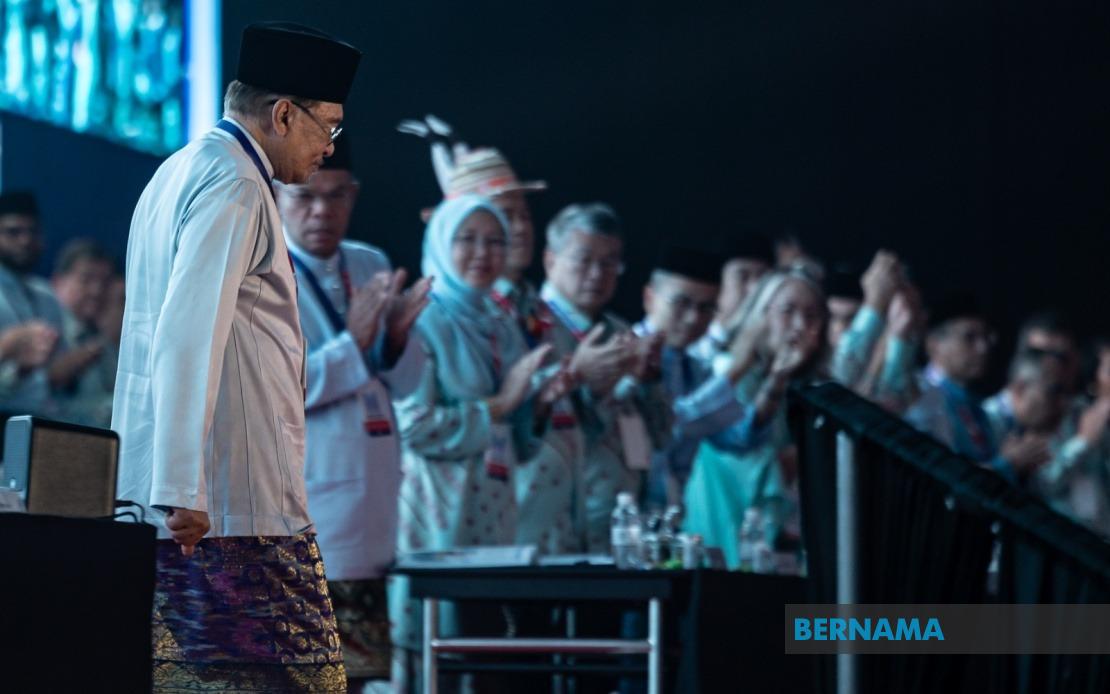
Prime Minister Datuk Seri Anwar Ibrahim has firmly pushed back against suggestions that the MADANI Government is treating some Malaysian states with less priority than others, delivering his response during the 2026 PKR National Congress held at the Melaka International Trade Centre in Ayer Keroh on August 15. The Prime Minister's remarks came amid broader political discourse about regional equity in federal spending, a perennial concern in Malaysian federalism where states with smaller populations or opposition-led administrations sometimes voice concerns about resource allocation fairness.
Anwar's central argument focused on the principle that budgetary distribution necessarily reflects differing developmental priorities and needs across states rather than political favoritism. He underscored that virtually all major states have experienced substantial funding growth since the MADANI Government took office in late 2022, presenting a comprehensive breakdown of budget trajectories that he argued demonstrated equitable treatment. This approach seeks to reframe the allocation debate from a question of fairness into one of rational, needs-based budgeting aligned with specific state circumstances and developmental objectives.
The Prime Minister cited Sabah as a flagship example, noting that federal expenditure allocated to the state has surged by 35 per cent over the three-year MADANI period, rising from RM13 billion in 2022 to RM17.6 billion in the 2026 budget. He contextually noted that preceding administrations had not faced similar accusations regarding Sabah's funding despite whatever budget levels existed then, implying that concerns about state sidelining may be politically motivated rather than substantively grounded. Sarawak similarly saw dramatic growth, with allocations climbing from RM10.2 billion to RM15.1 billion—a 48 per cent increase that represents one of the most substantial gains among major states.
Beyond East Malaysia, Anwar highlighted significant increases for several peninsular states. Johor's allocation nearly doubled from RM10.2 billion in 2022 to RM14.6 billion by 2026, while Terengganu experienced growth from RM6 billion to RM8.1 billion over the same period. The Prime Minister also mentioned improvements for Kedah, Kelantan, and Perlis, painting a picture of broadly distributed prosperity that he argued contradicted claims of selective neglect. These numbers, if accurate, suggest that the MADANI Government has prioritized substantial real-term spending increases rather than budget stagnation or cuts.
The political significance of these statements extends beyond mere accounting. In Malaysian federal politics, resource allocation disputes frequently map onto state governance divisions, with opposition-controlled states sometimes alleging that ruling coalition governments at the federal level deliberately disadvantage them financially. The MADANI Government under Anwar's leadership, despite commanding parliamentary majorities, has navigated complex relationships with various state administrations of differing political complexions. By citing concrete figures and emphasizing across-the-board increases, Anwar appears to be constructing a defense against partisan allocation allegations that could otherwise undermine his administration's federal legitimacy.
For Malaysian readers and observers across Southeast Asia, these funding dynamics matter considerably. The distribution of federal resources shapes state capacity to invest in infrastructure, healthcare, education, and economic development—ultimately affecting citizen welfare and regional competitiveness. States with larger development needs, higher population densities, or ambitious economic zones require substantial capital allocation, yet smaller or less economically developed states equally deserve adequate support for basic services and infrastructure maintenance. The MADANI Government's approach, as presented through Anwar's remarks, attempts to thread this needle by claiming to address state-specific requirements rather than applying uniform percentage increases.
The timing of these statements at the PKR National Congress also merits attention. As Anwar's party flagship for his wider coalition, PKR's congress provides an appropriate venue for the Prime Minister to articulate government achievements and respond to criticism from party delegates, opposition figures, or media commentary questioning federal fairness. The August timing suggests these remarks may be partly responsive to accumulating criticism that Anwar's administration has failed certain regions or communities, whether accurate or not.
Context matters significantly here. Malaysia's federal structure inherently creates tensions between central and state governments, between resource-rich and resource-dependent regions, and between political allies and opponents at the federal level. The MADANI Government inherited fiscal frameworks from its predecessors and operates within constitutional constraints regarding state autonomy and federal responsibility divisions. When Anwar asserts that allocations reflect priorities rather than political favoritism, he is essentially defending a technocratic spending approach that some may view as inequitable regardless of the actual figures involved.
Regional observers in Southeast Asia should note that Malaysia's experience with federal-state resource disputes reflects broader patterns visible across the region. Indonesia, the Philippines, and Thailand all grapple with similar challenges of equitable resource distribution, and how Malaysia's government addresses these questions—through transparent data, political rhetoric, or substantive policy adjustments—offers insights into contemporary governance approaches. Anwar's emphasis on quantifiable increases represents a data-driven response strategy that either builds public confidence through documentation or appears defensive depending on political perspective.
Moving forward, the effectiveness of Anwar's rebuttal will likely depend on whether states and their citizens perceive these budget increases translating into tangible improvements in service delivery, infrastructure quality, and economic opportunity. Federal allocations represent only one element of state financial capacity; how state administrations deploy these funds, their own revenue generation, and political-administrative efficiency ultimately determine developmental outcomes. States receiving larger allocations but suffering from governance deficiencies may still experience inferior outcomes compared to efficiently-administered regions with smaller budgets, complicating the straightforward interpretation of allocation figures as proof of equitable treatment.

