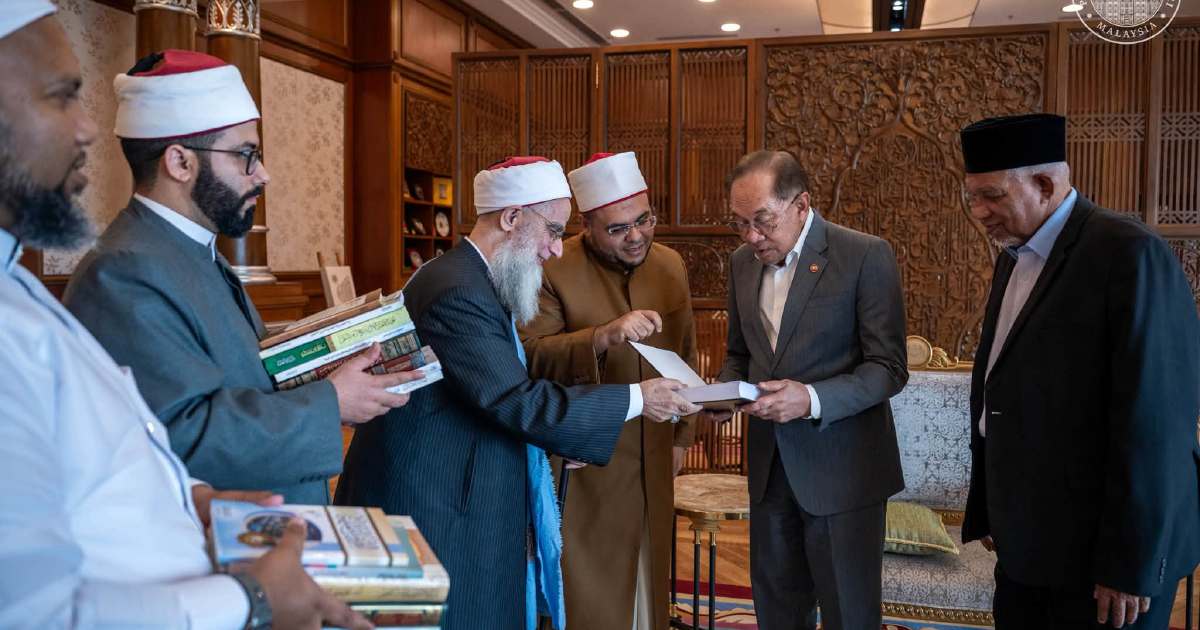
Prime Minister Datuk Seri Anwar Ibrahim received renowned Egyptian scholar Sheikh Dr Mustafa An-Nadwi Al-Hasani Mansurah at his official residence in Putrajaya, underscoring Malaysia's ongoing diplomatic and intellectual dialogue with prominent figures in the Islamic world. The meeting reflects the government's commitment to fostering relationships with influential scholars and thought leaders who shape contemporary Islamic discourse across the Middle East and beyond.
Sheikh Dr Mustafa An-Nadwi Al-Hasani Mansurah stands as a significant intellectual figure within Egypt's scholarly community, commanding respect for his contributions to Islamic jurisprudence and contemporary Islamic thought. His visit to Malaysia represents the kind of high-level academic exchange that strengthens cultural and intellectual ties between Southeast Asia and the Arab world, two regions with deep historical connections rooted in trade, migration, and shared Islamic heritage.
The reception at the Prime Minister's office carries symbolic importance in Malaysia's broader engagement strategy. By welcoming distinguished Islamic scholars, the Malaysian government demonstrates its positioning as a bridge between diverse Islamic traditions and a centre for moderate Islamic discourse in Southeast Asia. This approach aligns with Malaysia's historical role as a cosmopolitan Islamic nation that balances religious scholarship with multiculturalism and international cooperation.
Egyptian scholars have long played a pivotal role in shaping Islamic thought globally. Egypt's position as home to Al-Azhar University, one of Islam's most prestigious educational institutions, gives Egyptian Islamic figures considerable influence across Muslim-majority nations. The visit of Sheikh Dr Mustafa An-Nadwi Al-Hasani Mansurah therefore carries weightier implications than a routine diplomatic meeting, potentially signalling collaborative efforts on matters of Islamic education, scholarly exchange, or theological discourse.
For Malaysia, such engagements serve multiple strategic purposes. They enhance the nation's credentials as a serious participant in global Islamic intellectual conversations, attracting scholars and students to Malaysian Islamic institutions. Universities such as the International Islamic University Malaysia have built their reputations partly through hosting international scholars and facilitating cross-border research collaborations. Visits by figures of Sheikh Dr Mustafa An-Nadwi Al-Hasani Mansurah's stature can elevate Malaysia's standing within academic circles across the Muslim world.
The timing of this visit also reflects Malaysia's diplomatic priorities under Prime Minister Anwar Ibrahim's administration. His government has emphasised renewed engagement with the Middle East and Arab nations, seeking to strengthen economic partnerships, educational collaborations, and cultural exchanges. Egyptian ties hold particular value given Egypt's influence across the Arab world and its strategic position bridging Africa and the Middle East.
Moreover, the meeting occurs within a context of Malaysia's evolving role in promoting progressive Islamic scholarship. The nation has hosted numerous international conferences on Islamic finance, Islamic jurisprudence applied to contemporary challenges, and interfaith dialogue. Welcoming scholars like Sheikh Dr Mustafa An-Nadwi Al-Hasani Mansurah contributes to an intellectual ecosystem where Malaysia positions itself as intellectually serious about Islam while remaining open to diverse perspectives and global engagement.
For regional observers, such ministerial-level receptions of foreign Islamic scholars convey messages about Malaysia's international relationships and soft power ambitions. Southeast Asia increasingly competes for influence and prestige within the broader Islamic world, and academic and scholarly exchanges form part of this competition. Malaysian institutions hosting visiting professors and organising seminars featuring international scholars generates both intellectual vitality and enhanced regional standing.
The meeting also underscores how Malaysia navigates its identity as a Muslim-majority nation within a globalised world. Unlike some Muslim-majority nations that view international engagement with caution, Malaysia actively courts relationships with global Islamic intellectuals, viewing them as partners in advancing contemporary Islamic discourse rather than potential rivals. This openness has historically attracted scholars, students, and professionals to Malaysian shores.
Beyond the ceremonial aspects, such visits often facilitate substantive discussions on shared concerns facing Muslim societies, including education reform, combating extremism, economic development, and interfaith harmony. The private discussions between Prime Minister Anwar Ibrahim and Sheikh Dr Mustafa An-Nadwi Al-Hasani Mansurah likely touched on matters of mutual interest to both Malaysia and Egypt, though specific details remain within official channels.
The visit exemplifies how Malaysia maintains multiple diplomatic tracks simultaneously. While the nation pursues conventional economic and political relationships with countries worldwide, it simultaneously nurtures intellectual and religious connections that appeal to Malaysia's Muslim population and enhance its credibility within Islamic circles. This dual approach has become increasingly sophisticated under successive administrations.
Moving forward, such engagements may pave the way for more extensive collaborations between Malaysian and Egyptian institutions. Potential areas include student exchange programmes, joint research initiatives on Islamic studies, collaborative publications, and coordinated efforts in developing Islamic thought applicable to pressing modern challenges. The symbolic opening provided by ministerial-level visits creates pathways for deeper institutional relationships.

