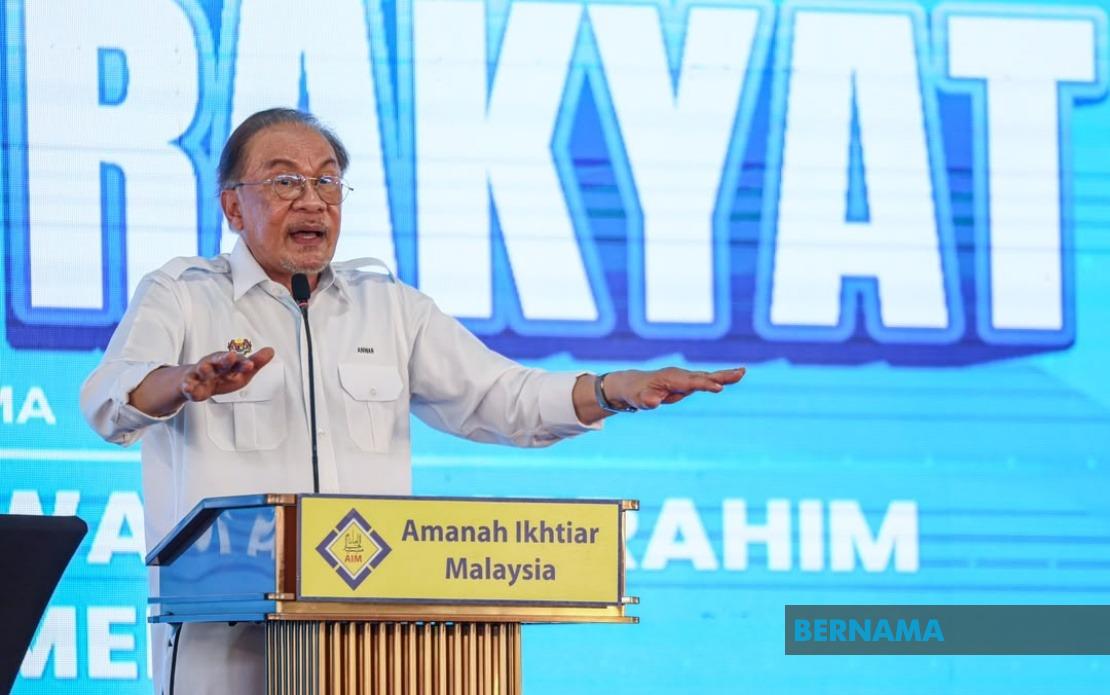
Prime Minister Datuk Seri Anwar Ibrahim has attributed mounting political opposition to his administration's resolute commitment to combating corruption and preventing the misuse of state power. Speaking at a campaign rally in Batu Pahat during the Johor state election campaign, the Pakatan Harapan chairman contended that the MADANI Government's unwillingness to tolerate financial misconduct or abuse of authority by public officials has created significant discomfort among certain political quarters, prompting them to coordinate against his leadership.
The Prime Minister characterised his government's approach as principled and non-negotiable, emphasising that safeguarding public resources and preventing officials from exploiting their positions for personal enrichment forms the cornerstone of his administration's governance philosophy. Anwar stressed that elected representatives should never use their office to acquire land, secure lucrative projects, obtain equity stakes, or accumulate private wealth through state mechanisms. This hardline position, he suggested, has naturally provoked resistance from those who view strict accountability as a threat to their interests and political viability.
Anwar dismissed suggestions that the political pressure directed at him would deter his administration from pursuing its anti-corruption agenda. Rather than viewing the coordinated opposition as cause for concern, he framed it as validation that his government's integrity measures are genuinely effective and consequential. His willingness to articulate this defensive posture publicly underscores the intensity of current political tensions and reflects the polarisation surrounding governance standards within Malaysia's political establishment.
To demonstrate his personal commitment to the principles he advocates, Anwar highlighted his own conduct during his tenure as Prime Minister. He noted that despite numerous visits to Johor in his official capacity, he has never personally acquired land, secured projects, or obtained shares within the state. This personal exemplification of clean governance reflects a deliberate strategy to contrast his leadership style with historical patterns of political patronage and self-enrichment that have characterised Malaysian politics. By establishing himself as a model of integrity, Anwar seeks to reinforce his anti-corruption messaging and establish a moral authority over his political opponents.
The Prime Minister appealed to Johor voters to grant Pakatan Harapan the opportunity to govern the state, framing such a mandate as essential for implementing comprehensive reform. His campaign messaging emphasised that state-level alignment with the federal government would facilitate more efficient delivery of development initiatives and welfare programmes. This appeal reflects a broader political strategy to consolidate power by securing state governments under PH control, thereby eliminating institutional friction and enabling coordinated policy implementation across multiple governance levels.
Anwar acknowledged that while Johor has received substantial infrastructure investment worth billions of ringgit, persistent gaps remain in addressing fundamental public needs. Housing affordability, road infrastructure, religious facilities including mosques and suraus, and welfare support for vulnerable populations continue to require attention. He critiqued the incumbent state administration for failing to translate resource availability into meaningful improvements in public welfare, particularly regarding housing accessibility for ordinary Malaysians. This line of argument positions PH as uniquely capable of ensuring that development gains benefit the broader population rather than concentrating wealth among narrow elite circles.
The Prime Minister's reference to Johor's relative prosperity carried implicit criticism of inequality within the state. His assertion that wealth should not concentrate exclusively among a privileged minority resonates with wider concerns about inclusive development and equitable resource distribution across Malaysia. By highlighting the disconnect between aggregate economic growth and individual living standards for ordinary Malaysians, Anwar taps into voter frustration with development models that generate headline statistics without translating into improved household circumstances.
Anwar devoted significant attention to defending Pakatan Harapan's coalition arrangement with the Democratic Action Party, a politically sensitive issue given DAP's multi-ethnic composition and historical friction with Malay-Muslim constituencies. He provided empirical reassurance by noting that during his three-and-a-half years as Prime Minister, DAP representatives within the Cabinet have never opposed programmes benefiting Malays or Islamic interests. This claim functions as a rebuttal to opposition accusations that PH's coalition structure undermines Malay-Muslim priorities. The specific framing invites voters to verify this assertion through public records, suggesting Anwar views documentary evidence of coalition behaviour as persuasive counter to political narratives questioning DAP's commitment to Malay-Muslim welfare.
The Prime Minister's remarks regarding enthusiastic voter turnout in Senggarang served multiple communicative purposes. Expressing his appreciation for supporters who endured extreme heat to attend the rally transformed a logistical observation into symbolic affirmation of his political momentum and grassroots appeal. This characterisation of extraordinary enthusiasm establishes a narrative of popular support and movement dynamism that contrasts with potential opposition messaging regarding declining PH popularity. The specific detail about supporters waiting in scorching conditions creates visceral imagery of genuine commitment rather than transactional political participation.
Anwar's exhortation to voters in Senggarang, Rengit, and Penggaram constituencies to mobilise behind PH candidates connected his national anti-corruption message to specific local electoral contests. The Johor state election, which involves 172 candidates competing across 56 constituencies with voting scheduled for July 11, represents a crucial test of PH's electoral viability and capacity to expand its state-level power base. Successful performance in Johor would substantially strengthen Anwar's political position and validate his governance approach. Conversely, poor electoral outcomes would undermine his anti-corruption narrative and strengthen opposition arguments regarding public dissatisfaction with PH leadership.
The campaign rally itself demonstrated the high stakes surrounding the Johor election for the federal government. Anwar's personal attendance reflected the electoral contest's national significance beyond parochial state-level concerns. His willingness to dedicate campaign time and explicitly connect anti-corruption governance to voter choice illustrates how corruption and accountability have become central to contemporary Malaysian political competition. Rather than remaining abstract institutional concerns, anti-corruption measures now function as concrete campaign platforms that political parties employ to differentiate themselves and appeal to voters demanding superior governance standards.
Anwar's political strategy involves reframing anti-corruption efforts as evidence of his administration's strength and determination rather than acknowledging them as responses to historical governance failures. This rhetorical repositioning transforms accountability measures from potential vulnerabilities into distinguishing accomplishments. By characterising political opposition as resulting from his firm stance against corruption, Anwar constructs a narrative where criticism becomes validation of his effectiveness. This approach requires voters to accept his interpretation of political conflict as fundamentally driven by differing governance philosophies rather than other potential factors.
Looking forward, the Johor state election results will provide significant insight into whether Malaysian voters prioritise anti-corruption governance and clean administration sufficiently to award electoral mandates to parties championing these commitments. The turnout, voting patterns, and campaign dynamics will indicate whether concerns about financial probity and accountability genuinely motivate voter behaviour or function primarily as rhetorical devices within broader political competition. For Anwar specifically, success would vindicate his governance approach and potentially position him as Malaysia's principal advocate for institutional integrity and transparent public administration.

