Prime Minister Datuk Seri Anwar Ibrahim has publicly thanked the Regent of Johor, Tunku Mahkota Ismail, for a recent courtesy visit, using the moment to deliver a pointed message about the proper boundaries between electoral competition and Malaysia's constitutional monarchy. Speaking at a Pakatan Harapan candidate announcement ceremony in Tangkak on June 22, Anwar framed the audience as a demonstration of healthy democratic practice, contrasting it with what he characterised as the irresponsible politicisation of royal institutions by some actors in the political landscape.
The Prime Minister's remarks carried implicit criticism of opponents who invoke the monarchy's name while avoiding direct political engagement. Anwar suggested that such tactics represent cowardice masquerading as deference to the crown, and argued that his willingness to receive the Johor Regent publicly sends a clearer signal about respectful inter-institutional relations than any electoral slogan could manage. By accepting the audience and subsequently consulting with the Johor Sultan, Anwar positioned his government as one that understands the delicate constitutional balance required in Malaysia's system of governance, where executive authority and royal prerogative must coexist.
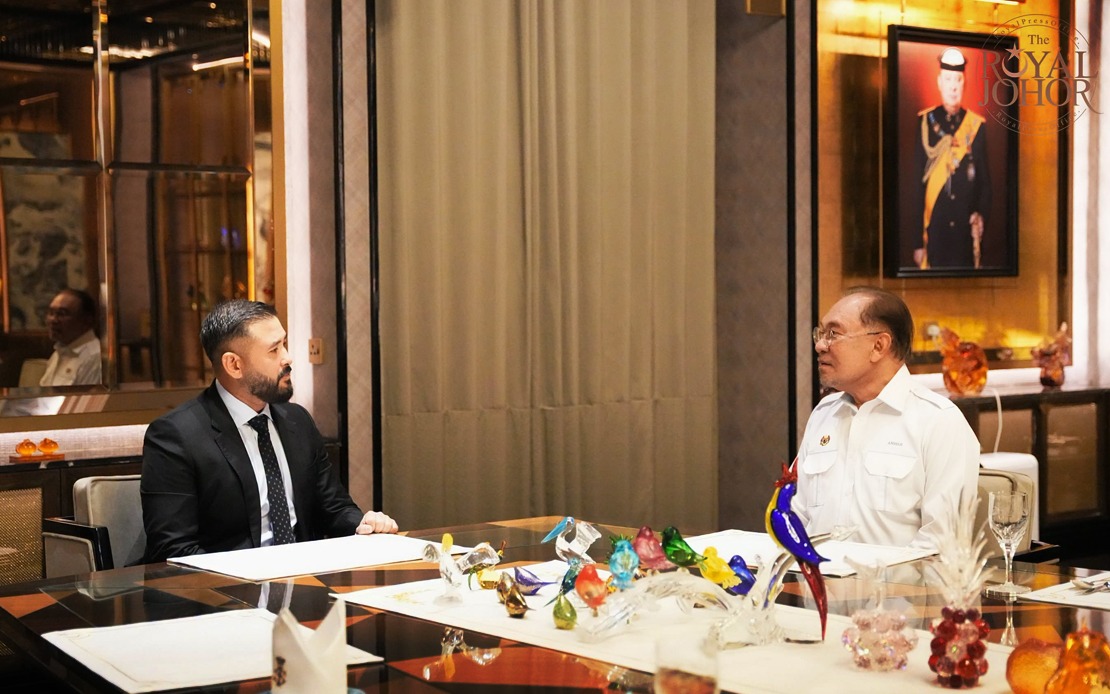
During his meeting with Tunku Mahkota Ismail, Anwar took the opportunity to brief the Regent on federal infrastructure and development initiatives specifically benefiting Johor's residents. This approach underscores the Prime Minister's strategy of using high-level engagements not merely for protocol but as occasions to communicate substantive policy achievements. For a state preparing for its 16th general election, such briefings carry practical significance, as they allow the federal government to articulate its contributions to local prosperity in conversations with influential stakeholders.
Anwar's insistence that political parties must shield the royal institution from campaign activities reflects growing concern within PH about the manipulation of traditional symbols in competitive politics. Malaysia's constitutional framework vests considerable symbolic and residual powers in the Malay Rulers, making them figures of immense national importance. When politicians invoke royal names or seek to create the impression of royal endorsement for partisan causes, they risk degrading both the integrity of electoral competition and the apolitical standing that sustains the monarchy's institutional health. Anwar's comments suggest his government views this boundary-setting as essential to Malaysia's political stability.
The presence at the ceremony of senior PH figures including DAP secretary-general Anthony Loke Siew Fook and Amanah president Datuk Seri Mohamad Sabu demonstrated coalition unity on this constitutional principle. Such consensus across the ideologically diverse PH partnership reinforces the message that respect for royal institutions transcends party divisions and is regarded as a governing norm rather than a partisan position. For Malaysian voters assessing which coalition demonstrates more mature stewardship of democratic institutions, such consistency holds significance.
Anwar's broader philosophy on sultan relations reveals an administration willing to engage in substantive dialogue even when disagreements emerge. Rather than viewing consultation as a formality to be completed, the Prime Minister characterised it as an ongoing conversation involving the exchange of perspectives, occasional disagreement, and mutual respect for advice offered in good faith. This framing acknowledges that Malaysia's constitutional monarchs are not rubber-stamp figures but individuals with legitimate voices in national governance, whose counsel carries weight even when not universally accepted.
The Prime Minister's respect extends to His Majesty Sultan Ibrahim, the King of Malaysia, with whom Anwar indicated similar patterns of consultation and candid exchange occur. By illustrating how his government navigates disagreement with the monarchy through dialogue rather than evasion, Anwar presented a model of constitutional governance that many Southeast Asian democracies struggle to achieve. Countries across the region face constant tension between assertive elected leadership and the ceremonial or substantive roles of traditional institutions, making Malaysia's approach instructive for regional observers.
For Johor specifically, Anwar's remarks carry immediate electoral implications. As PH campaigns for the state election, the visible support from the Regent—and the Prime Minister's public acknowledgment of that support—carries genuine weight in a state where royal connection remains deeply meaningful to voters. The Johor Sultanate has historically wielded significant influence in state affairs, and demonstrating alignment with the Regent's apparent openness to PH creates momentum for the coalition's campaign messaging.
Anwar's emphasis on consulting and seeking audiences reflects his conviction that democratic governance in Malaysia requires constant engagement with constitutional counterparts. Rather than centralising power within the executive, he has consistently advocated for respectful dialogue across institutional divides. This approach contrasts with more combative political styles that treat the monarchy as an obstacle or competitor for authority, and positions his administration as one comfortable with the constitutional distribution of power that Malaysia's founding documents establish.
The timing of these remarks, delivered during the Johor election campaign season, suggests strategic communication as well. By establishing early that his government consults properly with royal patrons and respects their institutional roles, Anwar preempts criticism from opponents who might otherwise claim that PH harbours republican or anti-monarchical sentiments. Simultaneously, he creates space to criticise opposition parties for supposedly exploiting royal names for electoral advantage without demonstrating comparable institutional respect.
Looking forward, Anwar's comments establish a benchmark for how PH will handle its relationship with the Malay Rulers throughout his tenure as Prime Minister. The willingness to acknowledge disagreement while maintaining respect, to seek counsel despite partisan pressures, and to shield royal institutions from electoral contamination will define whether his administration succeeds in sustaining both democratic vitality and constitutional monarchy health—a dual achievement that has eluded many governments in Southeast Asia.