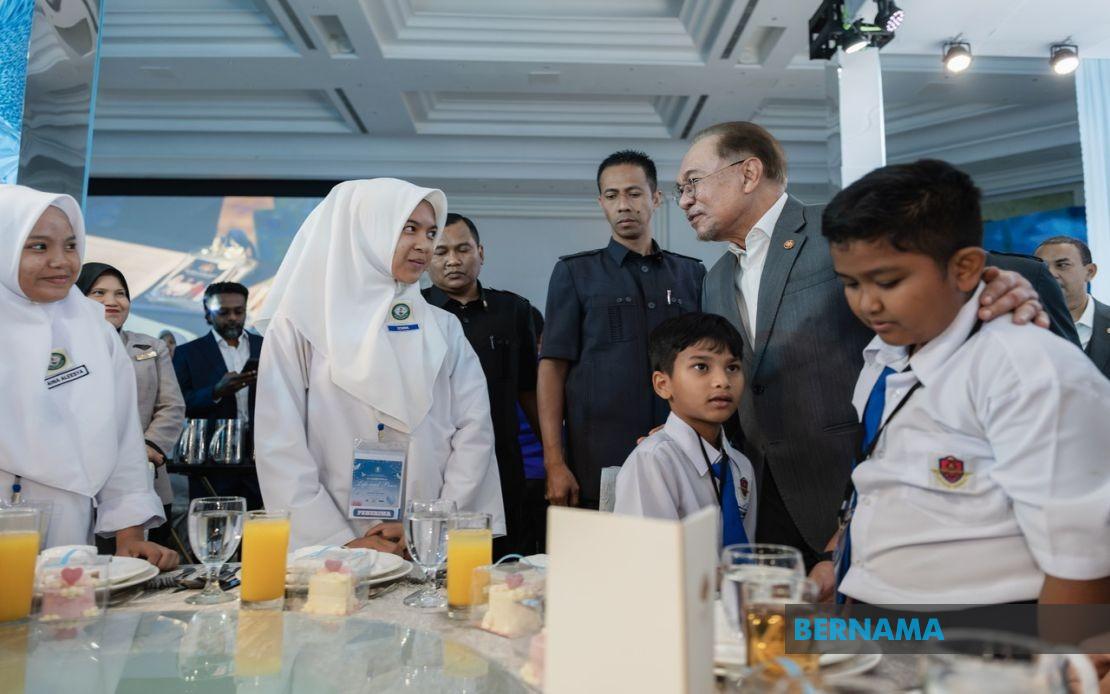
Prime Minister Datuk Seri Anwar Ibrahim has delivered a pointed message about the true purpose of education, arguing that intellectual prowess divorced from ethical conduct produces individuals ill-suited to contribute meaningfully to society. Speaking at a large gathering of schoolchildren in Kuala Lumpur and Putrajaya, the Prime Minister emphasised that parents and educators must work in concert to nurture young people who combine academic capability with emotional maturity and respect for others.
Anwar's remarks came during the "Celebration of Life and Peace" event organised by ERM Foundation, where he addressed approximately 700 pupils representing 47 schools across the federal territories. The occasion marked a confluence of birthday celebrations for the schoolchildren alongside commemoration of the foundation's founder, Xin'er. Accompanying the Prime Minister were his wife, Datuk Seri Dr Wan Azizah Wan Ismail, and his political secretary, Datuk Azman Abidin, underscoring the government's commitment to youth welfare initiatives.
The Prime Minister's central thesis challenged a purely academic-focused model of education that has long dominated discussions in Malaysia and across Southeast Asia. He articulated the view that schools exist for multiple purposes beyond transferring knowledge—they serve as institutions where young people should develop the capacity to empathise with others, internalise respect for authority figures such as teachers, and cultivate filial piety toward their parents. This framing represents a deliberate attempt to rebalance public discourse around educational outcomes, particularly as Malaysian society grapples with recurring concerns about student misconduct and social cohesion.
Anwar's specific reference to bullying carries particular resonance in the Malaysian context, where incidents of student violence and harassment have periodically sparked national concern and prompted institutional reviews. By casting bullying not merely as a disciplinary matter but as a fundamental impediment to students' life prospects, the Prime Minister elevated the issue from school-level problem to societal concern. He posed a rhetorical challenge to the assembled children, asking them to consider what kind of adults they wish to become, framing the choice between becoming "smart" yet harmful versus becoming capable contributors to society.
The ERM Foundation's founder, Xin'er, complemented these themes by contextualising the celebration within a broader humanitarian frame. She drew attention to the privilege inherent in the event itself—the ability to mark one's birthday with dignity, celebration, and community—noting that many children lack such opportunities due to illness or other hardships. This perspective grounded the occasion not in mere festivity but in gratitude and awareness of inequality, implicitly encouraging the young attendees to recognise their comparative advantages and channel them toward prosocial behaviour.
The practical dimensions of the event reflected the government's willingness to translate rhetorical commitments into tangible support. Each of the 700 schoolchildren received RM500 in direct cash assistance, a gesture that extends beyond symbolic recognition to material assistance for their families. The provision of food, entertainment, and activities throughout the day created an environment intended to be psychologically nourishing—what Xin'er termed an opportunity to experience "peace, love, and happiness" within a structured, celebratory context.
The timing and scale of this initiative merit consideration within Malaysia's broader policy landscape. As the nation continues navigating post-pandemic education recovery and grapples with mental health challenges among young people, governmental attention to holistic child development signals a shift in emphasis. Rather than focusing exclusively on standardised examination performance or STEM competencies, the event and the Prime Minister's remarks suggest an emerging recognition that resilience, emotional intelligence, and ethical grounding constitute equally vital educational outcomes.
For Malaysian parents and educators, the Prime Minister's message offers both validation and challenge. It validates approaches that prioritise character development alongside academic rigour, vindicating those who have advocated for more balanced pedagogies. Simultaneously, it challenges schools to create environments where bullying becomes socially unacceptable rather than a normalised feature of student life, and where respect for teachers and parents is actively cultivated rather than merely assumed.
The gathering also reflects official concern about maintaining social cohesion amid Malaysia's diversity. When a Prime Minister personally addresses 700 schoolchildren from multiple institutions across two federal territories, the symbolic weight extends beyond the immediate audience. Such events communicate to the broader public that leadership takes youth development seriously, that national unity requires cultivation at the grassroots level, and that preventing destructive behaviours like bullying constitutes a legitimate government priority worthy of ministerial attention.
Looking forward, the principles articulated at this event may inform ongoing discussions about educational reform and student wellbeing policy. If translated into systemic changes—whether through curriculum adjustments, teacher training initiatives, or school culture interventions—they could reshape how Malaysian schools approach the formative years when character and intellectual capacity develop concurrently. The challenge lies in moving from inspirational rhetoric to sustained institutional implementation, ensuring that the message reaches not merely select groups of pupils at specially organised events but permeates everyday school experience across Malaysia's diverse educational landscape.

