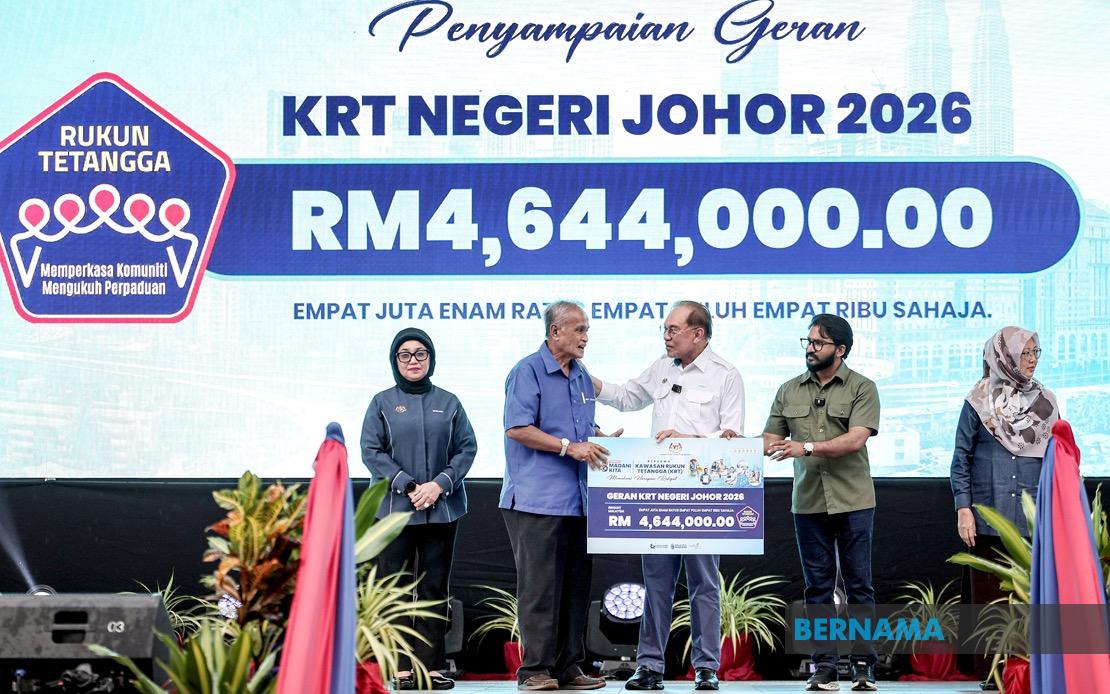
Prime Minister Datuk Seri Anwar Ibrahim has approved a significant boost to grassroots community policing in Malaysia, raising the annual grant for Neighbourhood Watch Areas known as KRT to RM10,000 from the current RM6,000. The new allocation will take effect on January 1, 2027, representing the first increase to the scheme in ten years. The announcement was made at the MADANI KITA Programme with KRT representatives in Segamat, Johor, an event that underscored the government's commitment to strengthening community-led security initiatives at the neighbourhood level.
The prolonged stagnation in KRT funding has been a persistent challenge for local watch committees across the country. For the past decade, the RM6,000 annual grant remained fixed despite inflation and rising operational demands on these volunteer-driven organisations. Anwar acknowledged this oversight, noting that the institution's contribution to addressing community concerns and supporting grassroots governance warranted a more responsive budgetary approach. The 67 per cent increase in the grant represents a tangible recognition of KRT's value within Malaysia's decentralised security framework, which relies heavily on community participation to complement formal law enforcement efforts.
The Prime Minister framed the grant increase within a broader narrative about Malaysia's multicultural and multireligious cohesion. He emphasised that KRT committees serve as vital nodal points for fostering consensus, dialogue, and national unity across neighbourhoods where residents of different backgrounds interact daily. In this framing, the financial support is not merely an administrative adjustment but a strategic investment in the social fabric that has underpinned Malaysia's stability since independence. Anwar stressed that Malaysia's strength derives from its capacity to celebrate rather than fear racial, cultural, and religious diversity, and that community organisations like KRT play a crucial role in reinforcing this commitment at the grassroots.
The grant announcement was accompanied by the presence of Deputy Minister of National Unity R. Yuneswaran and Deputy Minister of Domestic Trade and Cost of Living Datuk Dr Fuziah Salleh, reflecting the cross-departmental coordination involved in community development initiatives. The attendance of these officials signalled that neighbourhood watch funding is not isolated from broader policy areas such as cost-of-living relief and social cohesion, suggesting an integrated approach to governance that connects security, economic resilience, and community welfare.
Beyond the KRT grant, the Prime Minister unveiled additional allocations targeting institutional infrastructure in Johor. An immediate injection of RM3.205 million was approved for essential repairs and upgrades at sixteen Islamic educational facilities across multiple districts including Batu Pahat, Muar, and Segamat. These funds are designated for religious schools, madrasahs, study centres, and tahfiz institutions where significant numbers of Malaysian students receive Islamic education. The decision reflects the MADANI Government's stated priority of ensuring that educational institutions, regardless of their religious character, operate in environments conducive to learning and student wellbeing.
The allocation to Islamic educational institutions addresses a longstanding infrastructure gap in Malaysia's religious education sector. Many such facilities operate on constrained budgets and depend heavily on government support to maintain their physical infrastructure. By prioritising basic repairs and upgrades, the government aims to create more comfortable and effective learning spaces, which indirectly supports the quality of education and student outcomes. For Malaysian parents sending children to these institutions, improved facilities represent a tangible improvement in educational quality and student safety.
A separate RM1.0 million allocation was approved for urgent repair work at Royal Malaysian Police quarters in Johor, addressing housing conditions for uniformed personnel who work in frontline security roles. Anwar positioned this commitment as integral to maintaining the morale and welfare of security personnel, whose working conditions directly impact their capacity to discharge national defence responsibilities effectively. Police housing conditions have been a recurring concern among law enforcement unions and personnel associations, so targeted investment in quarters represents both a humanitarian gesture and a practical recognition of the link between officer welfare and operational effectiveness.
The cumulative spending announced in Segamat, totalling approximately RM4.205 million, demonstrates a strategic allocation approach that spans community policing, religious education, and security personnel welfare. This multi-pronged investment strategy reflects the government's understanding that national stability and cohesion require sustained support across multiple institutional domains rather than concentration in any single area. The announcement also signals responsiveness to long-standing advocacy from community organisations and civil society groups who have repeatedly called for adequate resourcing of grassroots initiatives.
For Malaysian communities, particularly in suburban and semi-rural areas where KRT committees operate with significant autonomy, the grant increase carries practical implications. The additional RM4,000 annually can enable KRTs to expand community engagement activities, improve communication infrastructure, conduct training for volunteers, and respond more flexibly to localised security challenges. The timing of the disbursement on January 1, 2027, allows committees to plan their annual budgets with greater certainty and allocate resources to high-impact initiatives identified through community consultation.
The KRT scheme itself occupies a distinctive position within Malaysia's security architecture, operating as a bridge between formal policing and civic participation. Unlike other neighbourhood watch models in Southeast Asia that remain largely voluntary and unfunded, Malaysia's KRT receives government financial support, reflecting official recognition of community policing's role in crime prevention and social order maintenance. The grant increase underscores this commitment while potentially encouraging greater participation in KRT committees, which depend on volunteer time and civic commitment from residents.
The announcement also carries implications for municipal governance and local administration. KRT committees often interact with local councils, district offices, and police contingents, and enhanced funding may enable more structured coordination mechanisms at neighbourhood level. Better-resourced KRTs could potentially conduct more systematic feedback collection from residents, conduct community surveys, and feed structured intelligence to relevant authorities about local concerns ranging from public safety to infrastructure gaps.
For the broader Southeast Asian region, Malaysia's renewed investment in community-based security models may hold relevance as other countries grapple with balancing formal policing with community engagement. The emphasis on consensus-building and multicultural participation within the KRT framework offers a model that prioritises social cohesion alongside crime prevention, contrasting with purely enforcement-oriented approaches. The grant increase signals that Malaysia continues to view community organisation as foundational to national stability rather than supplementary to state security provision.
Moving forward, the government's commitment to KRT sustainability through indexed or regularly reviewed funding levels will likely remain a topic of advocacy and discussion among community groups. The ten-year interval before the previous increase suggests that ongoing advocacy may be necessary to ensure that future grants maintain purchasing power amid inflation and changing community needs. Nevertheless, the Segamat announcement represents a significant reaffirmation of government support for the grassroots institutions that constitute Malaysia's first line of defence against social fracture and community-level security challenges.