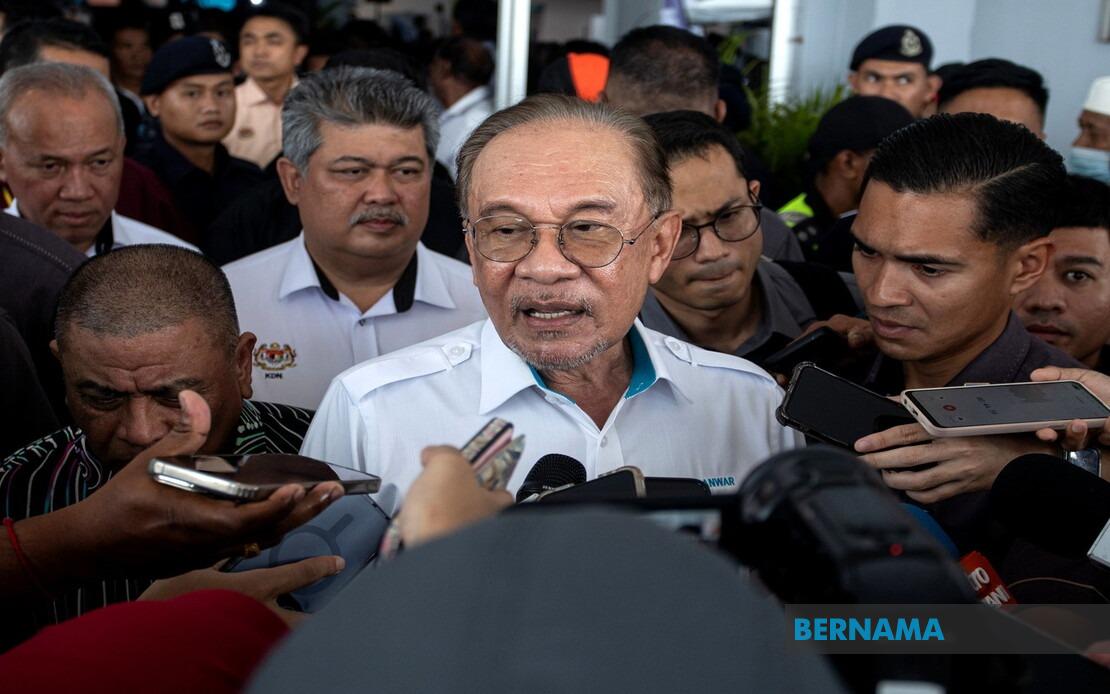
Prime Minister Datuk Seri Anwar Ibrahim issued a stern reminder to government officials on Friday that they must observe strict discipline and refrain from criticising the Federal Government while campaigning in state elections, emphasizing that such attacks undermine the political landscape and threaten the stability of the ruling coalition.
Speaking in Ipoh following the MADANI KITA with the Tambun Community programme, Anwar outlined clear expectations for those serving in ministerial, deputy ministerial, and agency leadership positions. He explained that while the Malaysian democratic system permits coalition partners to contest against one another at the state level—even when they remain united federally—this arrangement comes with conditions that government officials must respect.
The Prime Minister stressed that individuals holding official positions are bound by codes of conduct and institutional discipline. Those unwilling to accept these constraints face a straightforward choice: step aside from their posts. This ultimatum reflects a hardline approach to maintaining cohesion within the Unity Government, a coalition that has already weathered considerable internal tensions since its formation following the 2022 general election.
Anwar's directive addresses a recurring tension within Malaysian politics, where coalition partners frequently compete fiercely in state-level contests while maintaining federal cooperation. This duality creates opportunities for politicians to grandstand before state audiences by attacking their federal allies, a tactic that, if left unchecked, can erode the institutional credibility of the government itself. By publicly establishing boundaries, Anwar seeks to prevent the kind of internal friction that could undermine policy delivery or weaken public confidence in the administration.
The Prime Minister clarified that government candidates retain full freedom to campaign on state-specific issues and local grievances—a vital distinction that acknowledges the legitimate differences in priorities between state and federal governance. However, this freedom explicitly excludes launching attacks on the Federal Government or its policies. The distinction appears designed to prevent ambitious state-level politicians from using national institutions as convenient targets for political point-scoring.
According to Anwar, these guidelines have already been discussed with his two deputies, Datuk Seri Dr Ahmad Zahid Hamidi and Datuk Seri Fadillah Yusof, indicating that the message originates from the highest levels of government. This coordination between the Prime Minister and his deputies suggests awareness that disciplinary reminders require consistent messaging throughout the executive hierarchy to achieve compliance.
Beyond individual conduct, Anwar articulated a broader institutional objective: maintaining cordial working relationships between federal and state governments regardless of which parties control them. This vision extends beyond mere political maneuvering to encompass practical governance. The Prime Minister emphasized that preserving these relationships at both governmental levels remains essential for delivering effective public services, particularly in areas where federal and state authorities must coordinate—including education, healthcare, infrastructure, and social welfare.
As Pakatan Harapan chairman, Anwar has urged all parties within the Unity Government to prioritize this collaborative approach. The emphasis on growing stronger relationships while maintaining cordiality suggests recognition that the coalition's stability depends not just on formal agreements but on consistent mutual respect and restraint from individual politicians. This institutional approach contrasts sharply with adversarial politics, where candidates frequently weaponize opponent failures for electoral advantage.
The timing of Anwar's remarks carries significance, as various state elections loom on Malaysia's political calendar. State contests historically provide platforms for ambitious politicians to raise their profiles and challenge incumbent parties within government coalitions. By establishing clear expectations before these campaigns intensify, Anwar attempts to establish ground rules that prevent electoral competition from metastasizing into serious coalition fractures.
For Malaysian voters and observers, these reminders illuminate ongoing challenges within the Unity Government framework. The coalition unites ideologically diverse parties—from Barisan Nasional components like UMNO to Pakatan Harapan members including DAP and PKR—under a federal arrangement that remains fragile. Each state election becomes a crucible where these tensions surface, testing whether coalition discipline can withstand electoral pressures.
Regionally, Malaysia's experience offers lessons for other Southeast Asian democracies attempting to maintain multi-party coalitions. The explicit articulation of conduct expectations, combined with consequences for violations, reflects a maturing approach to coalition governance that acknowledges political competition while protecting institutional interests.
Moving forward, the effectiveness of Anwar's directive will depend entirely on compliance from government officials and coalition partners. Should ambitious politicians disregard these warnings and attack the Federal Government during state campaigns, the Prime Minister's credibility rests on enforcing promised consequences through resignations or removals. This enforcement capacity will ultimately determine whether the Unity Government framework proves sufficiently robust to manage internal competition while delivering on its promise of stable, effective governance across Malaysia's diverse political landscape.

