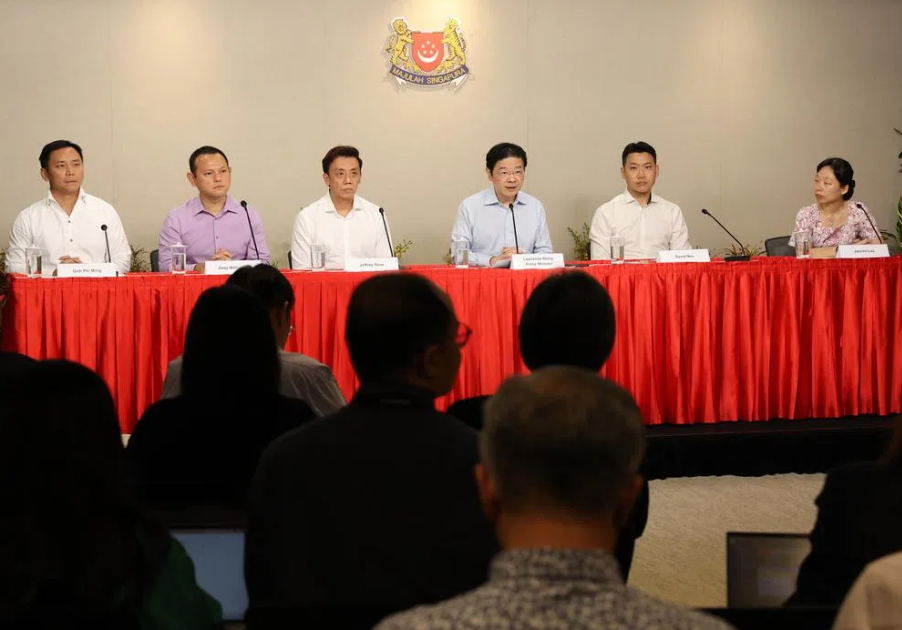
Prime Minister Lawrence Wong has moved to accelerate Singapore's political succession by elevating a cohort of first-term politicians into prominent ministerial positions, signalling the republic's determination to maintain executive continuity whilst refreshing its leadership ranks. The Cabinet reshuffle, unveiled on July 22, comes in response to recent high-profile resignations and reflects an intentional strategy to blend the steady hands of experienced statesmen with the energy of a newer generation of elected representatives who have proven themselves during their initial years in office.
Two Members of Parliament elected in GE2025—Jeffrey Siow and David Neo—have been elevated to full ministerial status, a promotion that rewards their rapid integration into government operations over the preceding months. Both men have served as acting ministers since May 2025, with Siow overseeing Transport and Neo managing Culture, Community and Youth portfolios respectively. Their transition from interim appointments to permanent posts indicates that Wong has assessed them as sufficiently grounded in their briefs and capable of commanding the confidence of permanent secretaries and senior civil servants—a crucial threshold for advancement in Singapore's technocratic system.
First-term MP Jasmin Lau will assume the role of acting minister at the Manpower Ministry, taking the reins from Tan See Leng, who shifts to become Minister for Trade and Industry with responsibility for the Energy and Industry portfolio. The deployment of younger politicians into labour affairs is strategically significant, as Singapore's workforce dynamics and aging demographics make this ministry increasingly central to long-term economic planning. Lau's appointment reflects Wong's confidence that she can manage the political sensitivity of employment policy whilst navigating unions and employer concerns.
The reshuffle also draws two backbench MPs—Foo Cexiang and Shawn Loh—into ministerial positions as ministers of state. Both are first-term representatives and former senior civil servants, suggesting that Wong is recruiting from the ranks of those who understand government machinery from inside, potentially accelerating their learning curve in elected office. This move underscores a deliberate strategy to pull capable individuals from Parliament's back benches into executive roles rather than waiting for them to develop profiles solely through parliamentary work.
Labour chief Ng Chee Meng returns to Cabinet as Minister in the Prime Minister's Office, whilst K. Shanmugam assumes the Senior Minister designation alongside Lee Hsien Loong. Wong explicitly described these two veterans as the Cabinet's most experienced members, signalling that whilst the government is promoting youth, it remains anchored to the counsel of seasoned operators. Shanmugam retains his Coordinating Minister for National Security position, underlining the priority Singapore places on this portfolio even as broader leadership transitions occur.
The reshuffle was triggered by two significant political departures in 2026. Acting Minister-in-charge of Muslim Affairs Faishal Ibrahim resigned on July 20 following what he characterized as a "lapse of judgment" in managing personal interactions with a woman; he also held the rank of Senior Minister of State for Home Affairs. Earlier, in June, senior minister of state Koh Poh Koon stepped down citing family reasons. Wong's framing of these departures as "unexpected changes" requiring Cabinet adjustment reflects his effort to portray the reshuffle as responsive governance rather than purely routine renewal, though he also noted that Cabinet composition is reviewed annually.
Wong's emphasis on building a "strong pipeline" addresses a perennial concern in Singapore's political system: the capacity to identify and nurture multiple tiers of ready talent to ensure continuity across successive administrations. His comment that "it is not just the ministers; you need younger office-holders, you need good backbenchers" reveals an understated anxiety about ensuring sufficient depth of capability at multiple levels of government. For Malaysia and other Southeast Asian observers, Singapore's systematic approach to succession planning offers a counterpoint to more ad-hoc or personality-driven transitions seen regionally.
Wong declined to appoint a second deputy prime minister alongside Gan Kim Yong, instead characterizing the current structure as providing "a strong senior leadership team" whilst remaining subject to future review. This decision reflects either confidence in current arrangements or caution about prematurely signalling succession intentions. He justified the architecture by pointing to the existence of three coordinating ministers—Shanmugam overseeing national security, and Chan Chun Sing and Ong Ye Kung coordinating other government operations—which Wong suggested distributes leadership responsibilities effectively without the symbolic weight of deputy prime ministerial appointments.
On his own tenure as Finance Minister—a portfolio he has held since 2021—Wong described his search for a successor as a "work in progress," arguing that individuals develop capability at different paces. This candid acknowledgment that no clear finance successor has yet emerged suggests either that the transition timeline remains distant or that Wong has not yet identified an individual combining the technical mastery and political judgment the position demands. The comment carries implications for Malaysia's own financial stewardship questions, where succession at the Ministry of Finance remains a live political issue.
Wong framed the overall reshuffle as expression of "the Singapore way of leadership renewal," portraying succession as a continuous process rather than a punctuated event. This rhetorical positioning allows the government to present itself as perpetually refreshing whilst actually maintaining significant continuity, a balance that appeals both to voters wanting generational change and to establishment interests seeking stability. The changes take effect progressively from July 27 onwards, with some taking effect later, permitting staggered transitions rather than wholesale upheaval.
The reshuffle's significance for the broader region lies in its demonstration of how a small, tightly-managed political system manages succession within a dominant-party framework. Unlike Malaysia, where factional competition within Pakatan Harapan and UMNO regularly disrupts executive stability, Singapore's ruling party orchestrates transitions from within, maintaining control over timing and personnel whilst adjusting course based on performance assessments. For observers in the region grappling with questions of leadership renewal and institutional continuity, the Singapore model offers both lessons in systematic development and reminders of the constraints inherent in less pluralistic systems.

