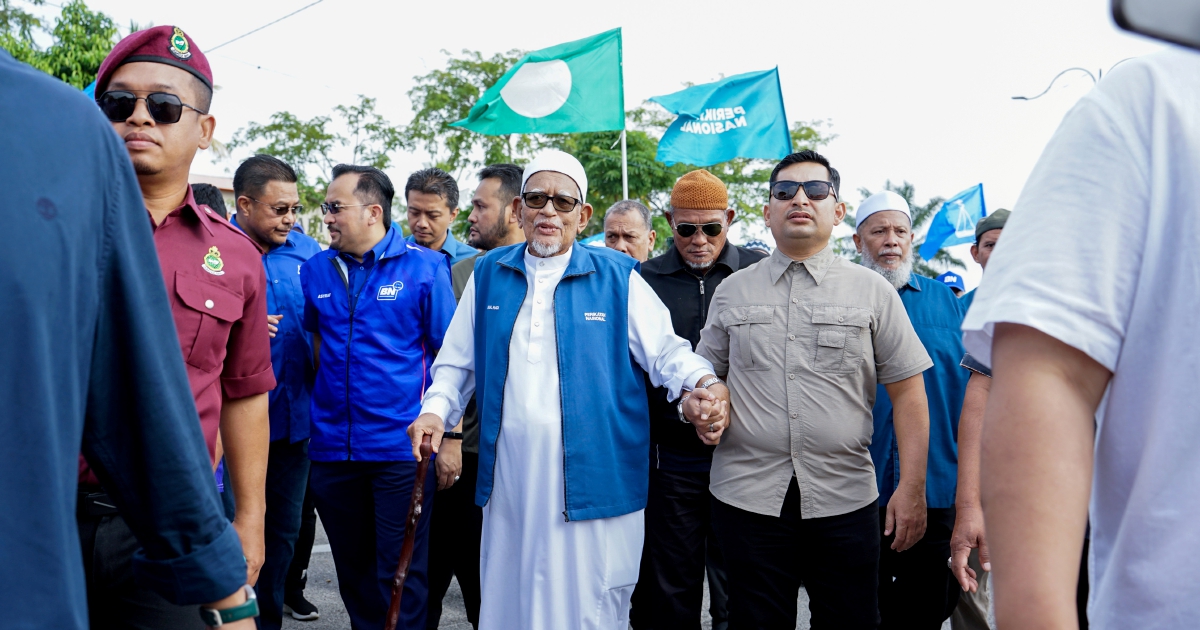
Perikatan Nasional and Barisan Nasional remain engaged in active negotiations over how to divide contested seats in the upcoming Melaka state election, PAS president Tan Sri Abdul Hadi Awang disclosed while in Marang. The announcement signals that despite recent political tensions between the two coalitions, behind-the-scenes discussions continue on how to structure their respective campaigns in the southern state.
The negotiations underscore the delicate balance Malaysia's top political formations must strike when pursuing elections at the state level. While PN and BN have positioned themselves as rivals on the national stage, state elections often necessitate pragmatic agreements that allow both groups to contest without damaging each other's electoral prospects. Melaka, a crucial coastal state with significant economic and political weight, represents exactly the sort of battleground where such calculations become essential.
Hadi's candid acknowledgement of the ongoing discussions reflects PAS's pivotal role as a kingmaker in contemporary Malaysian politics. The party's dual membership in PN while maintaining influence across multiple state governments makes it instrumental in brokering any arrangement between the two coalitions. By publicly confirming these talks, the PAS leadership appears to be signalling confidence that a workable settlement remains achievable, despite the complexity of competing interests involved.
Seat allocation negotiations in Malaysian elections typically hinge on several factors: each coalition's perceived electoral strength in specific constituencies, the performance of component parties in previous contests, demographic trends, and the desire to avoid multi-cornered fights that could split opposition or government votes. In Melaka specifically, the dynamics are complicated by the state's political history of shifting allegiances and its relatively compact geography, which means campaign resources can be concentrated efficiently but also means that poor negotiations could lead to mutual damage.
The timing of these negotiations is particularly significant given the broader political landscape. BN, under Prime Minister Datuk Seri Anwar Ibrahim's leadership, has sought to consolidate power following the 2023 general election. PN, meanwhile, has been attempting to rebuild itself as a credible alternative while maintaining its presence in several state governments. Melaka, where BN has historically held sway, represents an opportunity for both camps to demonstrate electoral viability and claim momentum.
For Malaysian voters and political observers, the PN-BN seat talks carry implications beyond Melaka itself. How the negotiations conclude will send signals about the broader stability of Malaysia's political architecture. A smooth settlement suggests these coalitions can cooperate when mutual interests align, potentially smoothing governance at the national level. Conversely, a breakdown in talks would intensify rivalry and could trigger competitive positioning that affects federal politics.
The state election context also matters for Southeast Asia's broader political economy. Melaka's strategic location along the Strait of Melaka and its significance as a commercial hub mean that governance stability—and the political configuration that ensures it—carries regional weight. Foreign investors and neighbouring governments watch Malaysian state elections partly to gauge political predictability and institutional health.
Previous seat-sharing arrangements between PN and BN have produced mixed results. In some contests, cooperation worked smoothly; in others, component parties from each coalition clashed bitterly despite top-level agreements. The complexity arises because PN comprises different parties—PAS, Bersatu, and others—with varying interests, as does BN with UMNO, MCA, MIC, and smaller allies. Hadi's statements suggest that PAS, as a central player, is trying to shepherd an arrangement that satisfies the most important stakeholders.
The substance of negotiations likely revolves around how many seats each coalition controls versus how many remain genuinely contested. PN will want sufficient representation to prove it remains a serious electoral force, while BN will seek to demonstrate continued dominance in a state traditionally aligned with its formation. The mathematics of Melaka's assembly—the specific number of state seats—directly constrains what either side can concede.
Background context is essential: Melaka's political history includes periods of BN control, PAS influence, and recent shifts that reflect broader Malaysian electoral volatility. The state has experienced coalition changes and internal power struggles that have sometimes destabilised governance. This history makes principled seat allocations important; they help prevent the sort of fractured mandates that have previously paralysed state administrations.
Hadi's public confirmation of negotiations also serves an internal political purpose within both coalitions. By transparently acknowledging talks are happening, he forestalls speculation that might otherwise generate damaging rumours or create the impression of secretive backroom dealings. For the grassroots members of both coalitions, clarity about negotiations—even if final terms remain confidential—helps maintain confidence in leadership decision-making.
The broader question for Malaysian readers is whether PN and BN can establish a sustainable framework for state-level cooperation that survives inevitable disputes over specific constituencies. The Melaka negotiations will set a template that other states may emulate or reject, depending on how successfully the two coalitions reconcile competing ambitions.

