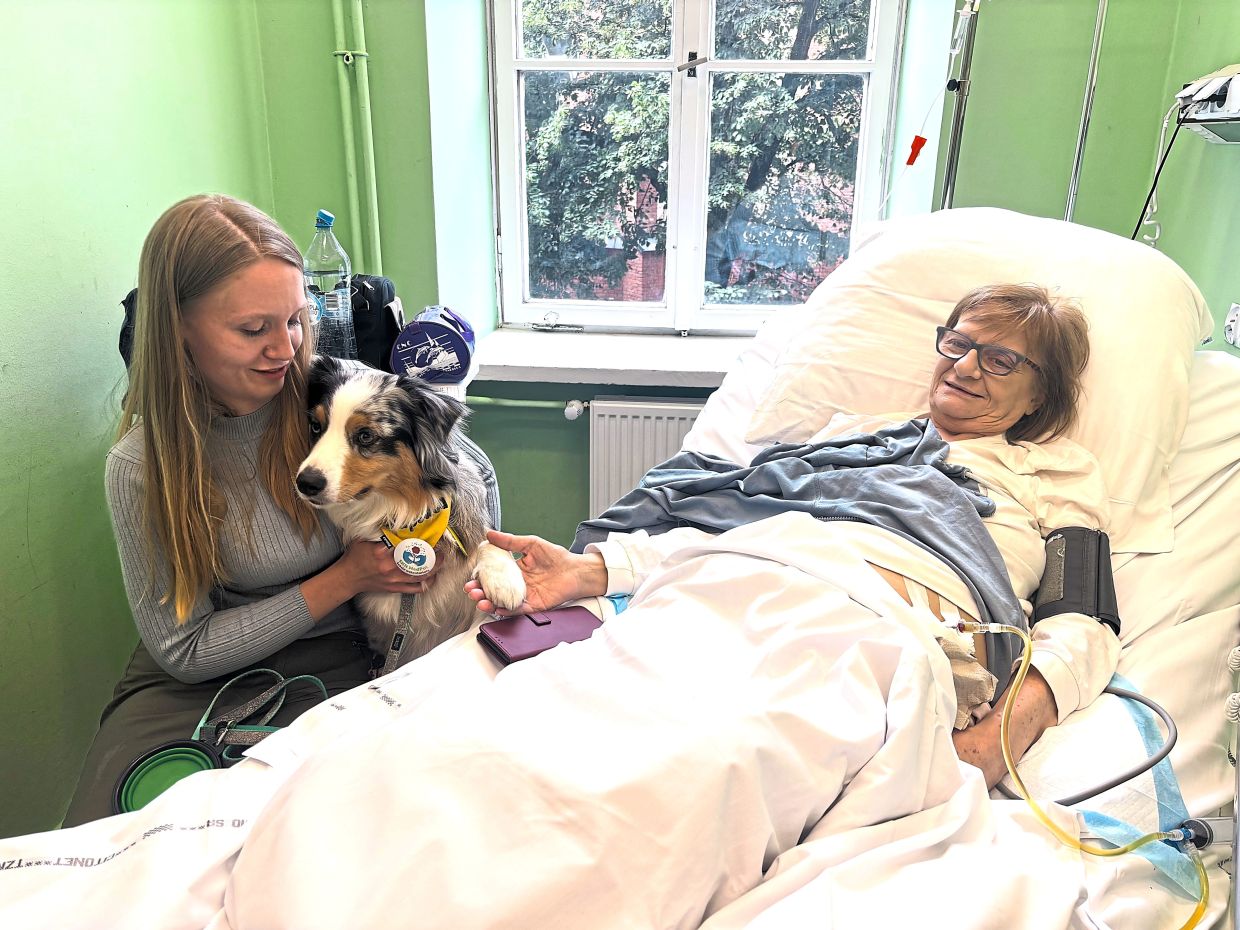
Poland is moving forward with groundbreaking legislation that would grant terminally ill patients a legal right to receive visits from their pets while in hospices and palliative care wards. The proposed law, introduced to parliament by a member of Prime Minister Donald Tusk's centrist party, represents a significant shift in how Polish healthcare facilities approach end-of-life care, recognizing the profound emotional and psychological benefits that animal companionship can provide to dying patients. While some hospitals already permit such visits on a case-by-case basis, the new law would establish universal protections and standardized protocols across all such facilities.
The initiative emerged from the personal experience of Dr Tomasz Dzierzanowski, director of the Palliative Medicine Clinic at the Medical University of Warsaw, who witnessed firsthand the transformative impact of pet reunion on a terminally ill cancer patient named Waldemar. Dzierzanowski arranged for Waldemar's two cats to visit him in the ward, and the emotional response—tears of joy from the patient and visible reactions from the animals, hospital staff, and other patients—crystallized his conviction that institutional barriers to pet visitation needed to be dismantled. That pivotal moment catalyzed Dzierzanowski's determination to champion legislative reform, turning anecdotal observation into systematic policy advocacy.
At the heart of the proposal lies a recognition of what Dzierzanowski identifies as an epidemic of loneliness afflicting modern society, particularly among patients facing their final days. He points to a demographic reality that many find overlooked: older patients in palliative care frequently find themselves isolated because they have outlived their peers and social circles. Simultaneously, younger terminally ill patients often lack the robust offline friendships that earlier generations cultivated, having invested instead in digital networks and virtual relationships that cannot provide the immediate comfort and presence required during profound suffering. In such circumstances, Dzierzanowski argues, the presence of a familiar animal companion serves not merely as a comfort but as a vital anchor to emotional continuity and identity.
The palliative medicine specialist articulates a philosophy of compassionate end-of-life care that prioritizes human connection above all else. His assertion that "we make sure that no patient dies alone" reflects a principle that extends beyond the availability of medical professionals or family members. When human relationships are unavailable—whether through death, distance, or circumstance—Dzierzanowski contends that society has a responsibility to facilitate alternative forms of meaningful companionship. For many patients, this means their beloved pets, creatures with whom they have built irreplaceable bonds and who offer presence unburdened by the awkwardness or complexity that sometimes accompanies human relationships during terminal illness.
Ewa Lutka-Krawczyk, a 70-year-old gallbladder cancer patient currently admitted to the Warsaw hospital, exemplifies the stakes involved in this legislative effort. When she received her dire diagnosis, her first concern was not her own mortality but the fate of Gaja, a shelter dog she adopted three years ago and to whom she remains deeply attached. She pleaded with her doctor to predict that she would survive long enough to ensure Gaja would not be abandoned. The separation has proven agonizing: back at home with Lutka-Krawczyk's husband, Gaja has ceased eating, clearly pining for her absent companion. The proposed legislation would guarantee that Lutka-Krawczyk could receive visits from Gaja during her final days, transforming a source of existential anxiety into an opportunity for shared comfort.
Lawmaker Katarzyna Piekarska, who introduced the legislation to parliament's health committee, acknowledges that the practical reality already exceeds the legal framework. "In reality, animals in hospitals are already there anyway," she observes, noting that ad-hoc pet visitation occurs throughout Polish healthcare facilities despite the absence of formal statutory authorization. Her point highlights a common pattern whereby institutional practice outpaces legal codification, creating ambiguity and inconsistency. The proposed law would regularize and legitimize what already transpires informally, while simultaneously establishing minimum standards and protections for both patients and animals.
Beyond family pets, Dzierzanowski's clinic also welcomes certified therapy dogs, whose presence generates measurable benefits across the entire hospital ecosystem. Kluska, an Australian shepherd whose name means "dumpling" in Polish, regularly makes rounds with her handler Malgorzata Brzozowska, a medical student. During a recent visit, Kluska provided distraction and momentary solace to patients like Lutka-Krawczyk, who held the dog's paw and smiled despite her suffering, and Wojciech Zelik, a 58-year-old tumor patient who mustered the energy to admire Kluska's fluffy coat and watch her perform tricks. The therapeutic benefits extend beyond patients: hospital staff members, including nurses and kitchen workers, visibly relaxed during contact with Kluska, crouching down to stroke her fur and offering treats.
Brzozowska, drawing on her medical training alongside her experience as a therapy dog handler, emphasizes that the restorative impact intensifies when patients encounter their own cherished pets rather than unfamiliar animals. The animals themselves experience demonstrable stress reduction when reunited with their owners, a response that Brzozowska interprets as evidence of animals' intuitive understanding of human mortality and separation. "The dog isn't as stressed," she explains. "We interpret this as meaning that he simply knows what's happening, that he knows where the owner, who was always there before, has disappeared to." This observation suggests that animals may possess emotional intelligence regarding human distress that transcends behavioral conditioning.
The proposed legislation carries implications that extend well beyond Poland's borders. As Southeast Asian nations increasingly confront aging populations and rising end-of-life care demands, the Polish model offers a template for integrating animal companionship into palliative medicine systems. Malaysia, where multigenerational households remain common but isolation nonetheless affects vulnerable elderly populations, could learn from Poland's legislative approach. The framework demonstrates how statutory frameworks can codify compassionate practices while establishing safeguards for hygiene, infection control, and animal welfare—practical concerns that hospitals rightly emphasize.
From a broader healthcare perspective, the Polish initiative reflects a paradigm shift in how medical institutions conceptualize terminal care. Rather than viewing hospices purely as clinical spaces for symptom management, the legislation embeds them within a holistic framework acknowledging that dignity at life's end encompasses emotional and spiritual dimensions alongside physical comfort. This aligns with growing international recognition, reflected in organizations like the World Health Organization, that palliative care should address suffering in its full complexity. The Polish model suggests that such comprehensive care need not require extraordinary expense or resource commitment; rather, it demands primarily institutional willingness to recognize pets as legitimate therapeutic agents.
For patients like Lutka-Krawczyk and families grappling with terminal illness, the passage of this legislation would represent meaningful acknowledgment that their connections extend beyond the nuclear family and that society recognizes those connections' legitimacy and importance. It signals that even in medicine's most difficult moments—when conventional treatments have exhausted themselves and cure has become impossible—institutions can prioritize what matters most to individuals facing death. In this sense, the Polish legislative effort transcends pet policy and becomes fundamentally about human dignity and the right to face mortality on one's own terms, surrounded by all the sources of comfort and meaning that have shaped a life.

