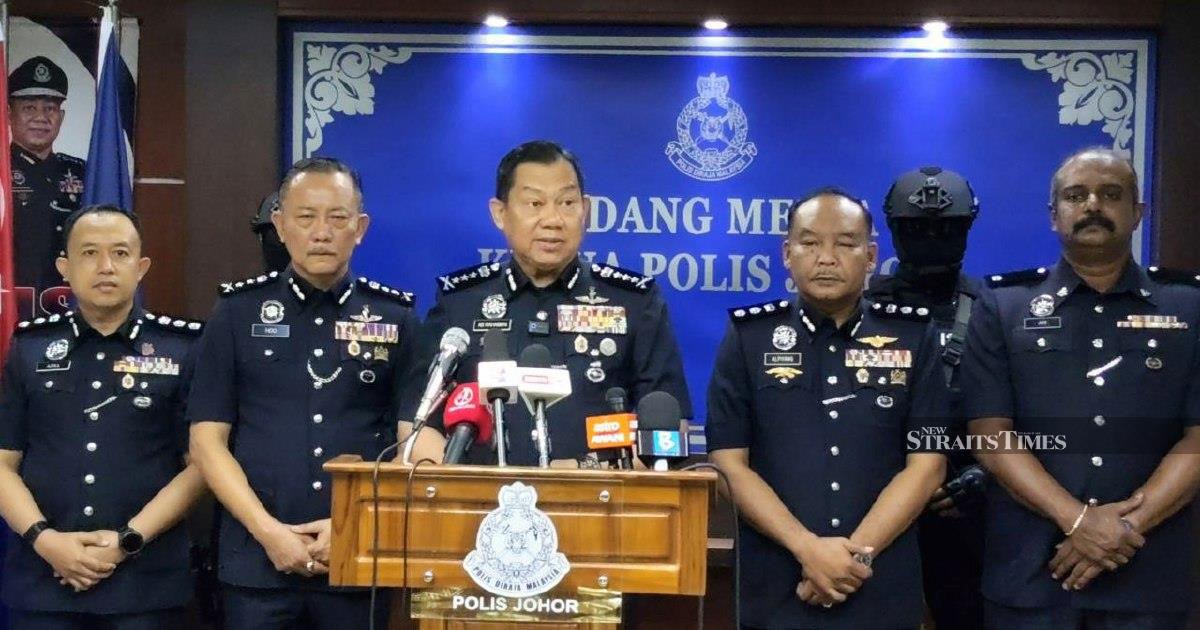
In a major strike against drug trafficking in southern Peninsular Malaysia, Johor Baru police have arrested eight individuals and seized approximately 60.78 kilogrammes of methamphetamine with an estimated street value of RM3.04 million following a series of coordinated enforcement operations conducted on Saturday. The operation represents a significant disruption to narcotics distribution networks operating across the state, one of Malaysia's primary drug trafficking corridors given its proximity to Singapore and its position as a major transportation hub.
Among those detained was a school dropout who had been recruited to serve as a transporter for the criminal syndicate, underscoring how trafficking organisations increasingly exploit young people with limited educational opportunities and economic prospects. This employment of teenage couriers reflects a deliberate strategy by drug networks to use individuals below the legal age of majority, calculating that younger suspects often receive lighter sentences and may attract less law enforcement scrutiny during street-level operations. The recruitment of school dropouts also highlights the social vulnerability that makes youth susceptible to involvement in organised crime.
The coordinated nature of Saturday's raids suggests police had conducted extensive surveillance and intelligence gathering prior to the enforcement action. Such operations typically involve coordination between multiple police units and, in cases involving significant quantities of drugs, liaison with federal anti-narcotics agencies. The scale of the seizure, alongside the number of arrests, indicates that authorities had identified what they assessed to be a relatively organised distribution operation rather than isolated street-level dealers.
Methodamphetamine, commonly known as meth or crystal meth, represents one of the fastest-growing drug threats across Southeast Asia. In Malaysia, consumption of amphetamine-type stimulants has surpassed heroin in certain urban demographics, particularly among younger users attracted to the drug's stimulant properties and affordability compared to cocaine or other international narcotics. The psychoactive properties of methamphetamine create severe public health consequences, with users frequently developing acute psychiatric symptoms and behavioural disorders that strain hospital systems and law enforcement resources.
The recovery of over 60 kilogrammes in a single operation underscores the volume of drugs flowing through Malaysian territory. While some of this supply feeds domestic consumption, substantial quantities are transshipped through Malaysia bound for regional markets in Singapore, Thailand, and beyond. Malaysian ports and border areas remain attractive transit points for international drug syndicates due to the country's geography, infrastructure, and established smuggling routes developed over decades.
The arrest of eight individuals provides police with multiple opportunities for intelligence development and potential prosecution pathways up the trafficking hierarchy. Structured questioning of couriers and lower-level distributors frequently yields information about suppliers, wholesale buyers, and money-laundering mechanisms. This information can enable authorities to dismantle broader networks rather than simply removing drugs from circulation in isolated incidents.
From a law enforcement perspective, the operation demonstrates the continued effectiveness of targeted intelligence-led operations in disrupting narcotics supply chains. However, the persistence of large-scale methamphetamine seizures across Malaysia suggests that disruption, while necessary, remains insufficient without parallel strategies addressing demand reduction, treatment capacity expansion, and prevention among vulnerable populations.
The involvement of teenage traffickers also raises questions about prosecution strategy and rehabilitation possibilities. Malaysian courts face mounting pressure to balance public protection with recognition that adolescent offenders involved in drug crimes often require intervention addressing underlying vulnerabilities rather than purely custodial approaches. The case highlights tensions between hard-line enforcement rhetoric and evidence-based rehabilitation approaches that many neighbouring countries have increasingly adopted.
Government drug enforcement agencies have intensified operations across Malaysia in recent years, reflecting both elevated drug seizure targets and genuine increases in trafficking activity. Johor Baru, as a major urban centre and transport interchange, naturally attracts significant drug enforcement attention. However, the continued volume of seizures suggests that supply remains robust despite increased policing efforts, indicating either insufficient enforcement resources or the remarkable profitability of narcotics distribution that enables syndicates to absorb operational losses.
The value attribution of RM3.04 million reflects typical police assessment methodologies that apply standard pricing metrics to seized quantities. Street-level prices vary considerably based on purity, packaging, and local market conditions, making valuations subject to debate. Nevertheless, even conservative estimates place the seizure among significant interdictions, representing supply that would have generated substantial revenue for the trafficking organisation had the operation not disrupted distribution.
Looking ahead, the case illustrates the enduring challenge of addressing regional drug trafficking through enforcement alone. Sustainable progress requires coordinated international cooperation, particularly with Singapore and Thailand where much of the supply transiting Malaysia originates or terminates. Cross-border intelligence sharing and joint operations have become increasingly common, yet gaps remain in operational coordination and sometimes divergent prosecutorial priorities between countries.

