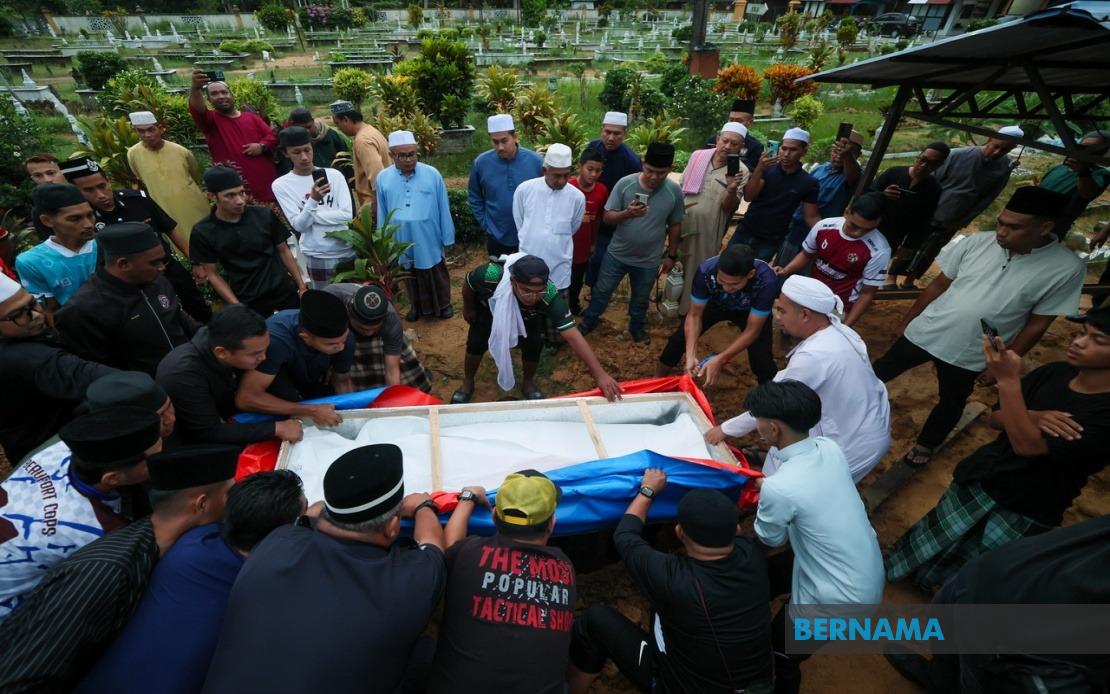
Corporal Mohamad Nur Hafiz Rahim, a 29-year-old police officer who died in an electrocution accident in Beaufort, Sabah, was laid to rest on Thursday morning at the Kampung Pangkal Kuang Muslim Cemetery in Ketereh, Kota Bharu. His funeral prayers took place at his family residence in Kampung Hutan Pasir before he was committed to the ground, concluding a deeply sorrowful chapter for his grieving relatives and the Royal Malaysia Police force.
The tragedy occurred at 5.50 pm the previous day when Mohamad Nur Hafiz and two colleagues stationed at Weston Police Station came into contact with live electrical current while attempting to relocate a 29-foot metal pole used for harvesting coconuts situated outside the station premises near Sekolah Kebangsaan Weston. The incident claimed three lives in total, making it one of the most significant workplace fatalities involving law enforcement personnel in recent months. The other two victims, Corporal Chiu Teck Siong, 40, from Sarawak and Constable Muhammad Raimi Ismarubee, 26, from Terengganu, also perished under similar circumstances at the same location.
His eldest sibling, 34-year-old Nurlella Rahim, acknowledged the assistance provided by the police force in coordinating the transportation of her brother's remains from Sabah back to Kelantan. Speaking to journalists at the cemetery, she expressed deep gratitude for the institutional support extended during what she described as an extraordinarily difficult period for the family. The body had arrived at the family home at 4.45 am, having been transported through the night following the completion of necessary investigations and documentation procedures.
The close-knit nature of Mohamad Nur Hafiz's family became evident through Nurlella's account of their regular communications despite being geographically scattered across Malaysia. The siblings maintained almost daily contact through video calls, supplemented by an active family WhatsApp group where they would exchange messages, photographs and updates whenever schedules permitted. Nurlella herself resides in Ipoh, Perak, while their brother had been stationed in Sabah, yet the distance had not diminished the bonds between them.
According to Nurlella, her brother's final conversation with their mother occurred on Thursday afternoon via video call. During that interaction, he appeared visibly fatigued and somewhat withdrawn, though he managed to convey reassurance and expressed a desire to continue their discussion later as he was obliged to commence his work duties. Even amid the pressures of his police posting, he had cultivated a habit of initiating video calls with family members during brief respites from his professional responsibilities, demonstrating a commitment to maintaining familial connection.
The most recent direct communication Nurlella had with her brother took place on Sunday, when he had arranged an outing with his wife Fatimah Shahira and their child to a beach location. These glimpses into his personal life paint a portrait of a dedicated family man who balanced the demanding nature of law enforcement work with devotion to his spouse and offspring, even whilst stationed far from the family home in the northern peninsula.
The incident at Weston Police Station represents a significant tragedy for Malaysia's police force and raises critical questions about workplace safety protocols at government installations. The involvement of a specialized tool such as a coconut-harvesting pole in causing the deaths of three trained officers suggests potential gaps in electrical safety awareness, equipment handling procedures, or the condition of the apparatus itself. The metallic nature of the pole would have made it an effective conductor for electrical current, particularly if any part of the station's electrical infrastructure was inadvertently exposed or improperly maintained.
Prime Minister Datuk Seri Anwar Ibrahim responded swiftly to the incident by issuing a directive for a comprehensive, impartial and expedited investigation into the circumstances surrounding the deaths. In a statement disseminated through Facebook, he underscored the critical importance of determining the precise cause of the tragic occurrence and of implementing corrective measures designed to prevent recurrence of similar incidents in the future. This high-level attention to the matter reflects the gravity with which the government views workplace safety failures, particularly those affecting security personnel.
The deaths of Mohamad Nur Hafiz, Chiu Teck Siong and Muhammad Raimi Ismarubee highlight the occupational hazards that extend beyond the conventional law enforcement threats to which police officers are typically exposed. While Malaysian police personnel regularly encounter dangers related to crime prevention and public order maintenance, this incident underscores that institutional infrastructure and routine operational tasks can pose equally fatal risks when safety standards are compromised. The investigation now underway will need to examine whether electrical hazards at the station were properly identified, marked and managed in accordance with established safety regulations.
For the broader Malaysian and Southeast Asian context, this incident serves as a sobering reminder of the importance of maintaining rigorous occupational safety and health standards across all government facilities and operations. As Malaysia continues to develop its institutional frameworks and workplace regulations, tragedies such as this one demonstrate the cost of inadequate safety protocols. The findings from the official investigation are expected to generate recommendations that could have implications for how other police stations and government installations manage similar equipment and potential electrical hazards.
The loss of three young police officers in a preventable industrial accident represents not merely a blow to their respective families and the police force, but a broader societal concern about workplace protection standards. Mohamad Nur Hafiz's death leaves behind a grieving family in Kelantan, a young widow in Sabah, and a child who will grow up without paternal presence. The investigation and any subsequent reforms that emerge from this tragedy will determine whether such preventable deaths can be avoided in future, honoring the memory of those lost through institutional improvements that safeguard other officers.

