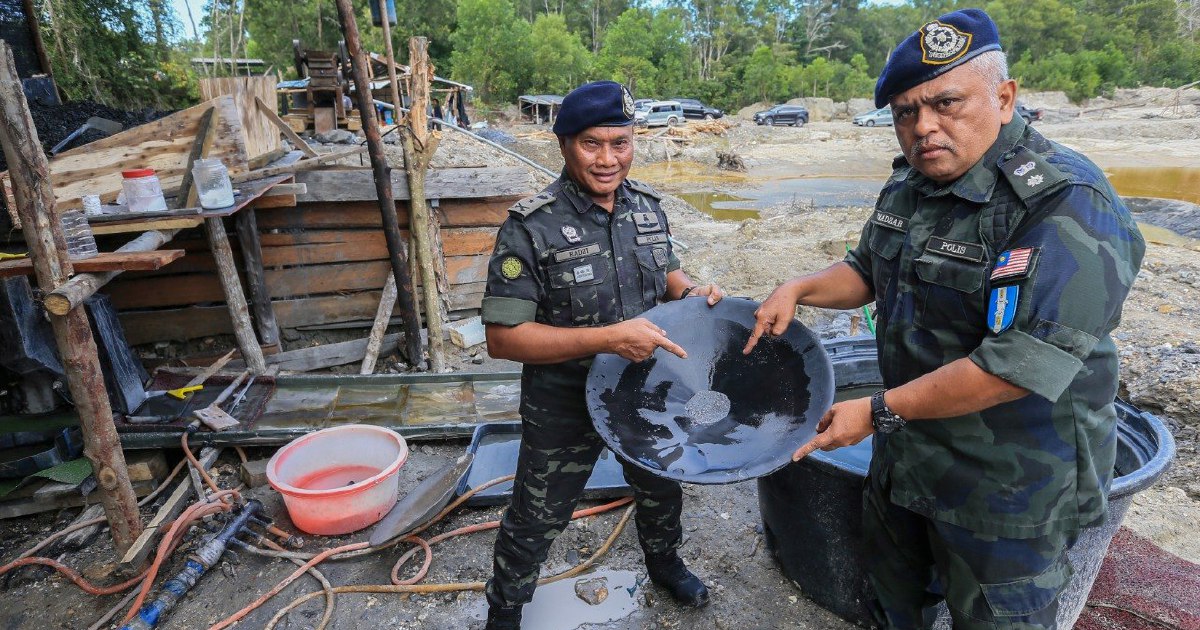
Police in Terengganu have successfully disrupted a well-organised illegal gold mining operation that was generating up to RM13,000 daily, with authorities detaining 15 individuals during a significant raid conducted at Bukit Kor in Marang. The operation, known locally as the 'Mak Siti' syndicate, represents the kind of sophisticated underground mining networks that have increasingly posed challenges to law enforcement agencies across Malaysia's resource-rich states.
The discovery underscores a growing problem in Malaysia where unregulated mining activities flourish in remote areas, often with minimal oversight. Illegal gold mining has become a lucrative enterprise for organised groups willing to circumvent environmental and safety regulations, and the financial scale of this particular operation—potentially generating nearly RM470,000 monthly—illustrates the substantial profits driving such criminal activity. The syndicate's ability to operate at Bukit Kor, an area with documented mining potential, suggests they had developed established supply chains and customer networks.
The busting of the 'Mak Siti' syndicate demonstrates the intensified enforcement efforts by Malaysian law enforcement agencies responding to the expansion of illegal mining operations. The coordinated nature of the raid, requiring deployment of resources to a remote location in Marang, reflects systematic investigation work that likely extended over weeks or months. Police operations targeting such networks often involve intelligence gathering, surveillance, and coordination with multiple departments to ensure effective apprehension of key operatives.
For Malaysia, illegal mining represents a multifaceted challenge extending beyond simple law enforcement. Environmental degradation caused by uncontrolled extraction activities threatens land stability, water quality, and ecosystem health across affected regions. Terengganu, with its significant mineral deposits, has experienced repeated incidents of illegal mining operations, making this bust part of a broader pattern of enforcement activity. The scale of this particular network suggests it was not a small-scale opportunistic operation but rather an established business with structured organisation.
The 15 arrests indicate the syndicate maintained a relatively large workforce, pointing to a hierarchical structure typical of criminal mining networks. Such operations generally involve supervisors, equipment operators, buyers, and distributors, with the daily revenue figure suggesting consistent market demand. The fact that authorities could identify and apprehend so many individuals simultaneously suggests the police operation was meticulously planned, likely based on intelligence from informants or systematic investigation.
The economic incentive driving gold mining crimes remains potent in Southeast Asia. Gold prices have remained relatively stable at elevated levels globally, making even small-scale extraction economically attractive for criminal enterprises. The RM13,000 daily figure translates to substantial annual earnings for participants, providing powerful motivation for continued illegal activity despite regulatory penalties. This creates an ongoing cat-and-mouse dynamic between authorities and criminal syndicates seeking new locations and methods.
Malaysia's regulatory framework for mining explicitly requires permits and compliance with environmental standards, yet enforcement remains challenging given the extent of Malaysia's mining regions and limited enforcement resources. The Bukit Kor operation exemplifies how determined operators can establish production capacity in areas with geological gold deposits, often establishing operations during periods of lighter enforcement presence. The syndicate's durability before detection suggests they had developed techniques to avoid immediate discovery, including possibly operating during specific hours or using lookouts to warn of police activity.
The implications for Malaysian mining policy are significant, particularly regarding the balance between legitimate resource extraction and environmental protection. While Malaysia maintains registered mining operations contributing to the economy, unregulated counterparts like the 'Mak Siti' network extract resources without environmental remediation, leaving degraded landscapes. This creates externalities that burden local communities and state governments responsible for land rehabilitation.
Regionally, the bust aligns with broader Southeast Asian challenges around illegal mining, with similar operations documented in neighbouring countries. The transnational nature of precious metals markets means operators can source equipment and materials across borders, complicating law enforcement efforts. International coordination on mining crime remains underdeveloped compared to other criminal enforcement areas, creating gaps that sophisticated networks exploit.
The detention of 15 individuals will now enter Malaysia's judicial process, with charges likely spanning illegal mining, equipment possession, and environmental violations. Conviction rates for such operations vary, with outcomes depending on evidence quality and suspect cooperation. The immediate impact includes disruption of the syndicate's supply chains, though enforcement agencies recognise that dismantling one network often prompts reformed operations under new management in alternative locations.
Moving forward, the Bukit Kor case demonstrates the importance of sustained enforcement focusing on high-yield illegal mining areas identified through intelligence analysis. Police and regulatory agencies will likely increase monitoring of similar geological zones in Terengganu and other states with mining potential. Investment in detection technology, community reporting mechanisms, and inter-agency coordination represents the strategic approach to addressing illegal mining beyond individual enforcement operations.
The RM13,000 daily take-in from this single syndicate provides a stark illustration of mining crime's economic scale in Malaysia. As long as gold maintains high market value and demand continues from regional buyers, illegal mining operations will remain attractive despite enforcement risks. Sustained police action, coupled with improved environmental monitoring and community engagement in mining regions, represents the multi-pronged approach required to address this persistent challenge in Malaysian law enforcement.

