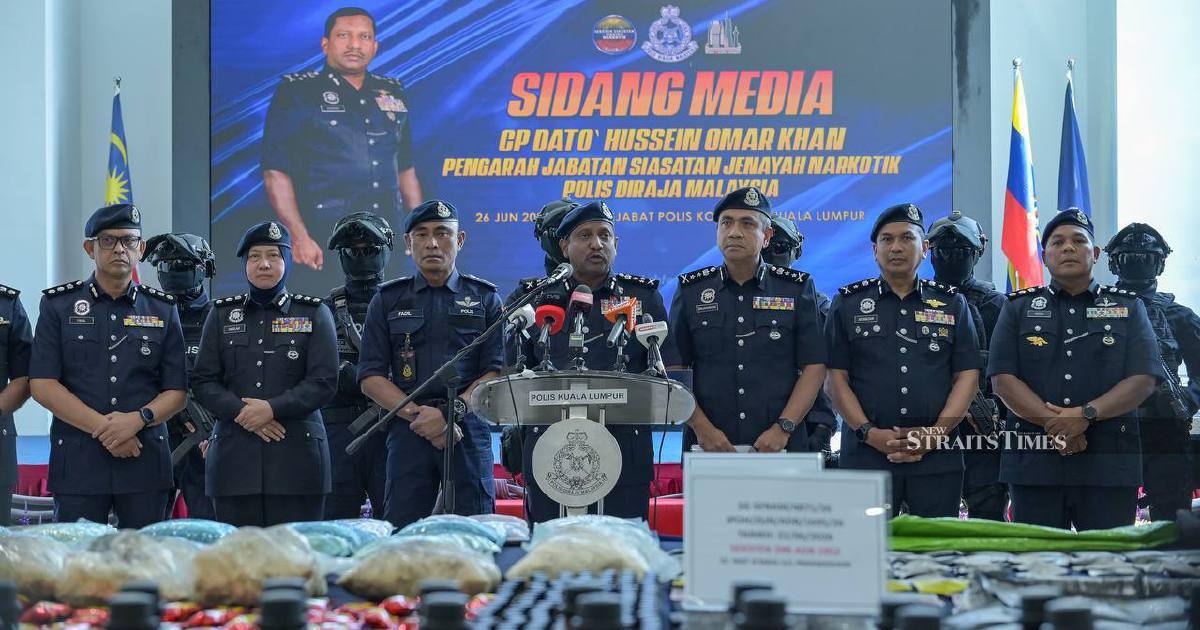
In a significant blow against organized drug trafficking in the Klang Valley, law enforcement authorities intercepted what appears to be a major distribution network attempting to flood Malaysian markets with controlled substances. The operation, conducted on June 20 across multiple locations in Cheras, resulted in the confiscation of narcotics estimated at RM135.63 million and the apprehension of seven individuals suspected of orchestrating the smuggling and distribution scheme.
The scale of the seizure underscores the persistent challenge facing Malaysian law enforcement as transnational criminal syndicates continue to exploit regional supply chains to move illicit drugs through Southeast Asia. Cheras, a densely populated area in Kuala Lumpur with established commercial and residential networks, has historically served as a transit point for narcotics destined for the Malaysian market and beyond. The coordinated raids targeting three separate locations suggest police had developed actionable intelligence about the organization's operational structure and storage facilities over an extended investigation period.
The RM135.63 million valuation reflects the wholesale or street value of the seized consignment, though the precise composition and quantities of each drug type remain subject to ongoing analysis by forensic specialists. Seizures of this magnitude typically involve bulk quantities of popular controlled substances including methamphetamine, heroin, cocaine, or ketamine, though authorities have not yet disclosed the specific drug categories involved in this particular operation. Understanding the drug mix is crucial for assessing market impact, as different substances command vastly different street prices and serve distinct consumer demographics across Malaysia's urban centres.
The arrest of seven suspects represents a significant disruption to what investigators believe was a well-coordinated trafficking operation. In organized drug networks, individuals typically assume specialized roles ranging from transportation and storage management to distribution logistics and customer relations. The fact that authorities managed to detain multiple operatives simultaneously suggests the raids were executed with precision timing, likely based on surveillance data and informant intelligence developed through weeks or months of police work. Each suspect now faces potential charges under the Dangerous Drugs Act, which carries severe penalties including lengthy imprisonment and mandatory rehabilitation requirements.
The timing and scale of this operation highlight the growing sophistication of drug trafficking organizations operating within Malaysia's borders. Rather than relying on small, individual couriers, contemporary smuggling networks employ compartmentalized structures with redundancies built into supply chains. The attempt to flood local markets with such a substantial quantity of drugs indicates that traffickers were anticipating strong demand and were willing to risk enormous capital to capture market share. This wholesale approach differs markedly from traditional street-level dealing and suggests the involvement of higher-tier criminal organizations with access to significant financial resources.
For Malaysian communities, the prevention of such market flooding operations carries substantial public health implications. The introduction of RM135.63 million worth of new supply into local drug markets would have resulted in dramatically reduced street prices, making drugs more accessible to younger users and marginalized populations. Lower prices typically correlate with increased consumption rates, particularly among experimental users who might otherwise consider illicit substances financially prohibitive. Schools, healthcare facilities, and social services throughout the Klang Valley could have experienced increased pressure from new addiction cases had this consignment successfully reached street-level dealers.
The enforcement action also reflects evolving police strategies emphasizing upstream interdiction rather than reactive arrests of low-level dealers. By targeting transportation hubs, storage facilities, and distribution nodes, authorities can achieve greater impact with fewer interventions compared to traditional community policing approaches. However, success in disrupting individual trafficking operations does not diminish the broader regional drug trafficking challenge, as international smuggling networks maintain multiple redundant routes and operational cells. The seizure in Cheras represents a temporary setback for the particular organization involved, but competitors and other syndicates continue operating across Malaysia and Southeast Asia.
The involvement of multiple raid locations simultaneously underscores police coordination capabilities and resource allocation to major narcotics investigations. Such operations require substantial planning, including surveillance officers, tactical teams, forensic specialists, and investigative personnel working in concert. The successful execution of three coordinated raids without leaks or compromised operations suggests reasonably tight security protocols within the investigating unit, a critical factor given the risks that drug traffickers pose to informants and undercover operatives working within their networks.
Investigators will now focus on determining the origin point of the seized drugs, identifying the financial networks funding the operation, and mapping connections to other trafficking organizations potentially operating within Malaysia. Significant seizures often provide intelligence value extending far beyond the immediate arrests, as police examine communications records, financial transactions, and contact networks to identify higher-level operatives potentially remaining at large. International coordination through law enforcement agencies in neighbouring countries may prove essential, particularly if the drugs originated in the Golden Triangle region of Southeast Asia.
The RM135.63 million seizure positions this operation among the more substantial drug confiscations recorded in Malaysia during recent years, reflecting both the magnitude of available illicit supplies entering the region and the serious commitment by enforcement authorities to intercept major trafficking flows. The successful disruption of this particular network sends a clear message that organized drug operations face significant operational risk within Malaysian jurisdiction, though the vast profits inherent in international drug trafficking continue to incentivize criminal enterprises to attempt similar ventures throughout the region.

