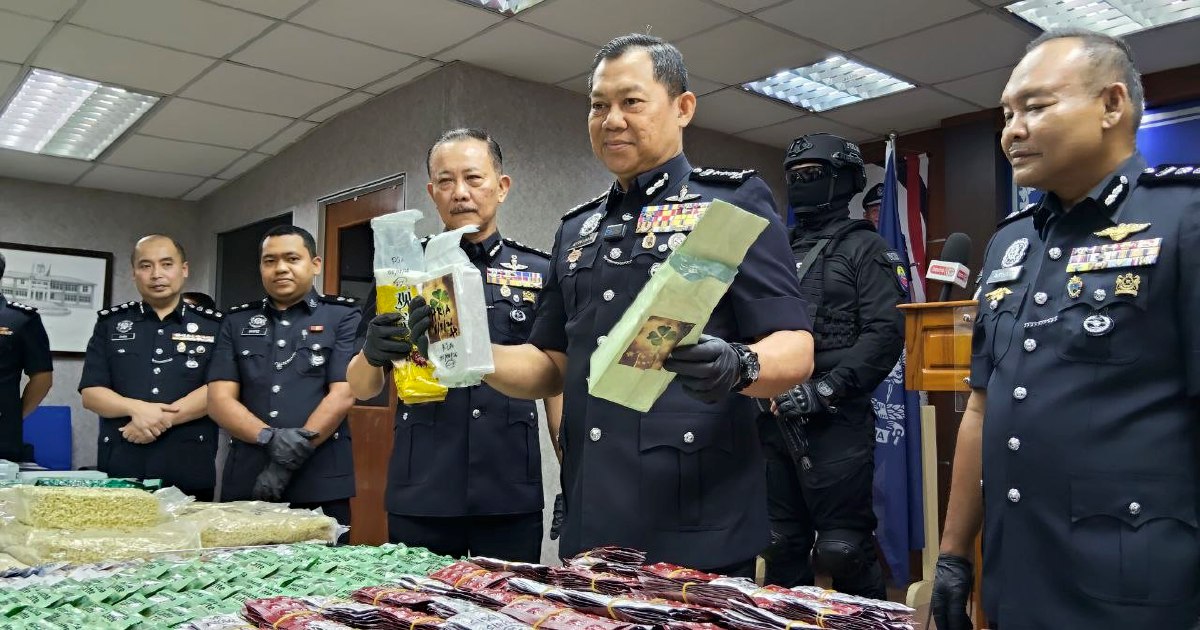
Law enforcement agencies in Johor Baru have successfully disrupted an organised drug trafficking operation, confiscating approximately 96.76 kilograms of various controlled substances valued at RM8.49 million from a residential unit located on Persiaran Senibong in Masai. The enforcement action has resulted in two arrests and represents a substantial blow against a distribution network that utilised the rented apartment as a clandestine storage depot.
The discovery underscores the evolving sophistication of drug syndicates operating across Malaysia, particularly in high-density urban and suburban areas like the Johor Baru region. By converting a residential apartment into what authorities describe as a distribution hub, the criminal organisation sought to evade detection whilst maintaining inventory for what appears to have been a regional supply operation. The strategic location within Masai, a densely populated area with multiple access points and proximity to major transport routes, would have provided operational advantages for rapid redistribution across the state and potentially beyond.
The seizure highlights police capacity to identify and neutralise such facilities through intelligence-led operations. The recovery of such a substantial quantity of mixed narcotics indicates this was not a small-scale operation but rather a professionally managed enterprise with significant financial backing and logistical capabilities. The variety of substances recovered suggests the syndicate was operating a diversified supply model, potentially servicing different market segments and customer profiles across Johor.
For Malaysia's ongoing fight against drug trafficking, incidents of this scale demonstrate both the persistent threat posed by organised crime groups and the effectiveness of targeted law enforcement responses. The Johor police force's ability to locate and disable a major distribution point reflects improved intelligence coordination and operational readiness. However, the existence of such operations also indicates that drug syndicates continue to identify and exploit vulnerabilities in residential areas where suspicious activity may be less apparent than in commercial zones.
The Masai operation occurs against a backdrop of sustained concerns about synthetic drug proliferation throughout Southeast Asia. Malaysia, situated at a critical juncture in regional trafficking networks, remains an attractive transit and distribution point for narcotics originating from both within and outside the region. The sophistication evident in this case—including the deliberate use of a rental property as a dedicated storage facility—suggests trafficking organisations are adapting methods to circumvent law enforcement capabilities.
The two arrests arising from this operation represent the initial phase of what will likely develop into a broader investigation. Police will presumably seek to identify the supply sources, distribution networks, and end-user customer base connected to this facility. Such investigations often reveal interconnected criminal enterprises spanning multiple states and occasionally international borders, potentially implicating additional individuals and uncovering wider organisational structures.
From a community perspective, the seizure provides reassurance that residential areas are subject to police scrutiny, particularly regarding unusual rental patterns or suspicious activity. However, it also raises questions about the effectiveness of landlord verification processes and whether property owners are adequately screened or informed about tenants' backgrounds. The use of a standard apartment for such purposes suggests that criminal operators are exploiting gaps in residential security protocols and property management oversight.
The economic dimension of this haul warrants consideration. The RM8.49 million valuation represents not merely the street value of seized substances but also reflects the profit margins inherent in organised drug distribution. Such figures underscore why criminal enterprises remain willing to assume significant risks; the financial rewards at each transaction level make the venture worthwhile despite enforcement dangers. This economic motivation means that disrupting individual operations, whilst important, must be accompanied by broader strategies addressing demand reduction and supply chain interdiction at source countries.
The Johor region, as a gateway between Malaysia and Singapore with established economic connections throughout the Klang Valley and beyond, presents particular challenges for narcotics control. Drug syndicates exploit the area's commercial infrastructure, population density, and transport networks. The Masai operation's scale suggests the region continues functioning as a significant distribution hub within Malaysia's drug economy. Sustained police operations across multiple jurisdictions and enhanced inter-agency coordination will be necessary to reduce trafficking through the state.
Moving forward, this seizure should catalyse discussions about enhanced preventive measures targeting organised drug syndicates' operational patterns. These might include greater scrutiny of short-term apartment rentals, improved information-sharing between police and property management companies, and community awareness initiatives encouraging residents to report suspicious residential activity. Simultaneously, law enforcement must maintain investigative pressure to identify and prosecute those higher up the distribution chain responsible for importing and wholesaling these substances.
The successful operation demonstrates that police capability exists to identify and disable trafficking infrastructure when proper resources and intelligence are deployed. However, the persistence of such operations indicates the fundamental challenge remains: organised crime continues adapting its methods faster than comprehensive prevention frameworks can be established. Whilst celebrations of individual seizures are warranted, the broader strategic imperative involves systemic improvements in border controls, precursor chemical monitoring, financial investigation capacity, and international cooperation to address trafficking at source.

