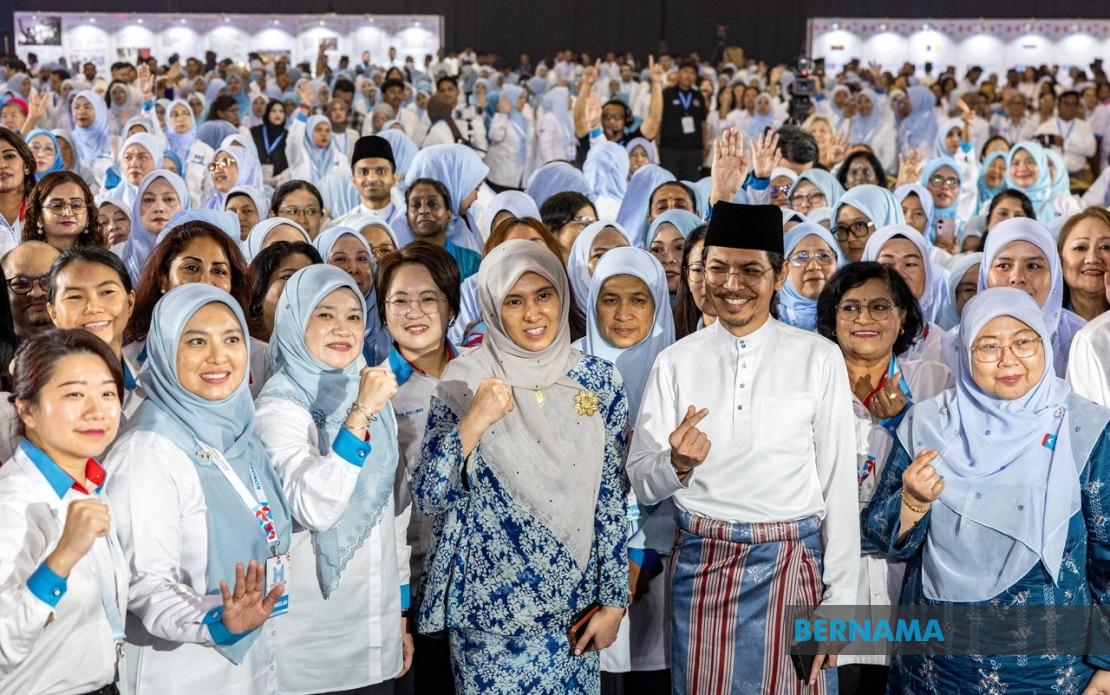
Political parties and their elected representatives must prioritize building robust networks at the community level to sustain meaningful relationships with constituents, according to Angkatan Muda Keadilan (AMK) chief Muhammad Kamil Abdul Munim. Speaking in Melaka during the 2026 AMK National Congress, he outlined how grassroots connectivity forms a critical foundation for effective governance and party cohesion in an increasingly complex political environment.
Muhammad Kamil emphasized that maintaining strong community bonds serves a dual purpose: it enables leaders to remain responsive to local concerns while simultaneously allowing parties to shape public discourse. When elected officials are genuinely embedded within their communities, they gain credibility that translates into receptiveness to party messaging. This proximity becomes especially valuable when opposition voices attempt to undermine a party's credibility through competing narratives. By establishing their presence at the ground level, leaders can preempt and counteract misinformation more effectively than through top-down communication channels alone.
The AMK chief articulated a comprehensive vision of political infrastructure that extends beyond conventional campaign machinery. He identified five interconnected elements essential for contemporary political success: organizational presence, narrative control, operational machinery, communication capacity, and crucially, authentic community relationships. This framework reflects a recognition that modern political competition involves more than periodic elections—it requires sustained engagement across multiple dimensions simultaneously. For Malaysian political parties facing increasingly sophisticated opponents, this integrated approach offers a strategic advantage that purely hierarchical structures cannot provide.
A particularly salient dimension of Muhammad Kamil's address concerns how electoral preparation should be recalibrated. Rather than concentrating exclusively on national-level messaging and broad policy platforms, political organizations must invest simultaneously in understanding and addressing hyperlocal concerns. Different communities face distinct economic pressures, infrastructure challenges, and social priorities. Leaders who can articulate how party platforms translate into concrete benefits for their specific constituencies demonstrate the political sophistication that modern voters increasingly demand. This localized approach also builds resilience against opposition attacks that exploit perceived disconnection between party leadership and ordinary citizens.
The AMK chief raised particularly important concerns about party renewal and ideological transmission within organizational structures. Attracting new members represents only the initial phase of party building; ensuring these recruits understand the deeper philosophical foundations and historical struggles that define their political movement requires deliberate institutional effort. Without such educational initiatives, parties risk having members who view participation as merely transactional or instrumental. This vulnerability becomes acute during periods of electoral difficulty, when members without deep ideological commitment may defect to seemingly more advantageous political platforms.
Muhammad Kamil's emphasis on instilling party ideals among grassroots members speaks to a broader Southeast Asian phenomenon where party loyalty has become increasingly fluid. Malaysian political history demonstrates that organizational coherence directly correlates with electoral performance and governmental stability. When members understand not just party policies but the underlying principles justifying those positions, they become more resilient advocates capable of engaging skeptical voters on substantive grounds. This intellectual anchoring proves particularly valuable when navigating the rapid political realignments that characterize contemporary Malaysian politics.
The leadership challenge articulated by the AMK chief extends beyond campaign cycles to encompass long-term party health and trajectory. His concern that inadequate attention to ideological transmission may cause parties to gradually deviate from their foundational commitments reflects sophisticated understanding of organizational entropy. Without continuous reinforcement of core principles, even well-intentioned parties risk becoming hollow shells—retaining institutional structures while losing the animating vision that originally mobilized supporters. For younger party members especially, who may lack direct experience of earlier struggles, the risk of meaning erosion becomes particularly acute.
At the Malaysian political level, these observations resonate across the spectrum. All major parties—whether government-aligned or opposition-oriented—have periodically grappled with tensions between national leadership and grassroots cadres. The most successful periods of party dominance typically coincide with eras when central leadership invested heavily in grassroots organization and ideological education. Conversely, parties that treated grassroots components as mere electoral infrastructure rather than genuine repositories of political purpose have frequently experienced organizational decay and membership disengagement.
For regional observers, the AMK chief's analysis offers insights into how Malaysian political organizations adapt to evolving democratic pressures. Southeast Asian democracies increasingly feature voters who demand authenticity and tangible evidence of commitment from their representatives. Political organizations operating in this environment cannot rely on patronage networks and hierarchical command structures alone. They must demonstrate genuine comprehension of community aspirations and sustained presence rather than merely appearing during electoral seasons. This represents a meaningful evolution in the performance standards by which voters evaluate political fitness.
The emphasis on local programming and member engagement reflects recognition that political machinery operates through human relationships, not merely institutional apparatus. When local leaders conduct regular community activities and cultivate relationships among party members, they create networks of political advocates who operate with minimal central direction. These organic networks prove more resilient than centrally-controlled structures, as they remain anchored to community trust relationships rather than depending solely on leadership directives. In this sense, Muhammad Kamil's prescription for grassroots investment represents not merely campaign strategy but a fundamental organizational philosophy.
Moving toward the 2026 electoral cycle, Malaysian political parties confronting the AMK chief's prescriptions face practical questions about resource allocation and leadership priorities. Genuinely implementing grassroots-centered strategies requires sustained financial commitment, consistent leadership attention, and systematic training of local cadres. This contrasts with the relative convenience of concentrated national campaigns managed from party headquarters. Yet the political experience across Malaysia and the region suggests that parties willing to make these investments typically reap measurable returns in both electoral performance and organizational stability. The challenge lies in maintaining this commitment through periods when electoral momentum may seem assured by other factors.

