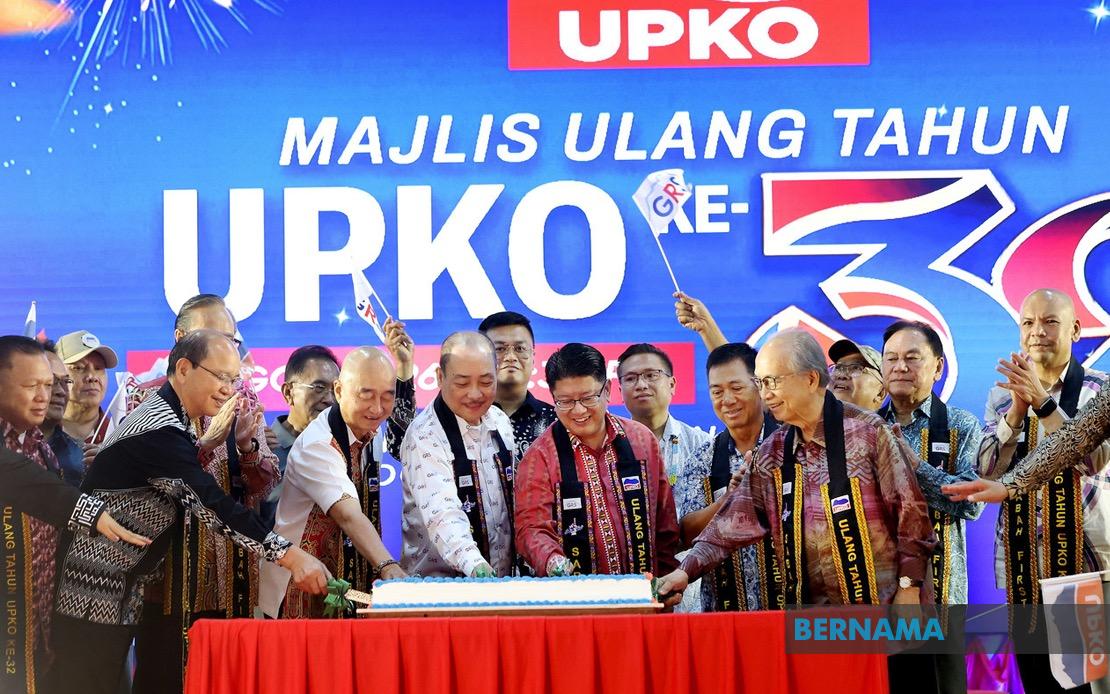
Sabah Chief Minister Datuk Seri Hajiji Noor has underscored the critical importance of political stability in enabling the state government to concentrate resources and efforts on development initiatives, economic growth, and infrastructure expansion. Delivering remarks at the 32nd anniversary celebration of the United Progressive Kinabalu Organisation (UPKO) and the opening of its 17th Triennial Delegates Conference in Kota Kinabalu, Hajiji emphasised that sustained political consensus provides the foundation upon which meaningful progress can be built.
The Sabah leader stressed that despite the diverse ideological roots and historical backgrounds of the various parties comprising the Gabungan Rakyat Sabah (GRS) coalition, their unified commitment to the state's welfare transcends factional divisions. This message carries particular resonance in Malaysian politics, where multi-party coalitions have frequently struggled with internal tensions that undermine policy implementation and public service delivery. Hajiji's framing of GRS as a shared institutional home signals an attempt to consolidate the coalition's identity beyond the transactional party-swapping that has characterised Sabah politics in recent decades.
Central to Hajiji's argument is the proposition that coalitional coherence directly enables developmental capacity. When governments expend political capital managing internal coalition conflicts, that energy becomes unavailable for the machinery of state development. In Sabah's context, this reasoning addresses longstanding concerns about governance continuity and the ability to execute multi-year development programmes without disruption from coalition realignments. The emphasis on "unity and close cooperation among GRS component parties" reflects recognition that infrastructure projects, economic diversification initiatives, and public sector reforms all require sustained political commitment.
The timing of Hajiji's remarks coincides with GRS's expansion through the formal incorporation of UPKO as a coalition member on June 18. This development enlarges GRS to six constituent parties, now including Parti Gagasan Rakyat Sabah, Parti Bersatu Sabah, the Liberal Democratic Party, Parti Harapan Rakyat Sabah, and Parti Cinta Sabah alongside UPKO. For Malaysian observers, this expansion represents both an opportunity and a potential vulnerability: while broader coalition membership can enhance representative legitimacy and distribute patronage networks more widely, it simultaneously increases the number of actors whose divergent interests must be accommodated within unified policy frameworks.
UPKO's entry into GRS carries specific significance for Sabah's political geography. The party commands organisational strength among particular ethnic and regional constituencies, and its integration signals Hajiji's ambition to consolidate support across multiple demographic segments. The inclusion of Datuk Ewon Benedick, who serves simultaneously as UPKO president and Sabah Deputy Chief Minister III with ministerial responsibility for Industrial Development, Entrepreneurship and Transportation, operationalises this coalition-building through institutional positioning. Such appointments ensure that coalition partners maintain meaningful executive responsibilities and revenue access, mechanisms that historically stabilise multi-party governments in Malaysian states.
The Chief Minister's invocation of the "Sabah First, Sabah United, Sabah Forward and Sabah Prosper" vision articulates a state-centric narrative designed to subsume party-level interests beneath collective state objectives. This rhetorical strategy attempts to reframe coalition maintenance not as a matter of electoral calculation or factional compromise, but as a moral obligation to the state and its population. For Malaysian audiences, this resonates with broader conversations about whether localism and state patriotism can function as stabilising forces in multiparty democracies where national polarisation threatens governance effectiveness.
The relationship between political stability and developmental outcomes in Sabah reflects broader patterns observable across Southeast Asia, where state governments operating under coalition arrangements frequently face pressure from both federal dynamics and internal party competition. Sabah's geographic distance from peninsular Malaysia and its constitutionally entrenched autonomy in certain domains create space for local political systems to operate according to somewhat different rules. However, the state remains enmeshed in national coalition politics, with federal-level alignments influencing resource distribution and investment flows. Hajiji's emphasis on maintaining internal coalitional stability thus addresses both the internal management of GRS and the state's external positioning within the Malaysian federation.
Infrastructure development in particular benefits from the policy continuity that political stability enables. Major transportation networks, industrial zones, and utility systems require sustained financing, regulatory consistency, and long-term planning horizons that coalition instability undermines. Sabah's ambitions for expanded port facilities, improved road networks, and enhanced energy infrastructure depend upon precisely the kind of multi-term commitment that stable coalitions can deliver. Previous periods of political turbulence in the state have demonstrably disrupted such projects, creating efficiency losses and deterring private investment.
Economic diversification represents another policy domain where Hajiji's stability argument gains traction. Sabah's historical reliance on natural resource extraction, particularly timber and palm oil, has created economic vulnerability to commodity price fluctuations and sustainability pressures. Transitioning toward more diversified economic foundations requires consistent industrial policy, skills development initiatives, and regulatory frameworks that cannot withstand frequent political disruption. Ewon Benedick's portfolio encompassing industrial development and entrepreneurship directly addresses this challenge, and his institutional positioning within a supposedly stable coalition theoretically enhances his capacity to implement longer-term economic transformation strategies.
Yet Hajiji's emphasis on stability simultaneously raises questions about how coalitional governance balances inclusion against effectiveness. Broader coalitions necessarily incorporate more diverse preferences, potentially complicating decision-making and slowing policy implementation. The inclusion of six parties within GRS creates multiple veto points and competing demands for resource allocation. Whether this expanded coalition actually enhances Sabah's development capacity or merely distributes constraints across more actors remains an empirical question that subsequent policy performance will address. The Chief Minister's framing assumes that stability itself constitutes sufficient condition for developmental success, a proposition that subsequent governance outcomes will either validate or refute.
For Malaysian readers, Hajiji's statement reflects broader tensions within the country's political system regarding the relationship between executive stability and policy effectiveness. The federal government's own coalition dynamics have generated similar arguments about whether political consensus enables or merely conceals substantive governance challenges. Sabah's relative homogeneity as a political system—its smaller scale, more contained party universe, and clearer stakeholder relationships—potentially creates conditions where coalitional stability might indeed translate more directly into developmental outcomes than occurs at federal level. However, this proposition requires sustained monitoring and evaluation rather than rhetorical assertion.
Moving forward, the effectiveness of Hajiji's stability-focused leadership will be measured against concrete development metrics: infrastructure completion rates, industrial investment levels, employment creation, and economic growth figures. The Chief Minister has positioned political stability as foundational to these outcomes, a framing that creates clear accountability standards. If Sabah's economy and infrastructure advance substantially over the coming years, Hajiji's argument gains empirical support. Conversely, if development proceeds sluggishly despite maintained coalitional coherence, the explanatory power of political stability as a primary determinant of development success will diminish, pointing toward other structural constraints or policy failures as more significant impediments to progress.

